
Selecting Heavy-Duty Workbenches for Maintenance Workshops: A Buyer's Decision Memo
Selecting Heavy-Duty Workbenches for Maintenance Workshops: A Buyer's Decision Memo
1. Objective
The objective of this memo is to establish a standardized evaluation framework for procuring heavy-duty workbenches for maintenance workshops. Facility managers and procurement teams in manufacturing, automotive parts, and hardware mold industries must select workstations that withstand high-impact forces, support heavy tooling, and integrate with 6S management protocols. This document outlines material alternatives, structural evidence, and procurement risks to guide the final purchasing decision.
2. Alternatives: Desktop Configurations
When selecting heavy-duty workbenches for maintenance workshops, the desktop material dictates the workstation's lifespan and operational safety. Buyers typically evaluate two primary configurations based on impact and load requirements:
Alternative A: 20mm A3 Steel Plate or Cast Iron Platform
For environments involving severe impact, such as mold repair, fitter operations, and heavy equipment assembly, a solid heavy-duty surface is mandatory.
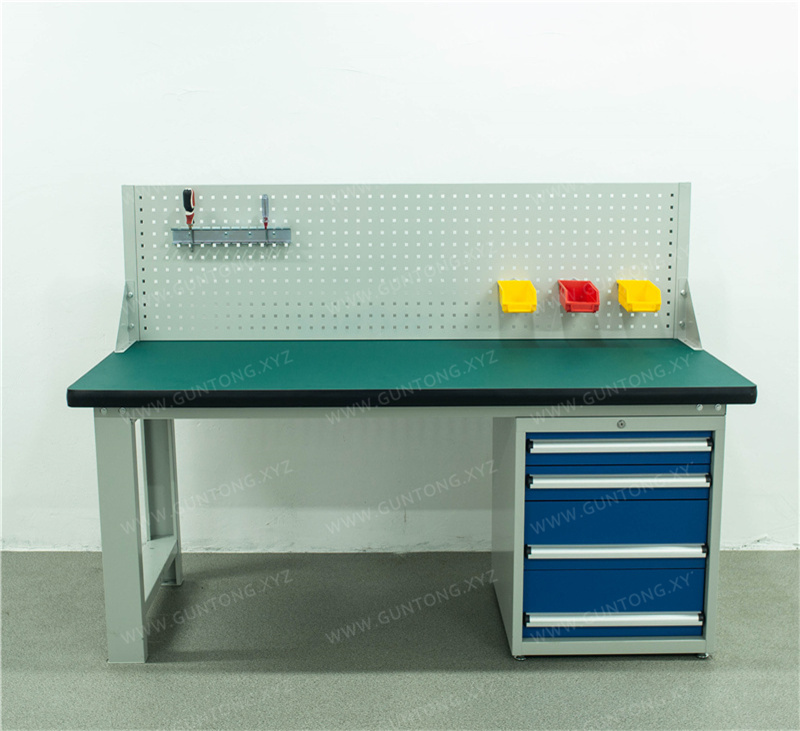
- Specification:*
- The desktop utilizes a 20mm A3 steel plate or a cast iron platform, treated with large water grinding to ensure flatness and precision.
- Use Case:*
- Ideal for maintenance and testing institutions where hammering, heavy part dropping, and high localized stress are daily occurrences. These surfaces provide exceptional impact resistance, corrosion resistance, and dirt resistance.
Alternative B: 5mm Raw Steel Plate Composite Desktop
For general heavy maintenance, equipment testing, and assembly lines requiring a balance of high load capacity and cost-efficiency, a composite structure is highly effective.
- Specification:*
- A composite structure featuring a 5mm raw steel plate bonded to a 45mm high-density fiberboard, finished with black PVC edge banding.
- Use Case:*
- Suitable for electronics, electrical appliance manufacturing, and general maintenance workshops. When paired with a C-type cold-rolled steel frame, this configuration reliably supports a total load capacity of up to 1000kg.
3. Evidence: Structural and Frame Criteria
A heavy-duty desktop is only as effective as its supporting frame. When evaluating supplier proposals, buyers must verify the following structural parameters to ensure the stated load capacity is genuine:
- Frame Material and Thickness:*
- The overall frame should be constructed from high-quality cold-rolled steel. For extreme heavy-duty applications, the steel thickness must be at least 2.0mm, formed using dedicated molds and rolling processes.
- Cross-Sectional Dimensions:*
- Verify the leg and beam dimensions. A robust heavy-duty workbench typically features leg cross-sections of 100x50x2.0mm and beam cross-sections of 80x50x2.0mm.
- Tool Configuration and Integration:*
- Maintenance workshops require organized tool storage. Evaluate whether the workbench design integrates single back panels, square-hole pegboards, and multi-drawer cabinets without compromising the overall structural rigidity.
4. Procurement Risks and Supplier Evaluation
Procuring industrial workstation equipment involves specific risks that must be mitigated during the supplier evaluation phase:
- Customization Boundaries:*
- While standard dimensions are readily available, maintenance workshops often require non-standard sizes. Ensure the supplier has dual capabilities in both standardized production and non-standard customization, allowing for bespoke dimensions without sacrificing structural integrity.
- Service and Installation Gaps:*
- A common risk is receiving equipment that lacks on-site adaptation. Select a supplier that provides full-chain services, including on-site workstation planning, load-bearing design validation, and physical installation.
- 6S Management Compatibility:*
- The workbench must support visual management. Verify that accessories like inner half-pegboard storage cabinets or tool carts with pegboards can be seamlessly integrated into the workstation layout to meet 6S adaptation requirements.
5. Recommendation
For maintenance workshops handling heavy molds and high-impact repairs, we recommend specifying the 20mm A3 steel plate or cast iron platform with a 2.0mm thick steel frame featuring 100x50x2.0mm legs. For general heavy maintenance and assembly tasks where a 1000kg distributed load is sufficient, the 5mm raw steel plate composite desktop offers an optimal balance of durability and budget.
Buyers should request detailed CAD drawings verifying the steel thickness and cross-sectional dimensions before finalizing the purchase order. Furthermore, prioritize suppliers who offer comprehensive after-sales service and on-site installation to ensure the equipment meets the specific ergonomic and load-bearing demands of your facility.