
Composite vs ESD Workbenches: Product Relationship and Configuration Limits
Who Needs to Understand This Comparison
Procurement teams and workshop planners in electronics assembly, automotive parts manufacturing, hardware mold factories, and maintenance/testing institutions frequently search for "composite workbench vs ESD workbench" as if choosing between two unrelated product lines. In reality, composite and anti-static (ESD) workbenches belong to the same core workstation family offered by manufacturers like Guang'ErMei Precision Components. The distinction lies not in the frame or structure, but in the tabletop material and the electrostatic protection configuration of the entire workstation.
For manufacturing enterprises in Huizhou, Guangdong Province, and nationwide, understanding this relationship prevents specification errors, avoids unnecessary costs, and ensures that workstation deployments meet both load-bearing and environmental requirements.
The Core Relationship: Same Frame, Different Surface and Configuration
Composite Workbenches: Built for Heavy-Duty Mechanical Work
A composite workbench is defined primarily by its tabletop—a high-density composite board, typically 50mm thick, designed to withstand impact, abrasion, and heavy static loads. According to confirmed product data, composite tabletop workbenches use C-type steel frames (100×50×1.5mm C-section steel legs) and carry an overall load capacity of up to 1000 kg. Standard lengths include 1500×750×800mm, 1800×750×800mm, and 2100×750×800mm.
These workbenches are specified for:
- Fitter and Fitter (bench fitting) operations where workpieces are clamped, filed, or assembled under force.
- Hardware mold maintenance stations where heavy dies or tooling components are placed directly on the surface.
- Automotive parts inspection and rework areas requiring a rigid, vibration-resistant platform.
- General mechanical assembly where electrostatic sensitivity is not a concern.
The composite surface is durable but does not inherently provide electrostatic discharge protection. If a workstation requires ESD compliance, the composite tabletop alone is insufficient.
ESD (Anti-Static) Workbenches: Defined by the Entire Workstation Environment
An ESD workbench is not simply a workbench with a different tabletop color. Anti-static performance depends on multiple coordinated elements:
- Tabletop material: A static-dissipative or conductive surface layer, often laminated over a composite or other substrate.
- Grounding path: A verified electrical connection from the tabletop through the frame to a dedicated earth ground point.
- Accessories: ESD-safe drawer liners, wrist strap jacks, ionizers, and matting that maintain the discharge chain.
- Environmental controls: Humidity levels and flooring conductivity that support consistent static dissipation.
Guang'ErMei's product range includes configurations such as the double-layer, three-drawer, single-pegboard anti-static workbench, demonstrating that ESD workbenches share the same modular accessory ecosystem—pegboards, drawers, shelf layers, and cabinet units—as their composite counterparts.
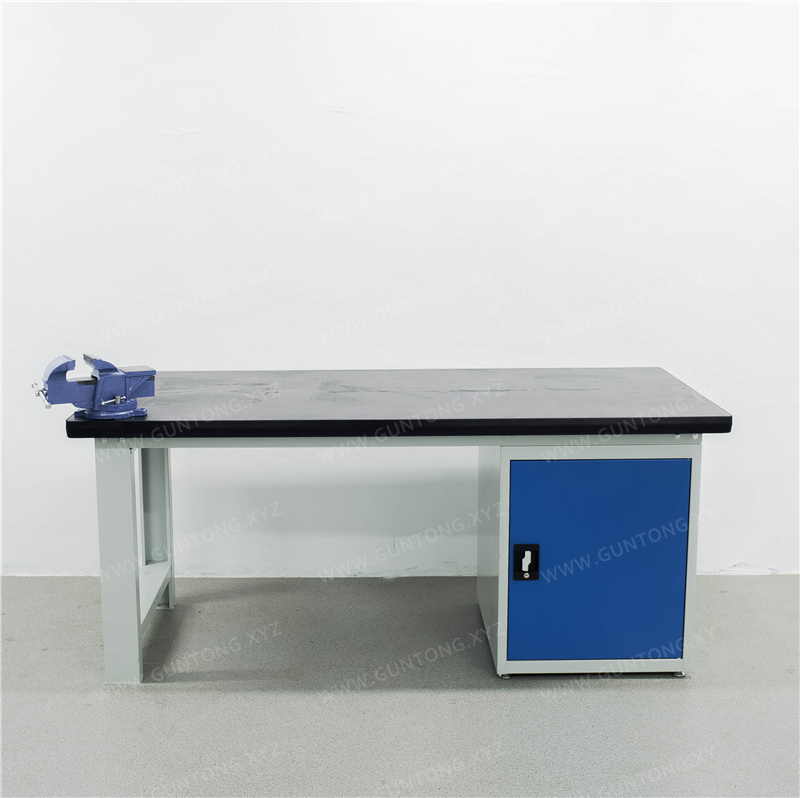
The critical point for buyers: ESD is a workstation configuration attribute, not a separate structural product category. A workbench frame that supports a 50mm composite tabletop can also support an ESD-compliant tabletop, provided the grounding infrastructure and accessory chain are correctly specified.
Configuration Limits and Selection Boundaries
When to Specify a Standard Composite Workbench
Choose a standard composite workbench when:
- The primary requirement is mechanical load capacity (up to 1000 kg overall, with drawer units rated at approximately 80 kg per drawer on single-rail slides that open to 85%).
- Operations involve metal-to-metal contact, clamping, hammering, or heavy part placement.
- The work environment does not handle electrostatic-sensitive components such as PCBs, semiconductor devices, or precision sensors.
- Budget allocation prioritizes structural durability over environmental compliance.
When ESD Configuration Is Mandatory
Specify ESD workstation configuration when:
- The workstation handles components rated as ESD-sensitive per internal quality standards or customer contractual requirements.
- The facility operates under ISO 14644 cleanroom protocols or ANSI/ESD S20.20 compliance frameworks (note: verify specific certification requirements with your quality department, as workbench suppliers provide the hardware, not the certification).
- Downstream testing or customer audits require documented grounding verification at each station.
Configuration Overlap: What Can Be Shared
Both composite and ESD workbenches within the same product family can share:
- Frame specifications: C-type steel frames in standard dimensions.
- Accessory modules: Square-hole pegboards, louver pegboards, drawer cabinets (two-drawer, three-drawer, or four-drawer configurations), floor-standing cabinets, shelf layers, and cross-brace structures.
- Installation methodology: Bolt-together assembly with on-site leveling and load verification.
This modularity means that a workshop can deploy a mixed fleet—composite-topped stations for mechanical areas and ESD-configured stations for electronics assembly—while maintaining visual consistency, shared spare parts, and unified maintenance procedures.
Before Adoption: Specification and Planning
Step 1: Map Workstation Functions
Before requesting quotations, classify each planned workstation by primary function:
| Function Type | Typical Surface Requirement | ESD Required? |
|---|---|---|
| Bench fitting /Fitter | Composite, 50mm | No |
| PCB assembly | Static-dissipative laminate | Yes |
| Mold inspection | Composite or beech wood | No |
| Sensor calibration | Static-dissipative laminate | Yes |
| General packing | Standard composite | No |
Step 2: Confirm Load and Dimension Requirements
Verify that the planned workbench dimensions (1500mm, 1800mm, or 2100mm lengths) align with the available floor space and operator reach envelopes. For stations requiring bench vices, confirm that the tabletop thickness and frame mounting points can accommodate vice bolt patterns and the dynamic forces generated during clamping.
Step 3: Define the ESD Chain
For ESD stations, document the complete grounding path specification before procurement. This includes the tabletop surface resistance range, grounding cord type, earth point location, and any wrist strap or heel strap integration. The workbench supplier provides the physical hardware; the facility's engineering team must validate the electrical continuity post-installation.
During Adoption: Delivery, Installation, and Verification
Delivery and Assembly
Workbenches in this product family are typically delivered in knock-down (flat-pack) form for on-site assembly. Upon delivery, verify:
- All frame components match the confirmed drawing and bill of materials.
- Tabletop surfaces are free from delamination, edge damage, or warping.
- Drawer slides operate smoothly and achieve the specified 85% extension.
- Pegboard mounting points align with the pre-drilled frame holes.
Post-Installation Verification
For composite workbenches, conduct a static load test at the rated capacity to confirm frame rigidity and leveling. For ESD workbenches, perform surface-to-ground resistance measurements at multiple points on the tabletop and document the readings. These measurements should be repeated quarterly as part of the facility's ESD control program.
After Adoption: Maintenance and Reconfiguration
Ongoing Maintenance
- Composite surfaces: Clean with non-abrasive industrial cleaners. Avoid prolonged exposure to solvents that may degrade the resin binder. Inspect edges quarterly for chipping, particularly at vice mounting zones.
- ESD surfaces: Use only ESD-approved cleaning agents. Standard household cleaners can leave insulating residues that compromise surface conductivity. Re-test surface-to-ground resistance after any cleaning protocol change.
- Drawer and cabinet hardware: Lubricate slides annually. Replace worn slide rails rather than forcing operation, which can misalign the cabinet and stress the frame.
Reconfiguration and Expansion
Because composite and ESD workbenches share the same modular accessory system, workshops can reconfigure stations as production needs shift. A composite-topped mechanical station can be converted to an ESD station by replacing the tabletop and adding grounding hardware, without replacing the frame or accessory modules. This interchangeability reduces long-term capital expenditure and supports lean manufacturing adaptation.
Risk Boundaries and Common Specification Errors
- Assuming any green tabletop is ESD-safe: Color alone does not indicate static-dissipative properties. Verify material specifications and surface resistance data.
- Omitting the grounding path: An ESD tabletop without a verified ground connection provides no protection. The entire chain must be specified and tested.
- Overloading drawers: Drawer load ratings (approximately 80 kg per drawer on single-rail configurations) are independent of the overall table rating. Distribute heavy tooling across the tabletop rather than concentrating it in drawers.
- Ignoring vice mounting requirements: Adding a bench vice to a workbench requires confirmation of tabletop thickness, bolt clearance, and frame reinforcement. Not all configurations support vice installation without modification.
Next Steps for Workshop Planners
If your facility is evaluating workstation deployments across mixed-use environments—mechanical fitting alongside electronics assembly—the most efficient approach is to specify a unified frame and accessory platform, then differentiate only at the tabletop and grounding level. This strategy simplifies procurement, standardizes maintenance, and supports future reconfiguration.
Guang'ErMei Precision Components provides design consultation, on-site workstation planning, load-bearing verification, and full-process after-sales support for both composite and ESD-configured workbenches. For project-specific configuration review or to request dimensional drawings aligned with your workshop layout, contact the Guang'ErMei engineering team directly.