
Composite vs. ESD Workbenches: Are They the Same Product and How to Choose
Direct Answer: They Define Different Things
No, composite workbenches and ESD (electrostatic discharge) workbenches are not the same product. Composite refers to the physical structure of the desktop—typically a layered build such as a steel plate bonded to high-density fiberboard. ESD refers to a functional requirement: the workstation must safely dissipate static electricity to protect sensitive components.
A workbench can be composite without being ESD-safe, and an ESD workbench can use a composite desktop, a stainless steel top with an ESD mat, or other configurations. The confusion arises because many electronics manufacturers order "composite ESD workbenches"—a hybrid that combines a heavy-duty composite top with static-dissipative surfaces and grounding points.
What Is a Composite Workbench?
A composite workbench is defined by its desktop construction. At Guang'ErMei, the standard composite desktop consists of a 5mm raw steel plate layered over 45mm high-density fiberboard, finished with black PVC edge banding. This structure delivers:
- High load capacity: The C-type cold-rolled steel frame supports up to 1,000 kg total load, making it suitable for heavy-duty assembly, mold fitting, and hardware processing.
- Impact resistance: The steel-fiberboard sandwich absorbs shock better than a single-material top, reducing damage to both the bench and the workpiece.
- Cost efficiency: Compared to solid stainless steel or thick polymer tops, composite desktops offer a favorable balance of durability and price for general manufacturing.
Composite workbenches are widely used in automotive parts production, hardware mold factories, and maintenance workshops where load-bearing and impact resistance matter more than static control.
What Is an ESD Workbench?
An ESD workbench is defined by its ability to control electrostatic discharge. The core requirement is that all surfaces contacting sensitive electronics—desktop, shelves, and sometimes the frame—maintain a controlled resistance path to ground, typically in the range of 10⁶ to 10⁹ ohms.
Key features of an ESD workbench include:
- Static-dissipative desktop surface: This can be an ESD laminate bonded to the composite core, or a separate ESD mat laid over a standard top and connected to a grounding point via a wrist strap cord or snap.
- Grounding infrastructure: Pre-drilled grounding holes at the desk corners, grounding bus bars, and connection points for wrist straps and equipment ground cords.
- Optional ESD accessories: Pegboards, shelves, and drawer liners made from static-dissipative materials to prevent charge buildup on stored tools and components.
ESD workbenches are essential in electronics assembly, semiconductor testing, PCB rework stations, and any environment where components rated below 2,000V HBM (Human Body Model) are handled.
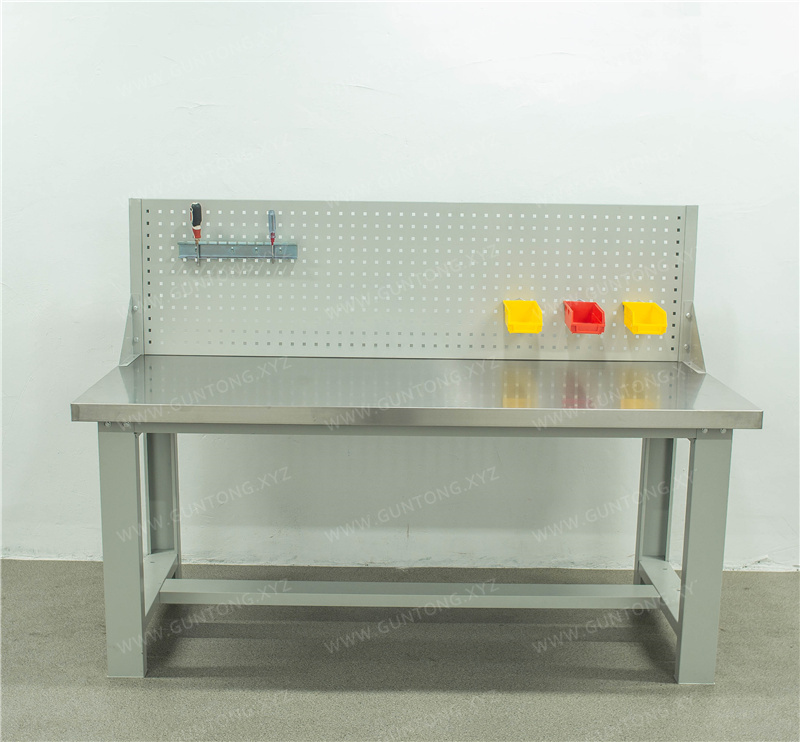
Where They Overlap: The Composite ESD Workbench
Many buyers in the electronics and automotive electronics sectors need both properties: the load capacity and durability of a composite desktop, plus the static control of an ESD surface. This is where the two concepts merge.
A typical composite ESD workbench configuration includes:
- Base structure: The standard 5mm steel plate + 45mm fiberboard composite desktop.
- ESD overlay: A 2mm static-dissipative rubber or laminate layer bonded to the top surface, with a resistance of 10⁶–10⁹ ohms.
- Grounding provisions: Brass grounding studs embedded in the desktop edge, connected internally to the steel plate layer, which then routes to the facility ground through the steel frame and adjustable leveling feet.
- Frame and accessories: Cold-rolled steel frame with ESD-safe powder coating, optional anti-static drawer liners, and pegboards with conductive hooks.
This hybrid approach is common in automotive ECU assembly, LED module production, and consumer electronics repair centers.
Selection Criteria: How to Decide
| Decision Factor | Composite Workbench (Non-ESD) | ESD Workbench (Any Top) | Composite ESD Workbench |
|---|---|---|---|
| Primary need | Heavy load, impact resistance | Static protection for sensitive parts | Both load capacity and static control |
| Typical load | 500–1,000 kg | 300–500 kg (lighter frames common) | 500–1,000 kg |
| Desktop surface | Raw steel, PVC edge | ESD laminate, stainless + ESD mat | Composite core + ESD overlay |
| Grounding required | No | Yes | Yes |
| Typical users | Mold shops, automotive stamping, hardware assembly | Semiconductor labs, PCB assembly, cleanrooms | Automotive electronics, mixed-line manufacturing |
| Cost range | Lower | Moderate to high | Moderate |
Step 1: Identify Your Static Sensitivity
If your process handles components with HBM ratings below 2,000V, or if your customer contract mandates ANSI/ESD S20.20 or IEC 61340-5-1 compliance, you need an ESD workstation. If you only handle robust mechanical parts, a standard composite top is sufficient.
Step 2: Assess Load Requirements
For workstations supporting heavy fixtures, press tools, or large assemblies (above 300 kg), the composite desktop's steel-fiberboard structure provides necessary rigidity. Lightweight ESD laminate tops alone may deflect under such loads.
Step 3: Evaluate the Environment
In cleanrooms or labs with strict particulate control, a seamless ESD laminate or stainless steel top with an ESD mat may be preferred over a composite top, which has edge banding that can trap debris. In general factory floors, the composite ESD hybrid is more practical.
Step 4: Plan Grounding Infrastructure
ESD workbenches require a verified ground path. Before ordering, confirm that your facility has accessible grounding bus bars or a dedicated ESD ground system. Without proper grounding, even the best ESD desktop will not function as intended.
Constraints and Risk Boundaries
- Retrofitting ESD onto an existing composite bench
- is possible by adding an ESD mat and grounding cord, but this is a temporary or budget solution. The mat can shift, wrinkle, or degrade, and the grounding path through a standard steel frame is not always reliable without dedicated grounding hardware.
- ESD performance degrades
- if the dissipative surface is scratched, contaminated with insulating oils, or cleaned with standard solvents. Specify ESD-safe cleaning protocols at the time of purchase.
- Load ratings change
- when an ESD overlay is added. The additional 2mm layer does not increase structural capacity, and the bonding process may slightly reduce the fiberboard's compression strength. Always confirm the final rated load with the manufacturer.
- Certification is system-level, not product-level. A single ESD workbench does not guarantee compliance; the entire workstation area—including flooring, seating, garments, and ionizers—must be validated as an EPA (ESD Protected Area).
---
Next Steps
If you are specifying workbenches for a new production line or upgrading an existing workshop:
- Audit your static sensitivity: List all components handled at each station and their HBM ratings.
- Map load requirements: Document the maximum weight each bench must support, including fixtures and workpieces.
- Request a site assessment: Guang'ErMei provides on-site workstation planning, including load-bearing design and 6S adaptation, to ensure the selected configuration matches your operational reality.
For detailed specifications on our composite workbench configurations, review the Double four-drawer floor cabinet composite workbench or the Single-door four-drawer floor cabinet composite workbench.
Contact our engineering team to discuss your specific load, ESD, and layout requirements. We support both standardized production and non-standard customization for manufacturing environments across electronics, automotive, hardware mold, and maintenance sectors.