
Stainless Steel vs. Composite Desktops: Resolving the Corrosion and Load Capacity Trade-Off in Workshop Workbenches
The Core Dilemma: Corrosion Resistance vs. Structural Load
Manufacturing facilities operating in high-humidity, chemical-exposed, or washdown environments—such as electronics assembly, automotive parts testing, and food-grade hardware processing—face a recurring procurement challenge. Traditional carbon steel workbenches degrade quickly under corrosive conditions, while pure stainless steel workbenches often fall short on heavy-duty load requirements or exceed budget constraints.
The prevailing assumption is that buyers must sacrifice load capacity to gain corrosion resistance, or vice versa. However, modern workstation engineering offers hybrid configurations that address both requirements without compromise. This comparison evaluates the factual conditions under which each desktop type performs, based on verified structural specifications.
Myth vs. Fact: Material Performance in Corrosive Workshops
Myth 1: Stainless Steel Desktops Always Provide Superior Corrosion Protection
Fact: Stainless steel offers excellent corrosion resistance, but its effectiveness depends on the grade and exposure conditions. A full 304 or 316 stainless steel desktop provides uniform protection but comes at a significant cost premium and may not support the same point-load thresholds as reinforced composite structures.
Condition: For environments with intermittent moisture, mild chemical splash, or high humidity (e.g., electronics manufacturing or coastal warehousing), a 201 stainless steel wrap over a high-density fiberboard core delivers practical corrosion resistance at a fraction of the cost. This configuration protects the primary contact surface while maintaining structural rigidity through the composite core.
Exception: In environments with continuous acid/alkali exposure, chlorinated washdowns, or salt spray (e.g., marine hardware testing or chemical processing), 201 stainless steel may still pit or discolor over time. Full 304/316 stainless construction or specialized polymer tops remain necessary for these extreme conditions.
Myth 2: Composite Desktops Cannot Handle Heavy Loads in Humid Conditions
Fact: A composite desktop constructed with a 5mm raw steel plate bonded to a 45mm high-density fiberboard core, finished with black PVC edge banding, achieves a total workbench load capacity of 1000kg when paired with a C-type cold-rolled steel frame (100×50×1.5mm profile). This specification is verified across standard dimensions of 1500×750×800mm, 1800×750×800mm, and 2100×750×800mm.
Condition: The composite structure excels in dry or climate-controlled workshops where heavy tooling, mold components, or automotive parts are assembled. The steel plate surface handles impact and abrasion, while the fiberboard core dampens vibration and reduces overall weight compared to solid steel plates.
Exception: In environments where the desktop is frequently exposed to standing water, corrosive solvents, or steam cleaning, the raw steel plate surface will oxidize unless protected. For these scenarios, upgrading to a stainless steel wrap or applying a protective coating is required to maintain surface integrity.
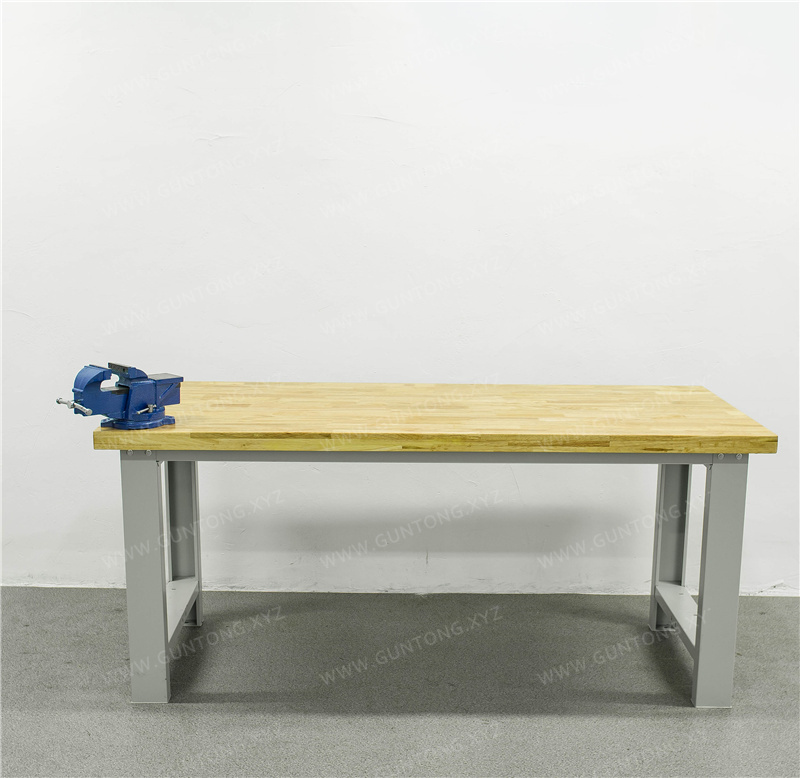
Myth 3: Hybrid Configurations Are Always the Best Compromise
Fact: A hybrid approach—such as a 201 stainless steel wrap over a high-density board core—balances corrosion resistance and load capacity for moderate environments. This configuration is particularly effective for maintenance and testing institutions, vocational training centers, and electronics assembly lines where occasional moisture exposure occurs but extreme chemical resistance is unnecessary.
Condition: The hybrid desktop maintains the 1000kg load capacity of the composite structure while adding a corrosion-resistant surface layer. It is compatible with standard accessories, including 4-drawer tiered storage, single back panels, and square-hole pegboards for tool management.
Exception: If the workbench requires frequent high-pressure washdowns or operates in a cleanroom with strict particulate controls, the edge banding and core material interfaces may become contamination traps. In such cases, a fully welded stainless steel top with sealed edges is the appropriate specification.
Decision Matrix: Selecting the Right Desktop for Your Environment
| Environment Condition | Recommended Desktop Type | Load Capacity | Corrosion Resistance | Cost Tier |
|---|---|---|---|---|
| Dry, heavy-duty assembly (hardware molds, automotive parts) | 5mm raw steel plate + 45mm HDF composite | 1000kg | Low (requires maintenance) | Standard |
| High humidity, occasional splash (electronics, warehousing) | 201 stainless steel wrap + HDF core | 1000kg | Moderate | Mid-range |
| Continuous chemical/washdown exposure (food, chemical processing) | Full 304/316 stainless steel | Varies by gauge | High | Premium |
| Cleanroom or sterile environment | Fully welded 304 stainless, sealed edges | Varies | High | Premium |
Implementation Boundaries and Procurement Considerations
Frame Compatibility: All desktop configurations discussed here are designed for C-type cold-rolled steel frames (100×50×1.5mm). When upgrading from an existing workbench, verify that the frame profile and mounting points are compatible with the new desktop thickness (typically 50mm total for composite structures).
Drawer and Accessory Integration: Workbenches with integrated storage—such as 4-drawer tiered designs or single-door configurations—require precise cutouts and mounting hardware. Custom dimensions beyond the standard 1500mm, 1800mm, or 2100mm lengths may require extended lead times for non-standard fabrication.
On-Site Planning and 6S Adaptation: For facilities implementing 6S management or lean manufacturing layouts, workstation planning should account for pegboard placement, tool cart positioning, and material flow. Guang'ErMei Precision Components supports on-site workstation planning, load-bearing design verification, and full-process after-sales service to ensure the selected configuration meets operational requirements.
Next Steps for Procurement Teams
- Audit your environment: Document the specific corrosive agents, moisture levels, and cleaning protocols in your workshop.
- Define load requirements: Calculate the maximum static and dynamic loads per workbench, including tooling, workpieces, and operator force.
- Request configuration samples: Evaluate material samples under your actual working conditions before committing to a full deployment.
- Verify lead times and customization boundaries: Standard dimensions are typically available with shorter lead times, while non-standard sizes or specialized finishes require project-specific scheduling.
For detailed specifications, custom dimension quotes, or on-site workstation planning consultations, contact Guang'ErMei Precision Components directly. Our engineering team can provide load calculations, material recommendations, and installation timelines based on your facility's specific conditions.