
Industrial Workbench Quality Control and Load Testing Standards
Industrial Workbench Quality Control and Load Testing Standards
When manufacturing enterprises, automotive parts manufacturers, and hardware mold factories deploy new workstation equipment, ensuring structural integrity is critical. Quality control must move beyond generic claims to verifying specific material and load-bearing designs. Establishing rigorous industrial workbench quality control and load testing standards before finalizing on-site installation prevents operational bottlenecks and safety risks.
Verifying Static Load and Frame Specifications
The foundation of a heavy-duty workbench lies in its frame construction. For instance, specific composite workbenches utilize 100501.5 mm C-type cold-rolled steel for the legs to achieve a verified overall load capacity of 1000 kg.
Quality Control Check: During on-site acceptance, inspect these structural components to ensure they match the manufacturer's load-bearing design. Verify the welding joints for uniformity and ensure the frame remains square when the maximum load is evenly distributed. Standardized dimensions, such as 1500×750×800 mm, provide predictable load distribution, whereas non-standard customization requires explicit engineering validation to maintain structural integrity.
Dynamic Load Testing for Storage Components
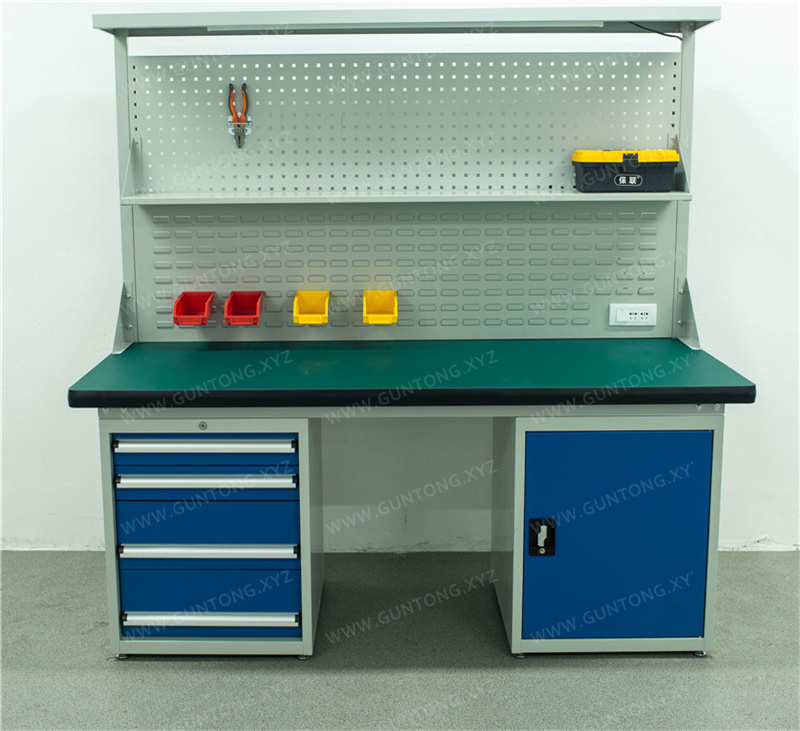
Static weight ratings do not account for the lateral forces exerted during operation. For tool storage solutions, such as the 4-Drawer 1-Door Tool Cart with Pegboard, quality control must verify dynamic performance.
Quality Control Check: A specific configuration may feature an 80 kg load capacity per drawer. The testing standard requires loading the drawer to this 80 kg limit and ensuring it can be opened smoothly to 85% of its total depth without binding, sagging, or derailing. This ensures safe retrieval of heavy tools in maintenance and testing institutions.
Desktop Material Inspection and Application Boundaries
The work surface must be matched to the operational scenario. Procurement teams should verify the exact desktop composition rather than accepting generic descriptions:
- Standard Assembly: For electronics or general warehousing tasks, a 50 mm thick green composite desktop offers adequate durability and anti-static properties.
- Heavy-Duty Applications: For hardware mold factories requiring impact resistance, the Single Back Panel 4-Drawer Steel Plate Workbench utilizes a composite structure of a 5 mm raw steel plate bonded to a 45 mm high-density fiberboard, finished with black PVC edge banding. This specific construction prevents impact damage and ensures long-term flatness under heavy localized loads.
Execution Advice for Procurement Teams
Implementing these industrial workbench quality control and load testing standards requires active engineering validation:
- Define the Scenario: Clearly document the maximum static weights and dynamic forces expected at each workstation.
- Audit the Specifications: Require suppliers to disclose exact material gauges (e.g., 1.0 mm or 1.2 mm cold-rolled steel for storage cabinets) and desktop layering.
- Conduct On-Site Acceptance: Perform dynamic drawer extension tests and visual weld inspections immediately upon delivery, before full deployment.
By enforcing strict load testing standards and verifying material integrity, manufacturing enterprises can ensure their workstation equipment supports safe, efficient, and compliant operations.