
Workbench Factory Production Capabilities and Equipment Scale: A Procurement Guide
Manufacturing facilities frequently encounter premature workstation failures: composite desktops sagging under heavy molds, drawers jamming when fully loaded with automotive parts, or structural frames wobbling during precision assembly. While facility managers often blame operator misuse or overloading, these anomalies usually trace back to a hidden root cause: inadequate workbench factory production capabilities and equipment scale.
When a supplier lacks the necessary industrial machinery and standardized quality control, the physical tolerances of the workstation degrade rapidly under real-world conditions. Understanding how to evaluate a manufacturer's equipment scale is the first step in preventing costly downtime and ensuring workplace safety.
Why Structural Anomalies Happen: The Capability Gap
A workbench rated for heavy-duty use requires more than just thick steel; it requires precision manufacturing. Small-scale workshops often rely on manual cutting and inconsistent welding jigs. When a frame is assembled with even minor angular deviations, the load distribution becomes uneven. Over time, localized stress causes the metal to fatigue and the desktop to warp.
Furthermore, producing high-density composite surfaces or bonding raw steel plates to fiberboard requires industrial-grade pressing equipment. Without high-tonnage hydraulic presses, the adhesive layers can delaminate when subjected to the repeated impact of hardware tools or automotive components.
Step-by-Step Guide: Evaluating Production Capabilities
To prevent these failures, procurement teams must shift their focus from superficial specifications to the supplier's actual manufacturing infrastructure. Here is how to assess a factory's capabilities based on tangible production evidence.
Step 1: Verify Raw Material Processing Equipment
The foundation of any heavy-duty workbench is its frame. Evaluate whether the factory utilizes automated laser cutting and CNC bending machines rather than manual shears.
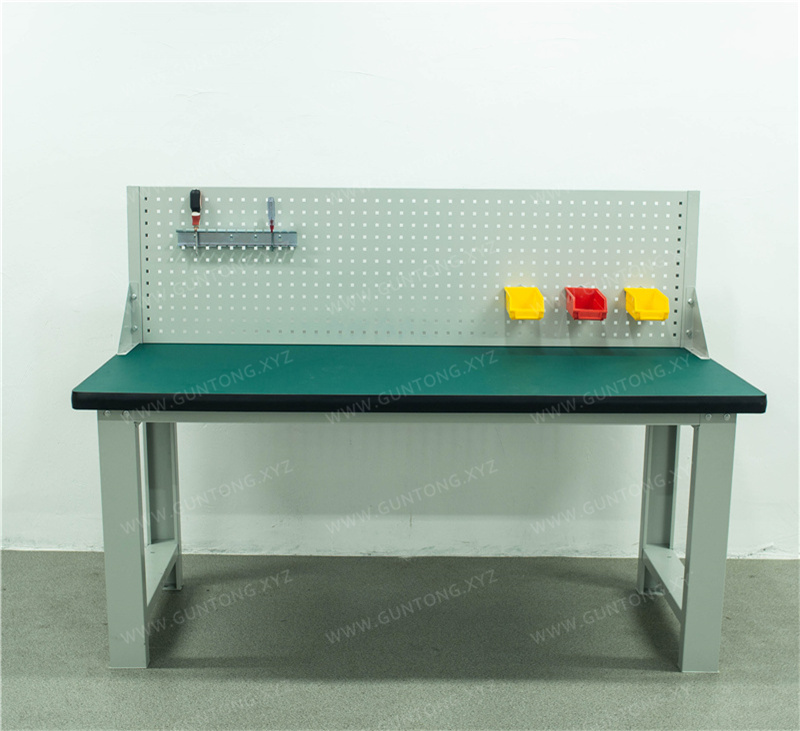
- The Precision Standard:*
- A robust workbench relies on a standardized C-type cold-rolled steel frame. Automated bending ensures that every angle is exactly 90 degrees, which is critical for achieving a genuine 1000 kg overall load capacity.
- Material Consistency:*
- For integrated storage, check if the facility can consistently process high-quality cold-rolled steel for cabinet bodies without causing micro-fractures in the metal.
Step 2: Assess Lamination and Pressing Capabilities
The workbench surface dictates the longevity of the station. Factories with advanced equipment scale can offer diverse, highly durable desktop configurations tailored to specific industry applications.
- Composite Desktops:*
- Ensure the manufacturer has the pressing capacity to produce a uniform, thick composite desktop. This prevents localized sinking when heavy testing equipment is placed on the surface.
- Steel Plate Integration:*
- For hardware mold factories or maintenance centers, a composite structure featuring a raw steel plate bonded to a 45mm high-density fiberboard (finished with black PVC edge banding) is ideal. High-tonnage pressing equipment guarantees that the steel and fiberboard act as a single, unyielding unit.
Step 3: Inspect Component Testing and Assembly Rigs
A factory's scale is often reflected in its quality assurance testing lines. Workbenches with integrated storage must undergo rigorous cycle testing before leaving the facility.
- Drawer Load Testing:*
- Verify that the manufacturer tests drawer slides under load. A properly engineered drawer should support an 80 kg load capacity and maintain a smooth 85% opening rate on single-track rails, even when fully loaded with dense metal tools.
- Modular Integration:*
- Check the factory's ability to seamlessly integrate accessories, such as a 450 mm high square-hole pegboard, into the workbench back panel. Precision punching equipment ensures the square holes are burr-free, allowing for secure tool hanging and effective 6S visual management.
Application Scenarios and Customization Boundaries
Understanding a factory's equipment scale also helps define the boundaries between standard procurement and non-standard customization.
For general electronics assembly or vocational training centers, factories with high production capacity can rapidly deploy standard dimensions, such as 1500×750×800 mm, 1800×750×800 mm, or 2100×750×800 mm workbenches. These standardized lines ensure consistent quality and faster lead times.
However, for specialized environments like automotive parts manufacturing or warehousing, non-standard customization is often required. A capable factory can design bespoke solutions, such as integrating a 4-Drawer 1-Door Tool Cart with a 500 mm pegboard for mobile maintenance, or engineering an Inner Half-Pegboard Storage Cabinet with adjustable shelves supporting 100 kg per tier. The boundary for customization lies in the factory's engineering software and flexible manufacturing cells, which allow for rapid prototyping without disrupting standard production lines.
Conclusion
Workbench failures are rarely accidental; they are the direct result of compromised manufacturing processes. By evaluating a workbench factory's production capabilities and equipment scale—specifically their steel processing precision, pressing tonnage, and component testing protocols—buyers can secure workstation equipment that withstands the rigors of daily industrial use. Investing in equipment from a manufacturer with comprehensive production infrastructure ensures long-term stability, safety, and operational efficiency.
Next Steps for Procurement
If your facility is experiencing workstation degradation or you are planning a new workshop layout, it is crucial to partner with a manufacturer that possesses both standardized production lines and non-standard customization capabilities.
Contact Guang'ErMei Precision Components today to discuss your specific load-bearing requirements, 6S management goals, and on-site workstation planning. Our team provides full-chain services from product design and manufacturing to on-site installation and after-sales support across the electronics, automotive, and hardware mold industries.