
How to Calculate and Verify Load Distribution for Heavy Equipment on Workbenches
Diagnosing Load Capacity Risks in Industrial Workstations
For manufacturing enterprises, electronics manufacturers, and automotive parts facilities, selecting a heavy-duty workbench is fundamentally a structural engineering decision rather than a simple furniture purchase. When placing precision testing equipment, heavy molds, or assembly fixtures, the primary failure point is rarely the total weight exceeding the limit; it is usually uneven load distribution causing localized deformation or frame instability.
Technical evaluators and facility planners must move beyond generic "heavy-duty" labels. Validating a workstation requires verifying three specific interfaces: the desktop composite structure, the frame’s load transfer mechanism, and the integrated storage load limits. This diagnostic checklist provides a verification framework based on actual product specifications from Guang'ErMei Precision Components to ensure safety and longevity in demanding environments.
Must-Have Structural Specifications for Heavy Loads
When evaluating workbenches for heavy industrial applications, specific structural parameters serve as non-negotiable baseline criteria. These distinguish true industrial equipment from light-duty commercial alternatives.
Composite Desktop Integrity
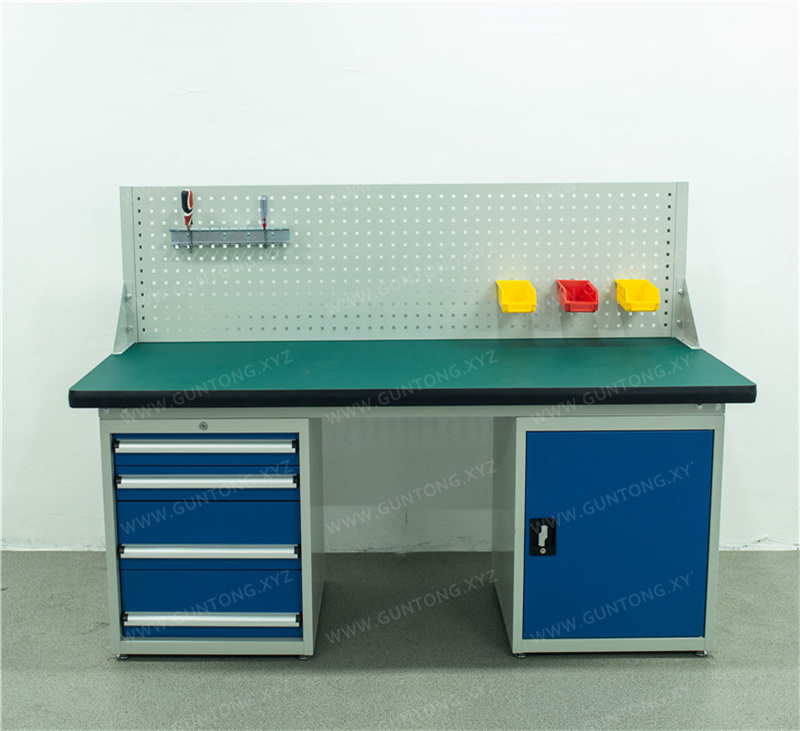
A solid steel plate alone often lacks the damping and flatness required for precision work, while wood alone lacks crush resistance. Verified heavy-duty configurations utilize a composite structure. For example, the Single Back Panel Single Door 4-Drawer Steel Plate Workbench specifies a desktop composed of a 5mm raw steel plate bonded to high-density fiberboard, finished with black PVC edge banding.
- Verification Point: Confirm the steel thickness meets impact and point-load requirements. The verified 5mm specification is designed for heavy-duty scenarios where thinner gauges might deform under concentrated equipment feet.
- Load Transfer: The high-density fiberboard core acts as a shock absorber and distributes point loads across the steel surface, preventing localized denting that compromises levelness.
Frame Load Rating and Geometry
The frame must support not just static weight but dynamic forces during equipment placement. Verified C-type cold-rolled steel frames in this category are rated for a total load capacity of 1000kg.
- Safety Margin Application: While the rated capacity may be 1000kg, best practice for permanent heavy equipment installation is to apply a safety factor. Technical evaluators should verify that the bench rating exceeds the sum of equipment weight, operator lean, tooling, and vibration forces.
- Leg Profile: C-type profiles provide superior torsional rigidity compared to open L-brackets, essential when heavy loads are placed off-center.
Evaluating Integrated Storage Under Load
A common diagnostic oversight is treating drawers and cabinets as separate from the workbench structure. In reality, fully loaded drawers significantly alter the center of gravity and add substantial dead weight to the frame.
Drawer Load vs. Total System Load
Storage components have independent limits that must be subtracted from the total system budget. For instance, mobile units like the 4-Drawer 1-Door Tool Cart with Pegboard specify an 80kg load capacity per drawer.
- Calculation Check: If all four drawers are loaded to capacity (320kg total), this weight counts toward the overall structural limit. Ensure the remaining capacity still supports the intended top-surface equipment.
- Stability Verification: For tall storage units like the Inner Half-Pegboard Storage Cabinet, which features 3 adjustable shelves with 100kg load capacity each, verify that the unit includes anti-tip anchoring provisions when fully loaded at height. The cabinet body uses 1.0mm or 1.2mm cold-rolled steel; confirm this gauge matches your expected shelf loading frequency.
Pegboard and Back Panel Limitations
Back panels and pegboards are organizational surfaces, not structural members. Even when integrated into a heavy-duty bench, they should never bear vertical loads from shelving or heavy tools unless explicitly engineered as load-bearing uprights. Use them strictly for visual management and lightweight tool hanging to preserve the primary frame’s load path.
Optional Factors and Configuration Boundaries
Once must-have structural criteria are met, evaluate these secondary factors based on specific workflow needs:
- Adjustability vs. Rigidity: Adjustable-height mechanisms introduce moving parts that reduce maximum safe load. For static heavy equipment, fixed-height welded frames typically offer higher verified stability.
- Floor Loading: Verify your facility’s floor slab capacity. A heavy-duty workbench concentrating weight on four small foot pads creates significant point pressure. Load-spreading foot plates may be required for older facilities or upper-floor installations.
- ESD and Surface Compatibility: For electronics manufacturing, ensure the composite desktop includes verified ESD grounding paths through the steel layer. Standard PVC edge banding may need replacement with conductive variants for sensitive component handling.
Risk Assessment: Common Failure Points in First Adoption
When deploying heavy-duty workbenches for the first time in a new facility or line, watch for these validated risk indicators:
| Risk Factor | Diagnostic Sign | Corrective Action |
|---|---|---|
| Point Load Exceedance | Visible denting under equipment feet | Add steel spreader plates; upgrade to thicker composite top |
| Dynamic Overload | Frame racking during equipment movement | Reduce live load; add cross-bracing; verify floor leveling |
| Drawer Sag | Drawers binding when heavily loaded | Redistribute weight; verify slide rating matches actual tool mass |
| Anchoring Failure | Unit shifting during use | Install mechanical floor anchors; verify concrete substrate integrity |
Implementation and Verification Next Steps
Load distribution validation is not a one-time procurement check but an ongoing operational discipline. Follow this sequence for reliable deployment:
- Document Actual Loads: Weigh all equipment and tooling before ordering. Do not rely on manufacturer nameplate weights alone; include fixtures, cabling, and consumables.
- Request Certified Specs: Ask suppliers for tested load ratings, not marketing claims. Request documentation on desktop composite layers, frame steel gauge, and drawer slide cycle testing.
- Plan Layout with Load Maps: Position heaviest equipment directly over leg supports, not at mid-span. Keep heavy storage low and centered.
- Schedule Post-Installation Inspection: After initial use, recheck levelness, fastener torque, and drawer alignment. Early adjustment prevents cumulative damage.
For facilities requiring non-standard dimensions or specialized load configurations beyond standard catalog offerings, engage directly with manufacturers who provide integrated design and production services. Guang'ErMei Precision Components supports custom workstation planning with verified load-bearing design and on-site installation, ensuring specifications match actual operational demands rather than generic assumptions.
Note: All load capacities cited above are based on specific verified product models. Always confirm final specifications against current technical drawings and contract documents before procurement, as configurations may vary by application.