
Technical Boundaries for Adding ESD Protection to Existing Composite Desktop Workbenches
When Electronics Manufacturing Demands ESD Protection on Existing Workbenches
Manufacturing enterprises handling sensitive electronic components, circuit boards, or precision instrumentation frequently encounter a practical dilemma: their current workshop workbenches are structurally sound and load-rated, but lack electrostatic discharge (ESD) protection. Replacing an entire fleet of heavy-duty workbenches is capital-intensive and disruptive. The alternative—retrofitting anti-static surfaces onto existing composite desktops—requires careful technical evaluation before commitment.
This assessment focuses specifically on composite desktop workbenches built with a raw steel plate bonded over high-density fiberboard, a configuration widely deployed in electronics assembly, automotive electronics testing, and hardware mold finishing operations across Guangdong manufacturing facilities.
Understanding the Composite Desktop Structure
Before evaluating any anti-static upgrade path, the existing desktop construction must be clearly understood. The standard composite workbench desktop from Guang'ErMei Precision Components uses a three-layer structure:
- Top layer: Raw steel plate providing impact resistance and high load capacity
- Core layer: High-density fiberboard for structural rigidity and vibration dampening
- Edge treatment: Black PVC edge banding for safety and moisture protection
This configuration delivers a total workbench load capacity of up to 1000kg when paired with a C-type cold-rolled steel frame. The steel plate surface is durable for heavy mechanical work, fitter operations, and mold assembly—but raw steel plate is not inherently ESD-safe. Surface resistance values on untreated steel plate vary with humidity, surface oxidation, and contact pressure, making it unreliable for static-sensitive assembly tasks.
Condition Comparison: Upgrade Paths and Their Boundaries
Path A: Surface-Mounted ESD Mat Overlay
Preparation requirements: The existing steel plate surface must be cleaned, degreased, and inspected for warping or pitting. Any surface irregularities will create air gaps beneath the ESD mat, reducing grounding effectiveness and creating snag hazards.
Implementation: A dissipative ESD mat (typically rubber or vinyl) is bonded to the steel plate surface using conductive adhesive or mechanical fasteners at the perimeter. A dedicated grounding cord connects the mat to the facility's ESD ground bus.
Acceptance criteria: Surface resistance must measure within the dissipative range (typically 10⁶ to 10⁹ ohms) at multiple test points under standard humidity conditions. Grounding continuity from mat surface to earth ground must be verified.
Maintenance boundary: ESD mats degrade with chemical exposure, mechanical abrasion, and UV exposure. In high-throughput electronics assembly environments, periodic mat replacement cycles are typical. The underlying composite desktop remains intact and functional.
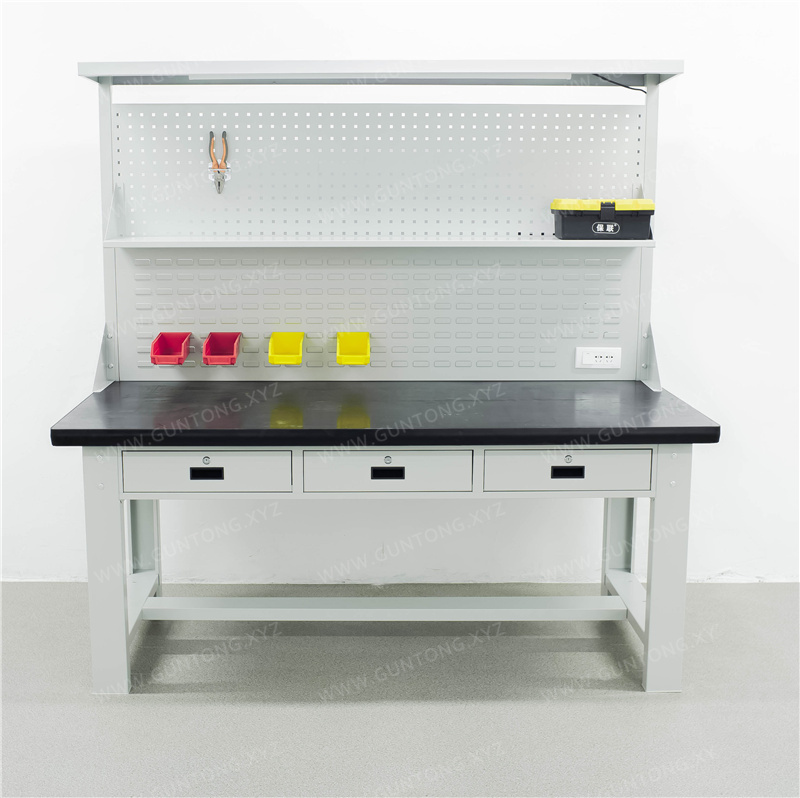
Limitation: This approach adds thickness to the desktop height, which may interfere with existing fixture clearances or drawer travel on configurations like the single back panel 4-drawer steel plate workbench. Drawer clearance and pegboard-mounted tool positions must be verified before commitment.
Path B: Conductive Coating Application
Preparation requirements: The raw steel plate must be stripped of any existing oils, oxidation layers, or contaminants. Surface profiling through light abrasive blasting is typically required to ensure coating adhesion.
Implementation: A carbon-loaded or metal-oxide conductive coating is sprayed or rolled onto the steel surface. Multiple coats may be required to achieve uniform thickness and target surface resistance.
Acceptance criteria: Coating adhesion must pass cross-hatch testing. Surface resistance uniformity must be verified across the entire work surface, including edges and corners.
Maintenance boundary: Conductive coatings on steel plate surfaces are vulnerable to scratching from metal tools, impact from dropped components, and chemical attack from fluxes or solvents common in electronics assembly. Touch-up protocols and re-coating schedules must be established.
Limitation: Coating application requires the workbench to be taken offline for surface preparation, coating, and curing. For production lines with continuous operation requirements, this downtime must be planned around shift schedules.
Path C: Full Desktop Replacement with ESD-Safe Composite
Preparation requirements: The existing steel plate and fiberboard assembly is removed from the frame. Frame mounting points and bracket conditions are inspected for wear or deformation.
Implementation: A purpose-built ESD-safe composite desktop—typically incorporating a conductive laminate surface bonded to a static-dissipative core—is installed on the existing C-type cold-rolled steel frame. The frame itself must be verified for grounding continuity, as the steel frame becomes part of the ESD grounding path.
Acceptance criteria: The complete assembly (desktop surface, frame, and casters if mobile) must demonstrate continuous grounding path to earth with resistance values within specification at all contact points.
Maintenance boundary: ESD-safe composite desktops are engineered for long-term durability and do not require periodic mat replacement or re-coating. However, they may have lower impact resistance compared to raw steel plate, requiring operational discipline around heavy tool drops.
Limitation: This is the highest-cost option and approaches the investment of a new anti-static workbench. It is justified when the existing frame and drawer configurations (such as the 4-drawer tiered layout for organized tool storage) remain in excellent condition and the facility requires permanent, maintenance-free ESD compliance.
Decision Matrix for Technical Evaluators
| Condition | Recommended Path |
|---|---|
| Temporary or pilot-line ESD requirement | Path A: ESD mat overlay |
| Existing desktop in good condition, moderate budget | Path A or B depending on chemical exposure |
| Permanent compliance requirement, high-throughput environment | Path C: Full desktop replacement |
| Existing workbench frame shows wear or corrosion | Full workbench replacement recommended |
| Mixed-use station (mechanical work + electronics assembly) | Dedicated ESD station rather than retrofit |
Implementation Boundaries Specific to Guang'ErMei Configurations
For facilities operating Guang'ErMei composite workbenches with integrated storage—such as the single back panel single door 4-drawer configuration—the following constraints apply:
Drawer interference: Adding surface thickness through ESD mats or coatings may reduce the vertical clearance between the desktop underside and the top drawer slide. Measure existing clearance before selecting an overlay thickness.
Pegboard grounding: If the workbench includes a square-hole pegboard back panel for tool hanging, the pegboard must also be evaluated for ESD compatibility. Metal pegboards can serve as grounding extensions if properly bonded; powder-coated pegboards may interrupt the grounding path.
Frame grounding verification: The C-type cold-rolled steel frame provides structural grounding continuity only if all bolted connections maintain metal-to-metal contact. Paint, powder coating, or corrosion at connection points must be addressed during ESD retrofit implementation.
When Retrofit Is Not Advisable
Technical evaluators should recommend against ESD retrofit and instead specify purpose-built anti-static workbenches when:
- The existing composite desktop shows delamination between the steel plate and fiberboard core
- Frame structural members exhibit corrosion or deformation beyond acceptable tolerances
- The facility requires certified ESD compliance with documented surface resistance values traceable to specific test standards
- Operational profiles include frequent heavy impact loading incompatible with ESD-safe surface materials
Next Steps for Facility Planning
For manufacturing enterprises in electronics, automotive electronics, or precision instrument assembly evaluating ESD upgrades across their workstation fleet, the recommended sequence is:
- Audit existing workbench inventory: document desktop type, frame condition, drawer configurations, and current clearance measurements
- Define ESD performance requirements: specify target surface resistance range, grounding topology, and compliance documentation needs
- Pilot one upgrade path on a representative station before fleet-wide rollout
- Establish acceptance testing protocols and ongoing maintenance schedules
Guang'ErMei Precision Components supports both standardized anti-static workbench configurations and non-standard customization for facilities requiring specific ESD performance parameters integrated with existing workshop layouts. On-site workstation planning and load-bearing design services are available for facilities in Huizhou, Guangdong Province, and nationwide project delivery.