
Applications for 800mm Height Workbenches: Selection and Configuration Guide
Why 800mm Is the Standard Height for Seated Workshop Tasks
In electronics manufacturing, precision inspection, and light assembly environments, operators typically work while seated. An 800mm workbench height aligns with standard industrial chair heights and allows operators to rest their forearms comfortably on the desktop without shoulder strain. This dimension appears across Guang'ErMei's standard product lines—including composite desktop workbenches and anti-static electronic workbenches—as a baseline configuration for tasks that demand stability, visual access, and tool reach within arm's length.
However, 800mm is not universal. Maintenance technicians who alternate between standing and seated work, or operators handling tall test fixtures, may require custom heights. The decision hinges on three factors: operator posture, the height of equipment placed on the desktop, and whether overhead accessories (lamp arms, pegboards, monitor mounts) reduce usable clearance.
Primary Use Cases for 800mm Height Workbenches
Electronics Assembly and PCB Inspection
Anti-static workbenches configured at 800mm are common in SMT lines, PCB rework stations, and component testing areas. The standard anti-static desktop consists of a static-dissipative rubber surface layered over medium-density fiberboard, with a total thickness designed to absorb impact while maintaining a flat reference plane. At 800mm, an operator seated on an ESD chair can handle small components under a magnifying lamp without neck flexion.
Guang'ErMei's anti-static electronic workbenches use a square tube frame rated for light to medium loads, which accommodates oscilloscopes, soldering stations, and fixture plates without deflection. The 800mm height leaves sufficient knee clearance for adjustable chairs with footrests.
Fitter and Precision Mechanical Assembly
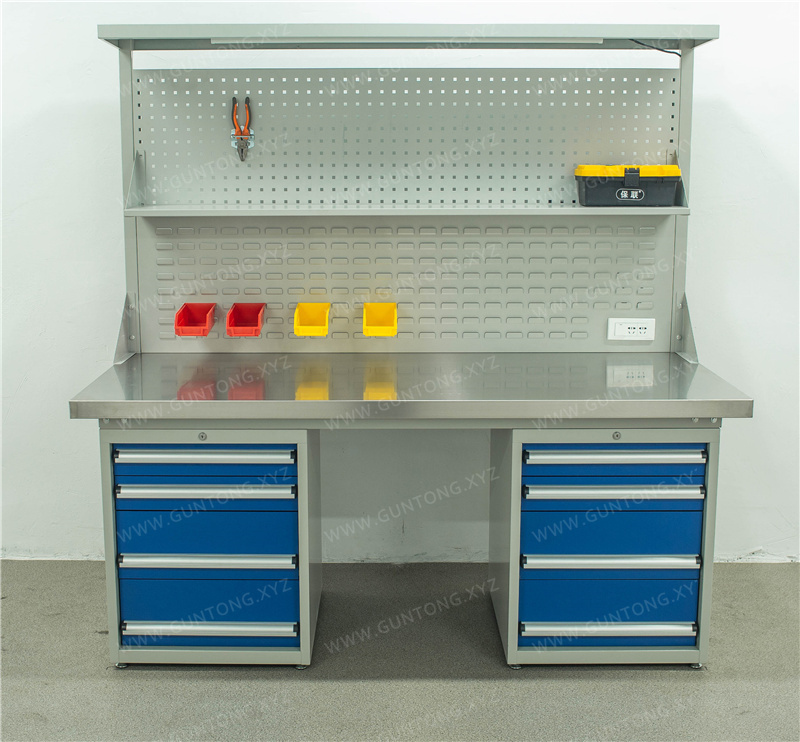
For bench-top fitting, small gearbox assembly, and calibration tasks, a composite desktop workbench at 800mm provides a stable, vibration-damped surface. The composite desktop—built from a polymer composite top layer, MDF core, and black laminate backing—resists oil, coolant, and impact from dropped hand tools. The C-type cold-rolled steel frame supports heavy loads, making it suitable for heavy vises or press fixtures mounted directly to the surface.
Quality Inspection and Measurement Stations
Coordinate measuring instruments, optical comparators, and surface plate setups often require a fixed, level reference height. An 800mm workbench with adjustable leveling feet allows inspectors to match the bench surface to adjacent CMM tables or granite surface plates. The standard footprint at this height provides enough depth for a monitor, keyboard, and part staging area without the operator needing to stand.
Vocational Training and School Workshops
Training centers standardize on 800mm benches because they accommodate the widest range of student heights when paired with adjustable stools. Guang'ErMei supplies both composite and anti-static configurations to vocational colleges, where a single bench may serve for electrical wiring practice in the morning and mechanical fitting in the afternoon.
Selection Checklist: Is 800mm Right for Your Application?
Use the following diagnostic steps before specifying workbench height on a purchase order.
Step 1: Measure the operator's elbow height while seated.
Have the target operator sit in the chair that will be used at the station, with feet flat on the floor and upper arms hanging naturally. Measure from the floor to the bottom of the elbow. The ideal desktop height is slightly below this measurement. For most adults, this falls within a range that makes 800mm a safe default.
Step 2: Account for desktop thickness and any surface mats.
A composite desktop with polymer top, MDF core, and backing has a specific thickness. If an ESD mat or a sacrificial cutting surface will be added, the effective working height increases. Confirm that the combined height does not push the operator's forearms above elbow level.
Step 3: Check clearance for under-bench storage.
If the station requires a drawer floor cabinet or a single-door cabinet beneath the work surface, verify that the cabinet height plus the desktop thickness does not reduce knee clearance excessively. Guang'ErMei's standard 800mm frames are designed to accommodate under-bench cabinets while maintaining ergonomic legroom.
Step 4: Evaluate overhead accessory interference.
Pegboards, lamp arms, and monitor mounts attached to the back panel or uprights reduce the vertical space available for tall equipment. Ensure the total structure height does not conflict with overhead conveyors, sprinkler heads, or lighting fixtures.
Step 5: Confirm load requirements.
Light-duty frames suit electronics and inspection. Heavy-duty C-channel frames are necessary for fitting, mold repair, or any task involving clamped fixtures. The 800mm height is available in both frame types.
Boundaries and Risks
- Standing tasks require taller benches.*
- For standing assembly or packing stations, a taller height is more appropriate. Specifying 800mm for standing work causes chronic lower-back strain.
- Non-standard heights affect lead time.*
- Guang'ErMei's standard configurations ship quickly from stock. Custom heights require additional working days for fabrication.
- Leveling on uneven floors.*
- If the workshop floor has a slope, adjustable leveling feet are mandatory. Without them, an 800mm bench may rock, compromising precision tasks.
- ESD grounding continuity.*
- For anti-static applications, the bench must include a grounding wire from the desktop surface to a verified earth point. A bench at the correct height but without proper grounding fails ESD audits regardless of other specifications.
---
Next Steps
- Audit your current stations. Measure existing bench heights and record operator complaints related to shoulder, neck, or back discomfort. Stations where operators use improvised footrests or seat cushions are candidates for height correction.
- Define the load and desktop material. Match the frame type and desktop surface (composite, anti-static, or steel plate) to the actual task.
- Request a site survey for multi-station projects. For deployments exceeding 10 benches, Guang'ErMei provides on-site workstation planning that includes height verification, 6S layout adaptation, and load-bearing design.
- Confirm accessory compatibility. If your station requires pegboards, drawer cabinets, or overhead lamp arms, specify these at the quotation stage to ensure frame pre-drilling and structural reinforcement.
For detailed specifications on standard configurations, review the Single Back Panel Single Door 4-Drawer Steel Plate Workbench or contact Guang'ErMei's engineering team to discuss custom heights, non-standard desktop materials, or multi-site rollout schedules.