
Procurement FAQ: Workshop Workstation Equipment Selection & Customization
Why Workshop Workstation Equipment Procurement Requires Structured Evaluation
Workshop workstation equipment is not a one-size-fits-all purchase. Manufacturing enterprises, electronics and electrical appliance manufacturers, automotive parts producers, hardware mold factories, maintenance and testing institutions, warehousing and logistics operators, and vocational training centers all face distinct operational demands. A workbench suited for a heavy-duty mold assembly line will underperform in an electronics anti-static assembly cell, and a standard tool cabinet may fail to meet the retrieval frequency required in a high-mix maintenance workshop.
This FAQ addresses the most frequent procurement questions we receive, grounded in real application scenarios, measurable specifications, and the customization capabilities we deliver across standardized and non-standard product lines.
1. What Types of Workbenches Are Available, and How Do I Match Them to My Workshop Scenario?
Workbenches are differentiated primarily by desktop material, frame structure, load capacity, and accessory compatibility. The key decision factors are:
- Load requirement: Light-duty electronics assembly (typically under 300 kg distributed load) versus heavy-duty hardware or mold work (500–1000 kg and above).
- Desktop material: Composite desktops (steel plate bonded to high-density fiberboard) offer high rigidity and impact resistance; stainless steel desktops serve food-grade, cleanroom, or corrosion-prone environments; anti-static desktops are mandatory for ESD-sensitive electronics assembly.
- Accessory integration: Pegboards for visual tool management, drawer units for classified storage, overhead lighting, and power distribution modules.
For example, a Single Back Panel Single Door 4-Drawer Steel Plate Workbench uses a 5 mm raw steel plate composite desktop bonded to high-density fiberboard, mounted on a C-type cold-rolled steel frame rated for 1000 kg total load. The 4-drawer tiered layout supports organized tool storage by category, making it suitable for hardware mold repair stations and maintenance testing benches where both heavy workpieces and precision tools coexist.
Common standard dimensions for this configuration include 1500×750×800 mm, 1800×750×800 mm, and 2100×750×800 mm, with the back panel adding approximately 500 mm in height. Non-standard widths, depths, and drawer configurations can be customized to fit specific cell layouts.
2. How Do I Choose Between a Tool Cart and a Fixed Tool Cabinet?
The choice depends on tool retrieval frequency, workstation mobility needs, and floor layout constraints.
Tool carts are designed for mobile tool deployment. A 4-Drawer 1-Door Tool Cart with Pegboard integrates a 4-drawer tiered storage system with a 500 mm standard square-hole pegboard, enabling both enclosed storage and open visual tool management. Each drawer supports an 80 kg load, and the overall unit is engineered for stable movement across workshop floors. This configuration is ideal for maintenance teams rotating between multiple work cells or for assembly lines where tooling must follow the production flow.
Fixed tool cabinets serve stationary workstations where maximum storage density is required. A Pegboard Storage Cabinet (Inner Half-Pegboard Type) combines shelf-based load-bearing capacity with pegboard flexibility: the upper interior section and dual pegboard layout on the cabinet door improve retrieval efficiency, while three adjustable shelves each support 100 kg. The overall dimensions of 1000×500×1800 mm make it suitable for wall-mounted or back-to-back configurations in 6S-compliant workshops.
Judgment criteria:
- If tools must travel with the operator → tool cart.
- If the workstation is fixed and storage density is the priority → fixed cabinet.
- If both are needed → deploy cabinets at fixed stations and carts for mobile support.
---
3. What Load-Bearing Specifications Should I Verify Before Ordering?
Load capacity is the most critical safety and durability parameter. Procurement teams should verify:
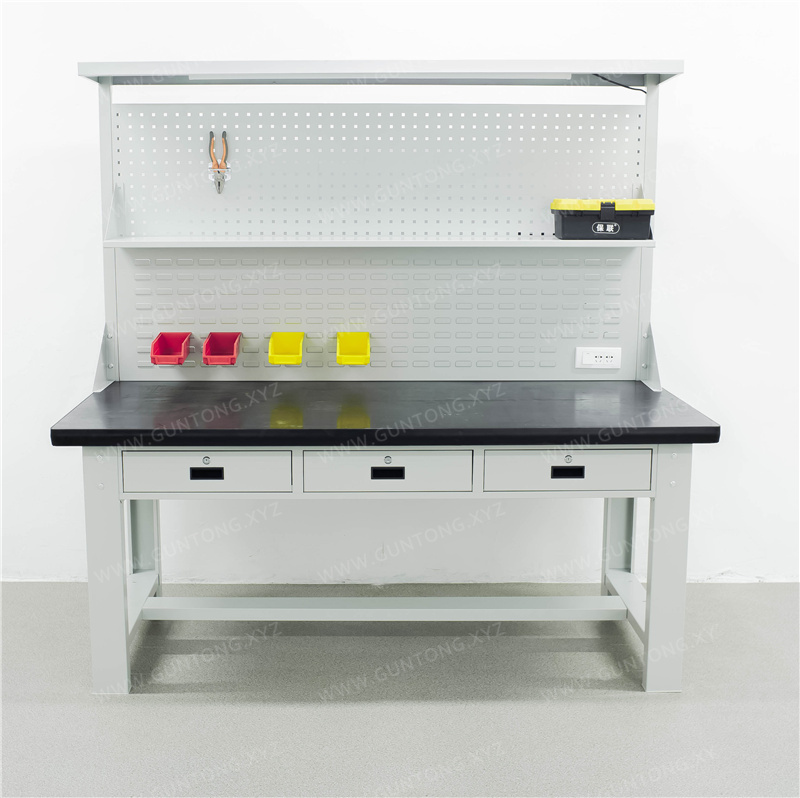
- Total frame load capacity: The maximum distributed weight the entire unit can support. Our C-type cold-rolled steel frame workbenches are rated at 1000 kg total load.
- Per-drawer load capacity: Drawer slides and panels have independent limits. Standard drawer configurations support 80 kg per drawer with single-rail slides allowing 85% extension.
- Per-shelf load capacity: Adjustable shelves in storage cabinets typically support 100 kg each.
- Desktop material thickness and composition: A 5 mm raw steel plate composite desktop with 45 mm high-density fiberboard core and PVC edge banding delivers significantly higher impact and abrasion resistance than thin-gauge steel tops.
Condition boundary: Load ratings assume evenly distributed static loads. Dynamic loads (dropping heavy parts), concentrated point loads (vise clamping), or uneven loading reduce effective capacity. Specify your actual use pattern during the consultation phase so we can adjust frame gauge, reinforcement, and desktop composition accordingly.
4. Can Workstation Equipment Be Customized for Non-Standard Workshop Layouts?
Yes. Our core differentiator is the dual capability in standardized production and non-standard customization. Customization covers:
- Dimensional adaptation: Non-standard widths, depths, and heights to fit existing cell footprints, aisle clearances, and ergonomic requirements.
- Desktop material selection: Composite, stainless steel, anti-static, or specialized surfaces based on industry requirements.
- Accessory integration: Custom pegboard heights, drawer counts and sizes, overhead panels, lighting mounts, and power strip integration.
- Color and finish: Standard gray-white and blue color schemes, with custom RAL colors available for corporate branding or 6S zone coding.
Execution suggestion: Provide workshop layout drawings (even hand sketches with key dimensions), load requirements per station, and a list of tools or equipment to be stored. Our engineering team will return a configuration proposal with dimensional drawings and load calculations before production begins.
5. How Does On-Site Workstation Planning Work?
Procurement is only the first step. Effective workstation deployment requires planning that accounts for workflow sequence, operator ergonomics, material flow, and 6S compliance.
Our full-chain service includes:
- On-site workstation planning: Mapping workstation placement to production flow, identifying bottlenecks, and recommending equipment configurations per station.
- Load-bearing design validation: Confirming that selected equipment matches actual operational loads, including safety factors.
- 6S adaptation: Configuring pegboards, drawer labeling, color-coded zones, and shadow boards to support Sort, Set in Order, Shine, Standardize, Sustain, and Safety practices.
- Full-process after-sales service: From delivery and on-site installation to ongoing support, spare parts supply, and reconfiguration as your workshop evolves.
---
6. What Product Range Is Available for One-Stop Procurement?
Our product catalog covers the full spectrum of workshop and warehouse equipment:
- Workbenches: Fitter workbenches, anti-static workbenches, heavy-duty steel plate workbenches, composite desktop workbenches, stainless steel workbenches.
- Tool storage: Tool cabinets, tool carts, pegboard storage cabinets, drawer cabinets.
- Industrial storage: Tool racks, mold racks, mold tables, automotive parts turnover racks, warehouse shelving, lean pipes.
- Automation accessories: Tote-based automated storage and retrieval system (Miniload) accessories, supporting load capacities of 50–100 kg per tote with rack heights up to 12 meters.
This breadth allows manufacturing enterprises to standardize supplier relationships, simplify procurement workflows, and ensure dimensional and aesthetic consistency across the entire workshop environment.
7. What Information Should I Prepare Before Requesting a Quote?
To receive an accurate and actionable quotation, prepare the following:
- Application scenario: Industry type, workstation function (assembly, repair, testing, packaging, training).
- Equipment type and quantity: Workbenches, cabinets, carts, racks—specify preferred configurations if known.
- Dimensional constraints: Available space per station, aisle widths, ceiling height (for tall cabinets or rack systems).
- Load requirements: Maximum weight per workstation, per drawer, or per shelf.
- Special requirements: Anti-static, corrosion resistance, cleanroom compatibility, color coding, branding.
- Timeline: Required delivery and installation dates.
With this information, we can provide a detailed proposal including product specifications, dimensional drawings, pricing, and lead time—typically within a few business days.
Final Notes for Procurement Decision-Makers
Workshop workstation equipment is a long-term infrastructure investment. The lowest unit price rarely delivers the lowest total cost of ownership. Prioritize:
- Verified load ratings
- over marketing claims.
- Material transparency
- (steel gauge, desktop composition, slide ratings) over vague descriptions.
- Customization capability
- to avoid costly workarounds when standard sizes do not fit.
- Full-chain service
- from design through installation and after-sales, reducing coordination overhead across multiple vendors.
Our product database covers hundreds of detailed configurations across workbenches, tool cabinets, tool carts, storage racks, and automation accessories, reflecting deep application experience across electronics, automotive, hardware molds, maintenance and testing, warehousing and logistics, and vocational training environments.
For specific configuration questions, load calculations, or on-site planning consultations, contact our engineering team directly.