
Tool Room Storage Cabinet vs Tool Cabinet: Selection and Configuration Guide
When equipping a workshop, maintenance bay, or assembly line, buyers often ask: should we install a tool room storage cabinet or a tool cabinet? While both store tools and components, their design intent, load behavior, and operational roles differ significantly. This guide compares the two based on real product configurations from Guang'ErMei Precision Components to support your selection process.
Who Needs This Comparison?
This comparison is relevant for:
- Manufacturing enterprises setting up new production lines
- Electronics and automotive parts factories organizing tool cribs
- Hardware mold shops managing heavy dies and fixtures
- Maintenance and testing institutions standardizing tool storage
- Warehousing and logistics operations implementing 6S management
If your facility requires both fixed storage and mobile tool access, understanding the boundary between these two categories prevents over-procurement or under-performance.
Structural and Functional Differences
Tool Room Storage Cabinet
A tool room storage cabinet is a fixed, high-capacity unit designed for centralized storage. Typical configurations include:
- Pegboard Storage Cabinet (Inner Half-Pegboard Type): Features an inner half-pegboard structure combining shelf storage with visual tool management on the door interior. Includes adjustable shelves rated for heavy-duty material storage.
- Drawer Storage Cabinet: Features drawer configurations with adjustable shelves. Constructed from cold-rolled steel for durability in manufacturing environments.
Key characteristics:
- Stationary installation, often anchored to the floor
- High vertical storage density for maximizing floor space
- Suitable for bulk tool storage, spare parts, or document archives
- Limited mobility; not designed for frequent repositioning
Tool Cabinet
A tool cabinet is a modular, medium-capacity unit typically integrated into workstation systems. Examples include:
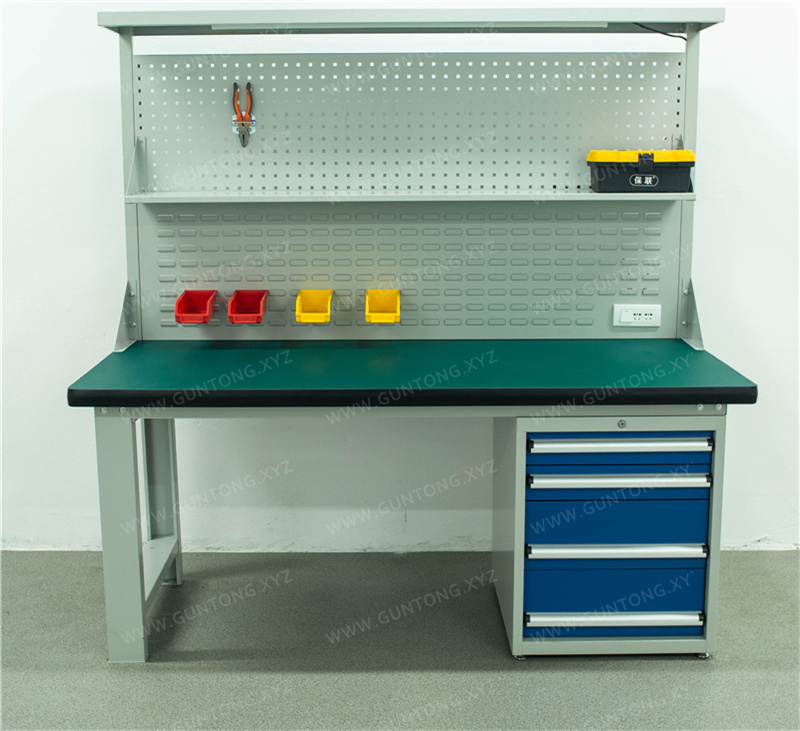
- Single Back Panel Single Door 4-Drawer Steel Plate Workbench: Combines a composite desktop structure with a 4-drawer cabinet base. The C-type cold-rolled steel frame supports high total load capacity. Available in multiple length configurations to match different workstation layouts.
- 4-Drawer 1-Door Tool Cart with Pegboard: Features a 4-drawer tiered design with a square-hole pegboard for flexible expansion and visual management. Each drawer supports substantial load capacity. This unit includes casters for mobility.
Key characteristics:
- Often integrated with workbenches or mounted on casters
- Medium storage capacity focused on frequently used tools
- Supports workflow integration (e.g., tools within arm's reach of assembly tasks)
- Mobile variants allow repositioning for flexible layouts
Selection Criteria: When to Choose Which
| Decision Factor | Tool Room Storage Cabinet | Tool Cabinet |
|---|---|---|
| Primary Use | Centralized bulk storage | Point-of-use tool access |
| Mobility | Fixed installation | Fixed or mobile (with casters) |
| Load Capacity | Varies by drawer/shelf configuration | Varies by frame and drawer design |
| Space Efficiency | High vertical density | Horizontal footprint with workflow integration |
| Typical Location | Tool cribs, storage rooms, back-of-house | Production lines, maintenance bays, assembly cells |
| 6S Adaptation | Visual management via pegboard doors | Integrated with workstation 6S layout |
Choose a Tool Room Storage Cabinet When:
- You need to store large quantities of tools, spare parts, or documents in a dedicated storage area
- Tools are not required at immediate point-of-use
- Floor space allows for tall, narrow units to maximize vertical storage
- Your facility prioritizes centralized inventory control
Choose a Tool Cabinet When:
- Tools must be accessible within the workflow (e.g., assembly, testing, repair)
- You need to integrate storage with a work surface (e.g., steel plate workbench with drawer base)
- Mobile tool access is required (e.g., maintenance teams moving between stations)
- Your layout supports modular workstation configurations
Implementation Boundaries and Risks
Load verification: Do not assume uniform load ratings across product lines. Drawer storage cabinets and workbench-integrated cabinets have different load specifications. Always confirm specifications against your actual tool weights and consult product documentation for exact ratings.
Space planning: Tool room storage cabinets require clear floor space for door swing and drawer extension. Tool cabinets with casters need brake-locking mechanisms to prevent unintended movement during use.
Customization limits: Standard dimensions may not fit all facility layouts. Non-standard customization is available, but lead times and minimum order quantities should be confirmed during procurement.
Material selection: Stainless steel storage cabinets are recommended for environments exposed to moisture, chemicals, or frequent cleaning. Cold-rolled steel is suitable for general manufacturing environments.
Next Steps for Procurement
- Audit your tool inventory: Categorize tools by frequency of use, weight, and access requirements.
- Map your workflow: Identify point-of-use locations versus centralized storage areas.
- Request specifications: For tool room storage cabinets, confirm shelf count, load per shelf, and pegboard configuration. For tool cabinets, verify drawer dimensions, frame load capacity, and caster options.
- Evaluate integration: If combining both types, ensure consistent material finishes and 6S labeling standards.
Guang'ErMei Precision Components provides both standardized and custom-configured tool room storage cabinets and tool cabinets. Our product range includes pegboard storage cabinets, drawer storage cabinets, steel plate workbenches with integrated cabinets, and mobile tool carts. All products support on-site workstation planning, load-bearing design, and full-process after-sales service.
For detailed specifications, custom configurations, or project quotations, contact our technical team with your facility layout and tool inventory list.