
Quality Control & Testing Capabilities for Industrial Workbenches
Quality Control & Testing Capabilities for Industrial Workbenches
When sourcing industrial workbenches, tool cabinets, or heavy-duty storage solutions, buyers often focus on dimensions and price. However, the true differentiator between a standard product and a reliable workshop asset lies in Quality Control (QC) and Testing capabilities. For manufacturing enterprises in electronics, automotive, and hardware mold sectors, the workbench is not just furniture; it is a critical component of production efficiency and safety.
This article details how professional manufacturers validate their products against industry demands, focusing on load-bearing verification, material integrity, and surface durability.
1. Structural Load Testing: Verifying Stability Under Stress
The most critical test for any industrial workstation is its ability to support intended loads without deformation or tipping. Manufacturers with robust QC processes employ static load tests to validate design specifications.
Static Load Verification
For a standard Steel Plate Workbench with a composite desktop, the frame must withstand significant weight.
- Standard Benchmark:*
- A typical C-type cold-rolled steel frame workbench is designed for a total load capacity of 1000 kg.
- Testing Method:*
- During QC, samples are subjected to distributed loading tests to ensure the frame does not buckle and the desktop remains level. This ensures that when operators place heavy tools, molds, or electronic components on the bench, the structure remains stable.
Drawer and Component Load Testing
For integrated units like Tool Carts or Tool Cabinets, individual component testing is essential.
- Drawer Capacity:*
- High-quality drawers are tested for smooth operation under full load. For instance, a 4-drawer tool cart typically specifies 80 kg per drawer. QC checks involve loading each drawer to its rated capacity to verify that rails do not jam and the overall unit does not tip forward.
- Shelf Load:*
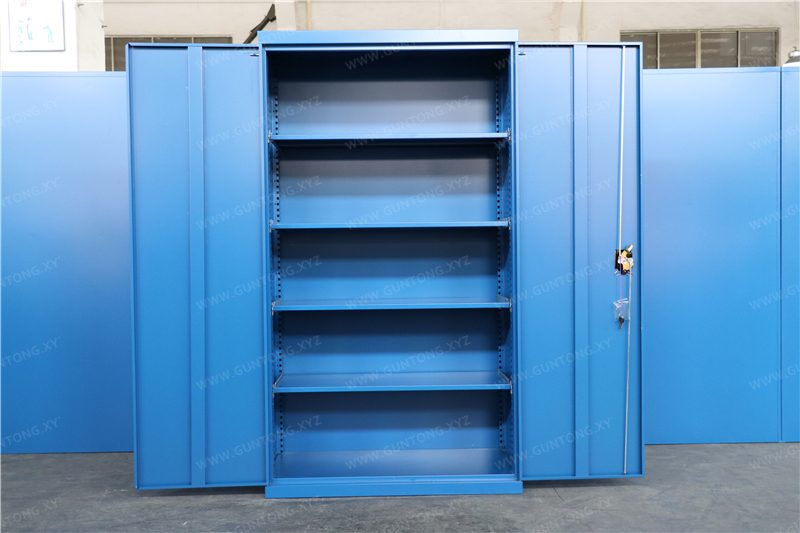
- In storage cabinets, shelves are tested for uniform load distribution. A standard specification might require 100 kg per shelf. The QC process ensures that adjustable shelves lock securely and maintain horizontal alignment under heavy material storage.
2. Material Inspection: Steel Thickness and Frame Integrity
The longevity of an industrial workbench depends on the quality of its raw materials. Reputable manufacturers implement strict incoming material inspections and finished product audits.
Cold-Rolled Steel Verification
The frame is typically constructed from cold-rolled steel. QC teams verify:
- Thickness Accuracy:*
- Using calipers and ultrasonic thickness gauges to ensure steel plates meet specified thicknesses (e.g., 1.0 mm or 1.2 mm for cabinet bodies, 1.5 mm for drawer panels). Deviations can lead to premature fatigue failure.
- Welding Quality:*
- Critical joints, such as where legs meet the base frame, undergo visual and sometimes dye-penetrant inspections to detect cracks or porosity. Welds must be smooth and consistent to prevent stress concentration points.
Desktop Composite Analysis
For workbenches featuring composite desktops (e.g., steel plate bonded with high-density fiberboard):
- Bond Strength:*
- Tests are conducted to ensure the adhesive bond between layers resists delamination under thermal expansion or mechanical impact.
- Edge Banding Durability:*
- PVC edge banding is inspected for secure adhesion to prevent moisture ingress into the fiberboard core, which could cause swelling in humid workshop environments.
3. Surface Treatment and Corrosion Resistance
Industrial environments expose equipment to oils, chemicals, and physical abrasion. QC includes rigorous checks on surface finishes.
Powder Coating Adhesion
Most steel components undergo electrostatic powder coating.
- Cross-Cut Test:*
- Adhesion is verified using a cross-hatch tape test to ensure the coating does not peel off during handling or use.
- Thickness Measurement:*
- Coating thickness is measured to ensure adequate protection against rust and corrosion, particularly important for stainless steel variants or workbenches used in wash-down areas.
Scratch and Impact Resistance
For anti-static or specialized workbenches, surface hardness is checked to resist scratches from metal tools. This preserves both aesthetics and functional properties (like ESD conductivity).
4. Functional Testing: Pegboards, Casters, and Moving Parts
Beyond static strength, dynamic functionality is tested to ensure ease of use.
Pegboard Flexibility and Load
Pegboards (e.g., 500 mm standard square-hole pegboards) are tested for flexibility. They should bend slightly under tool weight but return to shape without permanent deformation. Hooks and holders are also tested for retention strength.
Caster Mobility and Braking
For tool carts and mobile workbenches:
- Rolling Resistance:*
- Casters are tested for smooth rolling on various floor types.
- Brake Effectiveness:*
- Locking mechanisms are engaged repeatedly to ensure they hold the cart firmly in place when loaded, preventing accidental movement during assembly or maintenance tasks.
5. Why Manufacturer QC Matters for Your Procurement
Understanding these testing capabilities helps buyers make informed decisions:
- Safety Compliance:*
- Proper load testing prevents workplace accidents caused by collapsing benches or tipping carts.
- Total Cost of Ownership:*
- Products that pass rigorous QC have longer lifespans, reducing replacement costs and downtime.
- Customization Reliability:*
- When ordering non-standard configurations, a manufacturer’s QC process ensures that custom designs still meet structural safety standards.
Next Steps: Requesting a Technical Validation Report
If you are evaluating suppliers for your workshop equipment needs, consider asking potential partners for:
- Load Test Certificates: Documentation showing third-party or internal validation of load capacities.
- Material Specifications: Detailed reports on steel grades and coating thicknesses.
- Sample Inspections: Opportunities to inspect pre-production samples for weld quality and finish.
Guang'ErMei Precision Components integrates these QC steps into every production batch, ensuring that whether you order a standard Single Back Panel 4-Drawer Steel Plate Workbench or a customized Pegboard Storage Cabinet, the product meets rigorous industrial standards.
Need specific technical data sheets or load test reports for our workbench models? Contact our engineering team for detailed validation documentation.