
End-to-End Custom Workbench Design & Production Workflow: From Site Inputs to Acceptance
End-to-End Custom Workbench Design & Production Workflow: From Site Inputs to Acceptance
For manufacturing enterprises in electronics, automotive, hardware molds, and logistics, a "custom workbench" is rarely a standard off-the-shelf item. It is a specialized asset designed to fit specific spatial constraints, support unique tooling loads, and align with 6S management protocols. The End-to-End Custom Workbench Design & Production Workflow at Guang'ErMei Precision Components follows a rigorous path: starting with precise site inputs, moving through structural trade-off analysis, and concluding with on-site validation.
This guide outlines the critical decision points, evaluation criteria, and boundary conditions that define a successful workstation project.
1. Requirement Discovery: Defining the Scope Beyond Dimensions
The workflow begins not with drawing lines, but with understanding the operational reality. A standard dimension (e.g., 1500×750×800 mm) is insufficient without context. The first phase involves gathering three critical data points:
- Spatial Constraints:*
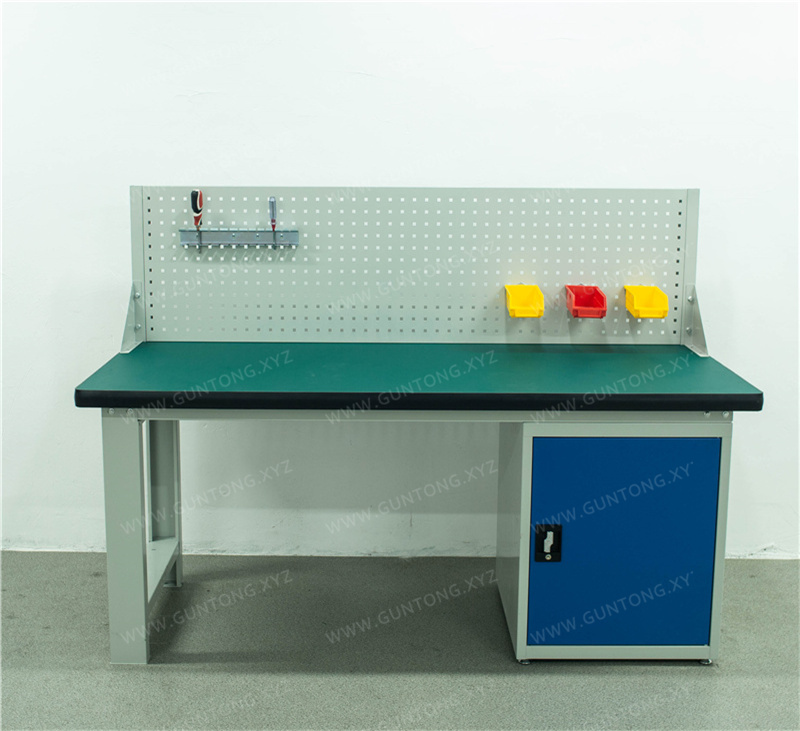
- Exact floor space availability, column locations, and ceiling height limits. For instance, if a facility requires a Single Back Panel Single Door 4-Drawer Steel Plate Workbench, the depth must accommodate both the bench surface and the rear panel clearance while allowing operator movement.
- Throughput & Tooling Load:*
- How many tools are stored daily? What is the weight distribution? This determines whether a standard Tool Cart or a heavy-duty Steel Plate Workbench is required. For example, our 4-Drawer 1-Door Tool Cart with Pegboard is engineered with stable overall stability suitable for medium-weight tool retrieval, whereas a fitter's bench might require a composite desktop structure capable of higher static loads.
- Environmental Factors:*
- Is the environment corrosive (requiring stainless steel), conductive (ESD anti-static surfaces), or high-dust? These factors dictate material selection, such as choosing between cold-rolled steel frames with PVC edge banding or specialized stainless steel components.
2. Design Trade-offs: Balancing Standardization and Customization
Guang'ErMei operates with dual capabilities: standardized production for efficiency and non-standard customization for complex scenarios. The design phase involves making specific trade-offs based on the client's priorities.
Structural Integrity vs. Flexibility
When designing a Pegboard Storage Cabinet (Inner Half-Pegboard Type), the team must decide between fixed shelving and adjustable configurations.
- Standard Approach:*
- Fixed shelves offer maximum rigidity for uniform items.
- Custom Approach:*
- Adjustable shelves allow for reconfiguration as inventory changes. Our models feature a main body constructed from cold-rolled steel with a shelf configuration supporting up to 100 kg per shelf, ensuring stability under dynamic loading.
Desktop Composition
For heavy-duty applications like automotive parts assembly, a simple particle board top may fail. The workflow often recommends a composite structure, such as the 5mm raw steel plate + high-density fiberboard found in our steel plate workbenches. This combination provides:
- High Load Capacity:*
- Essential for holding heavy machinery or jigs.
- Durability:*
- Resistance to impact and wear.
- Cost Efficiency:*
- Avoids the expense of solid steel tops where unnecessary.
Integration with Automation
In modern warehouses, workstations often interface with automated systems. If the project involves a Miniload Automated Storage and Retrieval System, the workstation design must account for tote dimensions (50–100 kg/tote) and rack heights up to 12 meters. The workflow ensures that manual workstations do not obstruct automated retrieval paths and that their footprint aligns with the system's cycle time requirements.
3. Production and Fabrication: Ensuring Consistency
Once the design is approved, the production phase adheres to strict quality controls. Key parameters monitored include:
- Frame Geometry:*
- C-type cold-rolled steel frames are fabricated to exact tolerances to ensure squareness and alignment during assembly.
- Surface Treatment:*
- Powder coating or galvanizing processes are applied based on the environmental risk assessment to prevent corrosion.
- Component Verification:*
- Drawer slides, pegboard inserts, and locking mechanisms are tested against the specified load ratings (e.g., ensuring the 4-drawer tiered design maintains stability even when fully loaded).
4. Delivery, Installation, and Acceptance Criteria
The final stage transforms the product from a factory unit into a functional asset. This phase is critical for validating the design intent.
On-Site Planning and Adaptation
Installation is not merely assembly; it is a verification of the site inputs. Technicians verify:
- Leveling:*
- Ensuring the workbench is perfectly level to prevent tool rolling or drawer misalignment.
- Load Testing:*
- Verifying that the installed unit meets the agreed-upon load capacity (e.g., confirming the 1000 kg total load capacity of a heavy-duty frame).
- 6S Alignment:*
- Adjusting the layout to match the visual management plan, ensuring pegboards and drawers facilitate the intended workflow.
Acceptance Boundaries
Clients should expect acceptance based on the following criteria:
- Dimensional Accuracy: Deviations within standard industrial tolerances.
- Functional Performance: Drawers slide smoothly, doors close securely, and shelves hold the rated load without deformation.
- Safety Compliance: All sharp edges are treated, and structures are stable.
Note on Limitations: While we provide comprehensive design and installation services, acceptance does not cover modifications to existing building infrastructure (e.g., electrical wiring or floor reinforcement) unless explicitly included in the scope of work. Similarly, extreme environmental conditions outside the specified material ratings may require special engineering agreements.
Next Steps: Initiating Your Project
To begin the End-to-End Custom Workbench Design & Production Workflow, prepare your site survey data and a preliminary list of tooling requirements. Whether you need a Single Back Panel Single Door 4-Drawer Steel Plate Workbench for a maintenance bay or a customized Tool Cart for an assembly line, our team can evaluate your specific needs.
Contact Guang'ErMei Precision Components today to discuss your site constraints and receive a tailored feasibility assessment. We serve manufacturing enterprises across Huizhou, Guangdong, and nationwide, delivering solutions that combine standardized reliability with custom precision.
Key Implementation Considerations
- Site Survey First:*
- Never order based on estimated dimensions alone. Measure actual floor space, door widths, and column clearances.
- Load Profile Matters:*
- Distinguish between static load (items sitting on the shelf) and dynamic load (tools being moved). Our 4-Drawer 1-Door Tool Cart is optimized for dynamic retrieval.
- Material Selection:*
- Match the material to the environment. Use stainless steel for washdown areas and composite tops for general assembly.
- Scalability:*
- Design with future expansion in mind. Modular systems allow for adding units or reconfiguring layouts as production scales.
By following this structured workflow, manufacturers can mitigate risks associated with ill-fitting equipment and ensure their workstations enhance productivity rather than becoming bottlenecks.