Custom Workbench Design and Prototyping: How Guang'ErMei Translates Requirements into Industrial Solutions
Custom Workbench Design and Prototyping: From Requirement to Industrial Reality
For procurement managers and production engineers in manufacturing enterprises, the gap between a standard catalog item and a functional workstation often lies in the details of custom design. Whether you are upgrading an electronics assembly line, organizing a heavy-duty mold maintenance area, or implementing 6S management in a logistics center, off-the-shelf solutions rarely fit perfectly. Guang'ErMei Precision Components bridges this gap by combining standardized manufacturing efficiency with non-standard customization capabilities. This article explains how we handle the design and prototyping phase, focusing on the critical decision points that determine durability, ergonomics, and total cost of ownership.
1. Requirement Discovery: Defining the "Real" Load and Use Case
Customization begins not with drawing, but with diagnosing the operational environment. A workbench is not just a table; it is a structural component of your production flow. Our engineering team typically evaluates three core dimensions before finalizing a design:
Operational Load vs. Static Load
Many clients underestimate dynamic loads. For instance, a fitter workbench in a hardware mold factory must withstand impact forces from hammering and heavy mold placement, not just the static weight of tools.
- *Standard Reference:
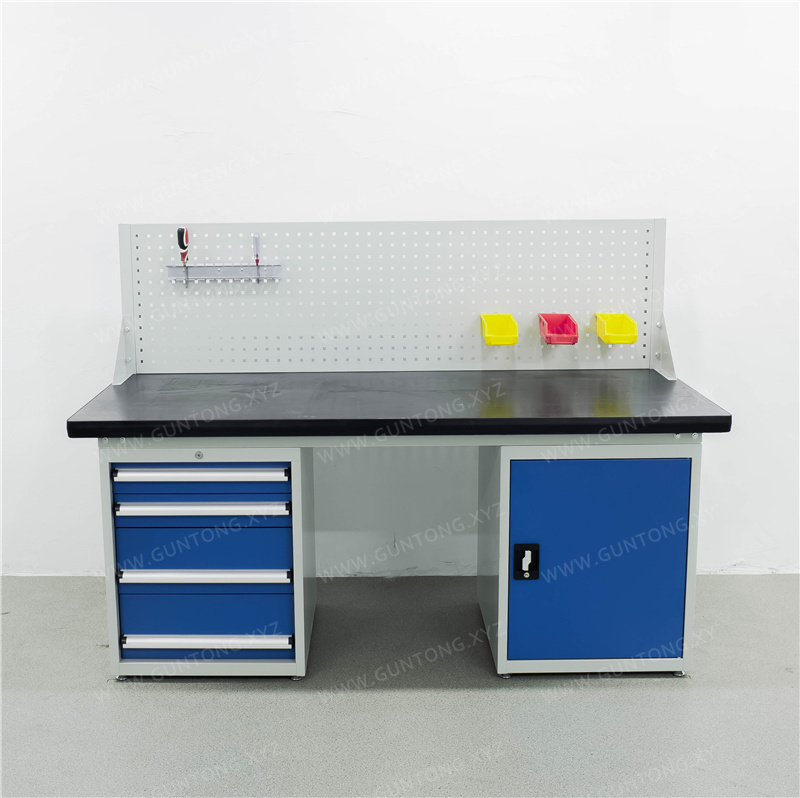
- Our standard heavy-duty workbenches, such as the Single Back Panel Single Door 4-Drawer Steel Plate Workbench, utilize a C-type cold-rolled steel frame capable of supporting a total load capacity of 1000kg.
- *Custom Adjustment:
- For lighter electronics assembly, we may optimize the frame gauge to reduce cost without compromising stability. For heavy automotive parts turnover, we reinforce the leg structure and cross-beams.
Desktop Material and Surface Compatibility
The desktop is the primary interface for workers. The choice depends on chemical exposure, static sensitivity, and abrasion resistance.
- *Heavy-Duty Application:
- For mechanical processing, we recommend a composite structure featuring a raw steel plate top bonded with high-density fiberboard. This provides superior resistance to oil, impact, and heavy tool dropping.
- *ESD-Sensitive Environment:
- For electronics manufacturers, we integrate anti-static materials and grounding points to protect sensitive components, ensuring compliance with ESD protection standards.
Spatial and Ergonomic Constraints
Workshop layouts vary significantly. We assess available floor space, aisle width for tool carts, and worker height to determine optimal dimensions. Standard widths are commonly configured to accommodate industrial workflows, but custom depths and heights are frequently required for specialized tasks like lean pipe assembly or automated storage integration.
2. Design Trade-offs: Balancing Cost, Durability, and Flexibility
Custom design involves making informed trade-offs. Here is how we approach key structural decisions:
| Design Element | Standard Option | Custom/Heavy-Duty Option | Best For |
|---|---|---|---|
| Frame Structure | Standard C-steel | Reinforced C-steel or Square Tube | General Assembly vs. Heavy Mold Repair |
| Desktop Core | MDF/Wood Composite | Steel Plate + HDF | Electronics/Light Assembly vs. Metalworking |
| Storage Integration | Fixed Drawers | Modular Pegboards & Tool Cabinets | Static Storage vs. Visual 6S Management |
| Load Capacity | Standard Duty | 1000kg+ | Light Duty vs. Heavy Industrial Use |
The Role of Modularity
In many automotive and warehousing scenarios, flexibility is as important as strength. We often integrate pegboard systems (such as square-hole pegboards) into custom designs. This allows teams to reconfigure tool layouts as processes change, extending the workstation's lifecycle without requiring new furniture.
3. From Digital Design to Physical Validation
Once requirements are defined, our process moves to technical realization:
- Structural Modeling: Our engineers create detailed drawings specifying material gauges (e.g., cold-rolled steel for cabinet bodies) and joint reinforcements.
- Prototype Fabrication: For complex non-standard orders, we produce a pilot unit. This allows us to verify drawer glide smoothness, door alignment, and overall structural rigidity.
- Client Review: We share dimensions, material specs, and layout diagrams for approval. This step ensures that the custom workbench fits precisely into your planned workflow, avoiding costly on-site modifications.
4. Implementation Boundaries and Lead Times
It is important to understand the boundaries of customization:
- *Standard vs. Non-Standard:
- Standard products (like our common length workbenches) have shorter lead times. Non-standard customization involving unique dimensions or special materials (e.g., stainless steel for food/pharma) requires additional engineering time.
- *Installation Services:
- Guang'ErMei provides full-process after-sales service, including on-site installation. This is crucial for large-scale projects where leveling and anchoring affect safety and usability.
Conclusion: Why Partner with Guang'ErMei for Custom Workstations?
Guang'ErMei Precision Components does not just sell furniture; we provide one-stop workstation equipment solutions. By leveraging our dual capabilities in standardized production and non-standard customization, we help manufacturing enterprises in Huizhou, Guangdong, and nationwide achieve:
- *Precise Fit:
- Workbenches designed for your specific load and spatial needs.
- *Durability:
- Proven structures like the 1000kg load-capacity steel plate workbenches.
- *Efficiency:
- Integrated storage solutions that support 6S and lean manufacturing principles. Whether you need a simple tool cart with pegboard for mobile maintenance or a complex automated storage system accessory setup, our engineering team is ready to translate your operational requirements into robust, efficient industrial solutions.
Next Steps
Ready to optimize your workshop layout? Contact our engineering team to discuss your specific load requirements, spatial constraints, and customization needs. We provide professional on-site planning and detailed quotation services.