
From Design to Delivery: Our Custom Workbench & Cabinet Engineering Workflow
From Design to Delivery: Our Custom Workbench & Cabinet Engineering Workflow
For manufacturing enterprises, electronics manufacturers, and automotive parts producers, selecting workstation equipment is not merely a procurement task but an engineering decision. The core challenge lies in bridging the gap between standard product catalogs and unique on-site requirements such as floor space constraints, specific load-bearing needs, and 6S management standards.
Huizhou Guang'ErMei Precision Components Co., Ltd. addresses this by combining standardized production capabilities with non-standard customization. This article details our engineering workflow, helping technical evaluators understand how we translate operational needs into durable, efficient workstation solutions.
Phase 1: Requirement Discovery and Site Assessment
The engineering process begins before any drawing is made. We focus on identifying the specific constraints of your workshop environment.
Key Inputs for Design
- Operational Scenario:*
- Is the station used for heavy-duty fitter work, precision electronics assembly (requiring anti-static properties), or general maintenance?
- Load Requirements:*
- What is the maximum static and dynamic load per shelf or drawer? For example, our Single Back Panel Single Door 4-Drawer Steel Plate Workbench is engineered with a C-type cold-rolled steel frame supporting a total load capacity of 1000kg, suitable for heavy tools and components.
- Space Constraints:*
- Exact dimensions (Length × Width × Height) are critical. Standard sizes may need adjustment to fit existing aisle widths or integrate with automated storage systems. Common configurations include heights that accommodate both seated and standing operations, often featuring back panels for additional vertical storage.
- Storage Logic:*
- Do you need tiered drawer organization for small tools, or open shelving for larger molds? Our 4-Drawer 1-Door Tool Cart with Pegboard integrates a square-hole pegboard for visual management, allowing flexible expansion based on tool variety.
Phase 2: Design Trade-offs and Parameter Selection
Once requirements are defined, our engineers select materials and structures that balance durability, cost, and functionality.
Material and Structure Decisions
- Desktop Composition:*
- For high-wear environments, we recommend composite desktops. The aforementioned steel plate workbench uses a raw steel plate combined with high-density fiberboard and black PVC edge banding. This structure ensures long service life and resistance to impact compared to pure wood or thin metal tops.
- Frame Stability:*
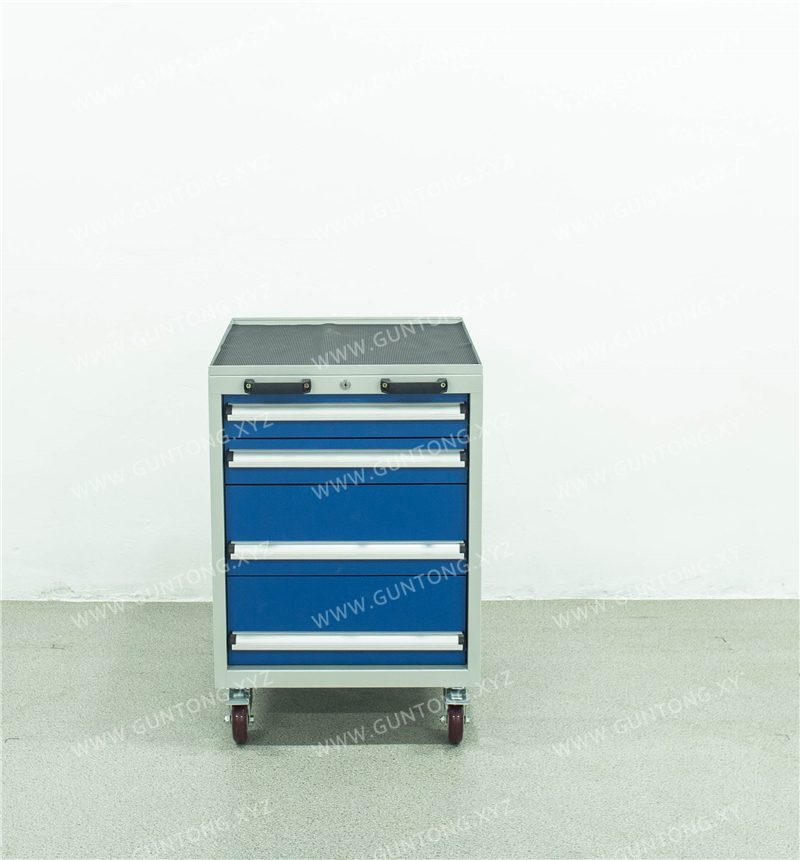
- We utilize cold-rolled steel frames to ensure rigidity. For instance, our Pegboard Storage Cabinet (Inner Half-Pegboard Type) features adjustable shelves with a 100kg load capacity per shelf, supported by a robust cabinet body designed for heavy-duty material storage. The main body material thickness is selected based on the required load class, typically ranging from standard gauge to heavier gauges for industrial applications.
- Modularity vs. Fixed Design:*
- While custom dimensions are available, leveraging modular components (like standard drawer heights) can reduce lead times and costs. We advise clients to adopt standard module sizes where possible, reserving customization for critical interface points.
Phase 3: Production and Quality Control
Our manufacturing process adheres to strict quality controls to ensure that the delivered product matches the design specifications.
- Precision Fabrication:*
- Components are cut, stamped, and welded using automated equipment to maintain dimensional accuracy.
- Surface Treatment:*
- All steel components undergo degreasing, phosphating, and electrostatic powder coating to prevent corrosion and ensure a uniform finish suitable for industrial environments.
- Assembly Verification:*
- Before shipment, key structural elements are checked for stability. Drawers are tested for smooth operation under load, and pegboards are verified for hole alignment to ensure compatibility with standard hooks and accessories.
Phase 4: Delivery, Installation, and After-Sales Support
The workflow concludes with professional delivery and on-site support, ensuring the equipment is ready for immediate use.
- Logistics Planning:*
- Given the weight of items like mold racks or heavy-duty workbenches, we coordinate logistics to handle safe transport.
- On-Site Installation:*
- Our team provides installation services to ensure proper leveling and anchoring, which is crucial for safety and longevity, especially for tall units like storage cabinets.
- 6S Adaptation:*
- We assist in arranging the workspace to align with 6S management principles, ensuring that tool carts and workbenches contribute to an organized, efficient, and safe working environment.
Conclusion and Next Steps
Choosing the right workstation equipment requires a clear understanding of your operational loads, space constraints, and workflow needs. Guang'ErMei’s dual capability in standardized and non-standard production allows us to deliver solutions that are both cost-effective and precisely tailored.
Recommendation:
- Audit Your Current Setup: Identify pain points such as insufficient load capacity, poor tool accessibility, or space inefficiencies.
- Define Critical Parameters: Determine the exact dimensions and load requirements for your most demanding stations.
- Consult with Engineers: Share your site layout and operational needs with our team to receive a customized proposal.
For detailed specifications on our workbenches, tool cabinets, and storage solutions, or to discuss a custom project, please contact Huizhou Guang'ErMei Precision Components Co., Ltd. directly.