
How Guang'ErMei Validates Custom Workbench Quality: Testing & QC Process
How Guang'ErMei Validates Custom Workbench Quality: Testing & QC Process
For manufacturing enterprises, electronics producers, and automotive parts suppliers, a workbench is not just furniture; it is a critical component of the production line. When equipment fails—whether due to desktop deformation, drawer jamming, or frame instability—it disrupts workflow and compromises safety. At Guang'ErMei Precision Components, we recognize that "customization" does not mean compromising on standards. Instead, it requires stricter validation protocols to ensure that non-standard designs meet industrial-grade performance. This article outlines our internal quality control (QC) framework, focusing on how we validate the structural integrity, material durability, and functional reliability of our workstation equipment.
1. Material Verification: The Foundation of Durability
Quality validation begins before assembly. We strictly verify raw materials against design specifications to prevent long-term degradation.
Steel Plate and Composite Desktops
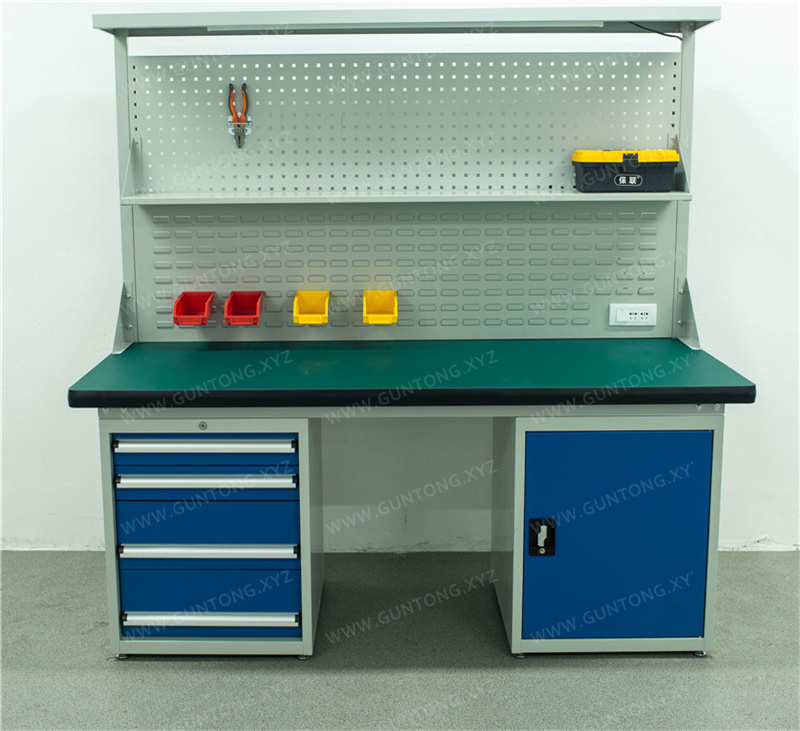
For heavy-duty applications, such as our Single Back Panel Single Door 4-Drawer Steel Plate Workbench, the desktop structure is critical. We utilize a composite design featuring a raw steel plate bonded with high-density fiberboard.
- *Validation Check:
- We inspect the steel plate thickness and surface treatment to ensure resistance to impact and corrosion. The composite bonding process is monitored to prevent delamination under heavy loads or temperature fluctuations.
- *Why it matters:
- A pure steel top can dent; a pure wood top can warp. The composite structure provides the rigidity of steel with the shock-absorption and flatness stability required for precision assembly tasks.
Frame Construction
The skeleton of our workbenches typically uses C-type cold-rolled steel. For standard models, we specify profiles such as C-section steel with specific gauge requirements.
- *Validation Check:
- Incoming steel coils are checked for gauge consistency. During fabrication, weld points are inspected for continuity and strength to ensure the frame can support the rated total load capacity without buckling.
2. Structural Load-Bearing Tests
Once assembled, every custom workbench undergoes static and dynamic load assessments to verify its rated capacity.
Static Load Testing
We apply distributed weights across the desktop to simulate real-world usage, such as placing heavy molds, machinery, or bulk components.
- *Benchmark:
- Our standard heavy-duty workbenches are validated to hold up to their specified total load capacity (e.g., 1000kg for specific models).
- *Observation:
- Engineers measure deflection (bending) at the center and edges. Acceptable deflection limits are strictly enforced to ensure the work surface remains level for precision tasks. If a custom design exceeds standard dimensions, additional reinforcement brackets are added and re-tested.
Drawer and Storage Mechanism Validation
Storage units, such as the 4-Drawer 1-Door Tool Cart with Pegboard, require specific functional testing.
- *Load per Drawer:
- Each drawer is tested to handle its specified load capacity.
- *Cycle Testing:
- Drawers are opened and closed repeatedly to test the smoothness of the rail system. We check for alignment issues, rail deformation, or handle stress. This ensures that tools remain accessible and organized over years of daily use.
3. Functional and Safety Inspections
Beyond weight, we validate the usability and safety features tailored to specific industry scenarios.
Pegboard and Accessory Integration
For workstations equipped with pegboards (like the Inner Half-Pegboard Storage Cabinet), we verify the square-hole pattern accuracy.
- *Check:
- Hooks and accessories must fit securely without slipping. The pegboard itself is tested for pull-out strength to ensure it can hold heavy tools without tearing away from the cabinet body.
Edge Banding and Surface Finish
Safety is paramount in busy workshops. All desktop edges are finished with protective materials such as PVC edge banding.
- *Check:
- We inspect for sharp edges, burrs, or loose banding that could cause injury or damage to sensitive electronic components. For anti-static workbenches used in electronics manufacturing, surface resistance tests are conducted to ensure compliance with ESD protection standards.
4. Customization vs. Standardization: Managing Trade-offs
Clients often ask: "Does customizing my workbench reduce its quality?" The answer lies in our dual capability approach.
- *Standardized Modules:
- We use proven, pre-validated components (like standard C-frame legs and drawer slides) wherever possible. This reduces risk and ensures consistent quality.
- *Non-Standard Adaptations:
- When you require unique dimensions, special cutouts, or integrated power systems, we treat these as engineering challenges. We perform additional stress simulations or physical prototypes for significant deviations. Risk Boundary: Highly customized designs may have longer lead times due to this extra validation step. However, this ensures that your specific operational needs (e.g., fitting a specific automated storage retrieval system accessory) do not compromise the unit's structural integrity.
Conclusion: Quality as a Service Commitment
Guang'ErMei’s QC process is not just about passing inspections; it is about ensuring that your workstation equipment supports your production efficiency for years. From the steel composite tops to the load-bearing frames, every element is verified against rigorous standards. When selecting a supplier, look beyond the price tag. Ask about their load-testing protocols, material sourcing, and after-sales support. A workbench that fails in six months costs far more than one built to last.
Next Steps for Procurement Teams
- Define Your Load Requirements: Clearly specify the maximum weight per shelf or desktop area.
- Request Specification Sheets: Ask for detailed material grades (e.g., steel thickness, board density) rather than generic descriptions.
- Consult on Custom Needs: If you need non-standard sizes or integrations (like Miniload AS/RS accessories), engage our engineering team early to discuss feasibility and validation plans. Ready to validate your workstation needs? Contact Guang'ErMei Precision Components for a detailed consultation on custom workbench design, load-bearing analysis, and project delivery.