
How to Choose a Custom Workbench Manufacturer: Process and Capabilities
The Hidden Cost of Poor Workstation Selection
A frequent failure in manufacturing facility deployment is not the equipment itself, but the mismatch between the workstation's structural capacity and the actual production workflow. Buyers often focus solely on unit price or basic dimensions, overlooking critical factors like load-bearing distribution, ergonomic integration, and 6S adaptability. This leads to premature deformation, inefficient tool retrieval, and costly retrofits.
Choosing the right custom workbench manufacturer requires shifting from a "product buyer" mindset to a "solution partner" evaluation. You must assess whether the supplier can bridge standardized efficiency with non-standard customization needs across your specific industry scenario.
Core Evaluation Criteria: Beyond Basic Specifications
When comparing potential suppliers, prioritize these three capability dimensions that directly impact long-term operational stability:
1. Dual Capability: Standardization vs. Non-Standard Customization
The most capable manufacturers offer a hybrid model. They utilize standardized components (such as lean pipes, modular frames, and standard drawer configurations) to ensure cost-efficiency and rapid delivery, while retaining the engineering flexibility to modify structures for unique spatial or functional constraints.
- Why it matters:*
- Purely custom-built items often suffer from longer lead times and higher costs. Purely standard items may fail to fit complex factory layouts. A manufacturer with dual capabilities can optimize both speed and fit.
- Guang'ErMei Context:*
- Our approach combines standardized production lines with non-standard customization services, covering categories from heavy-duty steel plate workbenches to specialized automotive parts turnover racks.
2. Structural Integrity and Load-Bearing Design
Workstations are not static furniture; they are active tools subjected to dynamic loads. Evaluate the manufacturer’s ability to perform precise load-bearing calculations based on your specific usage.
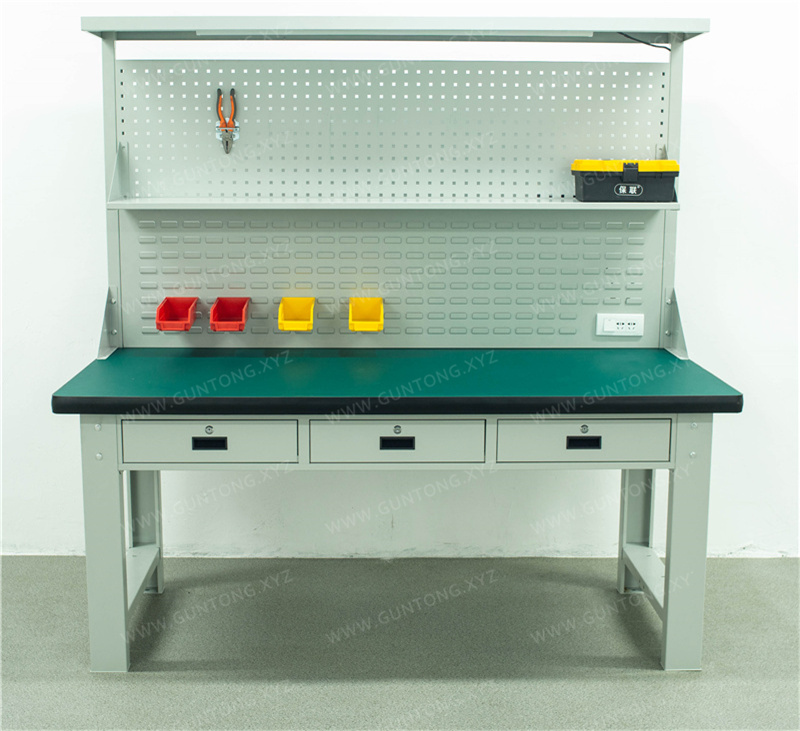
- Desktop Structure:*
- Look for composite designs that balance weight and durability. For example, our Single Back Panel Single Door 4-Drawer Steel Plate Workbench uses a composite desktop of 5mm raw steel plate and high-density fiberboard, engineered for high load capacity and long service life.
- Frame Engineering:*
- The frame material and geometry determine stability. We utilize C-type cold-rolled steel frames designed to support up to 1000kg total load capacity, ensuring safety even under heavy industrial use.
- Drawer Capacity:*
- Tool storage units must withstand repeated stress. Our 4-Drawer 1-Door Tool Cart with Pegboard features drawers rated for stable overall storage, preventing sagging or jamming over time. Note: Specific per-drawer weight limits should be verified against the specific model's technical sheet, as capacities vary by configuration.
3. Full-Chain Service: From Planning to After-Sales
A reliable manufacturer does not just ship boxes; they manage the entire lifecycle. Assess their service scope against these stages:
- On-Site Planning & 6S Adaptation:*
- Can they analyze your floor plan and workflow to propose optimal layouts? Effective workstation design integrates seamlessly with 6S management principles, reducing clutter and improving visibility.
- Installation & Commissioning:*
- Professional installation ensures structural integrity and safety. Poor assembly can compromise even the highest-quality materials.
- After-Sales Support:*
- Availability of spare parts, maintenance guidance, and responsive technical support is crucial for minimizing downtime.
Industry-Specific Application Considerations
Different manufacturing sectors have distinct requirements. Ensure your chosen manufacturer has experience in your specific field:
- Electronics & Electrical Appliance Manufacturers:*
- Require anti-static workbenches with precise grounding systems to protect sensitive components. Focus on ESD-safe materials and cable management integration.
- Automotive Parts Manufacturers:*
- Need robust automotive parts turnover racks and heavy-duty workstations capable of handling large, irregularly shaped components. Load capacity and space utilization are key.
- Hardware Mold Factories:*
- Demand high-strength mold racks and fitter workbenches that can support extreme weights and resist vibration during precision work.
- Maintenance & Testing Institutions:*
- Benefit from mobile tool carts and pegboard storage cabinets that allow for flexible tool organization and easy transport to various testing stations.
- Warehousing & Logistics Enterprises:*
- Require durable warehouse shelving and lean pipe systems that maximize vertical space and facilitate efficient material flow.
- Vocational College Training Centers:*
- Need versatile, durable workstations that can withstand frequent student use and support diverse training modules.
Decision Framework: Next Steps for Procurement
To make an informed decision, follow this structured approach:
- Define Your Requirements: Document specific load requirements, spatial constraints, tool types, and workflow processes. Identify which aspects require standardization and which need customization.
- Request Detailed Quotations: Ask for itemized quotes that break down material specifications, structural designs, and service components (planning, installation, after-sales).
- Evaluate Technical Proposals: Review the manufacturer’s proposed solutions for alignment with your 6S goals and ergonomic needs. Check if they provide detailed drawings or 3D visualizations.
- Verify Experience: Inquire about their experience in your specific industry sector. Request references or case studies (if available) that demonstrate successful implementations in similar environments.
- Assess Communication & Responsiveness: Gauge their ability to understand your needs, answer technical questions, and provide timely support throughout the procurement process.
Conclusion
Selecting a custom workbench manufacturer is a strategic decision that impacts operational efficiency, safety, and long-term costs. By prioritizing dual capabilities, rigorous load-bearing design, and comprehensive full-chain service, you can mitigate risks and secure a solution that truly supports your manufacturing objectives. Guang'ErMei Precision Components offers tailored workstation solutions backed by extensive industry experience and a commitment to quality and service.
Call to Action
Ready to optimize your workshop layout? Contact Guang'ErMei Precision Components today for a free consultation and customized workstation design proposal. Let us help you build a safer, more efficient, and organized production environment.