Custom Workstation Manufacturing: From Design to Mass Production
Custom Workstation Manufacturing: From Design to Mass Production
For manufacturing enterprises, electronics factories, and automotive parts suppliers, a workbench is not just furniture; it is a critical node in the production line. When standard off-the-shelf solutions fail to meet specific ergonomic, load-bearing, or spatial constraints, custom manufacturing becomes necessary. However, moving from a conceptual need to mass-produced, reliable equipment requires a structured approach.
Guang'ErMei Precision Components bridges this gap by combining standardized modular production with non-standard customization. This article outlines the practical workflow from initial requirement discovery to final delivery, helping procurement managers and facility planners understand what inputs are needed and what outcomes to expect.
1. Requirement Discovery: Defining the "Why" and "Where"
The first step in custom manufacturing is not drawing a CAD file, but understanding the operational context. A workbench for an electronics assembly line has different needs than one for a heavy-duty hardware mold factory.
Key Inputs for Design:
- Application Scenario:*
- Is the station used for precision electronics (requiring anti-static properties), heavy mechanical fitting (requiring high impact resistance), or general warehousing (requiring mobility)?
- Load Requirements:*
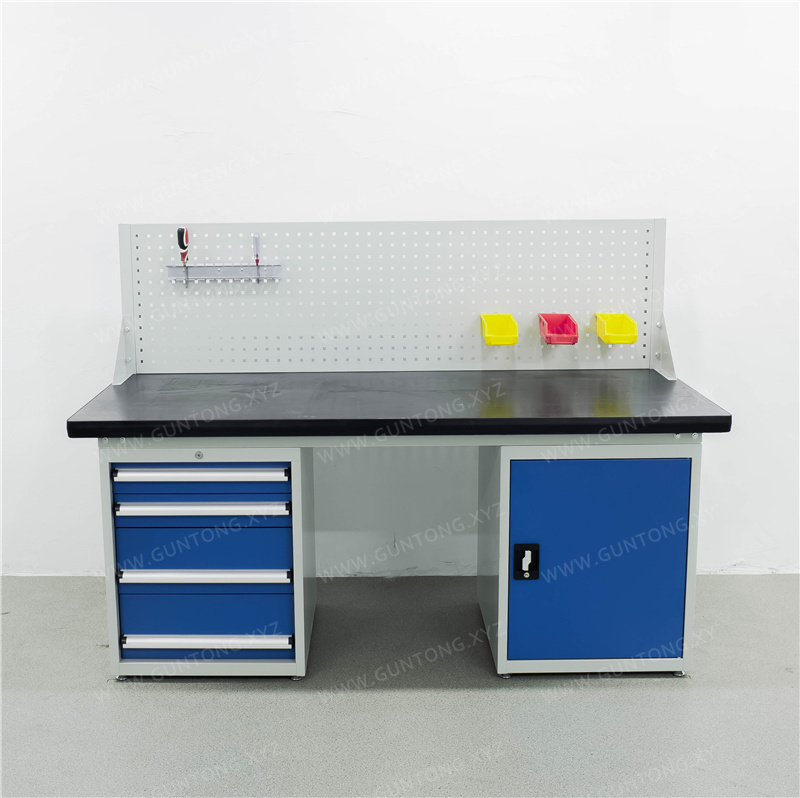
- What is the maximum static and dynamic load? For example, our Single Back Panel Single Door 4-Drawer Steel Plate Workbench is engineered with a C-type cold-rolled steel frame to support a total load capacity of 1000kg. This specification is derived directly from the weight of tools, molds, or components typically handled at that station.
- Spatial Constraints:*
- What are the floor dimensions? Are there overhead obstructions? Standard dimensions often vary in length to accommodate different aisle widths, but non-standard sizes can be fabricated to fit tight corners or specific layout requirements.
- 6S Management Goals:*
- Does the client require visual management tools? Integration of pegboards, shadow boards, or specific drawer configurations helps maintain order and reduce tool retrieval time.
2. Design Trade-offs: Balancing Cost, Durability, and Function
Once requirements are clear, the engineering team evaluates material and structural trade-offs. Customization does not mean starting from scratch; it means adapting proven modules.
Material Selection:
- Desktop Structure:*
- For heavy-duty applications, we use a composite structure. The raw steel plate combined with high-density fiberboard offers superior impact resistance and longevity compared to pure wood or thin metal tops. The black PVC edge banding protects against chipping and improves safety.
- Frame Construction:*
- Cold-rolled steel is preferred for its strength-to-weight ratio. In our 4-Drawer 1-Door Tool Cart, the cabinet body uses stamped steel plates to ensure stability while keeping the unit mobile.
Functional Configuration:
- Storage Logic:*
- Drawers should be tiered by height to accommodate different tool sizes. Our standard configuration includes drawers of varying heights to optimize space usage.
- Expandability:*
- Features like the standard square-hole pegboard on our tool carts allow users to add hooks, bins, or shelves later without replacing the entire unit. This flexibility reduces long-term costs.
3. Production Process: Standardization Meets Customization
Guang'ErMei’s manufacturing capability lies in its dual approach: using standardized components for reliability and custom fabrication for specific needs.
Step 1: Modular Fabrication
Standard parts such as legs, frames, and drawer slides are produced in bulk using automated cutting and bending machines. This ensures consistency and reduces lead times. For instance, the Pegboard Storage Cabinet uses cold-rolled steel sheets, cut to precise dimensions for uniform assembly.
Step 2: Custom Assembly
Non-standard elements, such as unique desktop sizes or specialized back panels, are fabricated separately. The composite desktops are assembled by bonding the steel plate to the fiberboard core, ensuring a flat, stable surface.
Step 3: Surface Treatment
All steel components undergo degreasing, phosphating, and electrostatic powder coating. This process provides corrosion resistance and a durable finish suitable for industrial environments, including those with humidity or chemical exposure.
4. Quality Control and Acceptance Criteria
Before shipment, each unit undergoes rigorous testing to ensure it meets the specified load-bearing and functional standards.
- Load Testing:*
- Workbenches are tested to verify they can handle their rated capacity (e.g., 1000kg for heavy-duty models) without permanent deformation.
- Drawer Smoothness:*
- Drawers are cycled multiple times to ensure smooth operation under load. Our tool cart drawers are rated for 80kg per drawer, a figure verified through stress testing.
- Dimensional Accuracy:*
- Final dimensions are checked against the approved drawings to ensure fitment in the client’s facility.
5. Delivery and On-Site Installation
The process does not end at the factory door. Guang'ErMei provides full-chain service, including logistics and on-site installation.
- Packaging:*
- Units are packed to prevent damage during transit, with protective films on surfaces and reinforced corners.
- Installation:*
- For complex setups, such as integrated workstation lines or automated storage accessories, our team assists with on-site assembly and leveling.
- After-Sales Support:*
- We provide guidance on maintenance, such as checking grounding connections for anti-static workbenches or lubricating drawer slides, to extend product lifespan.
Conclusion: Making the Right Choice
Custom manufacturing is most valuable when your operational needs exceed the capabilities of generic products. By focusing on load-bearing integrity, material durability, and functional adaptability, Guang'ErMei ensures that every workbench, tool cart, or storage cabinet contributes to a more efficient and organized workspace.
Whether you are outfitting a new electronics assembly line or upgrading a hardware mold workshop, understanding this process helps you communicate your needs effectively and evaluate supplier proposals with confidence.
Ready to Optimize Your Workshop?
If you have specific dimensional requirements or load-bearing challenges, contact Guang'ErMei Precision Components. Our team can provide a tailored design proposal based on your site conditions and operational goals.