Custom Manufacturing Workflow and Engineering Support: How to Evaluate Guang'ErMei's Design-to-Delivery Process
Custom Manufacturing Workflow and Engineering Support: Evaluating Design-to-Delivery Capabilities
When evaluating industrial workstation suppliers, the most critical differentiator is not just the product catalog, but the engineering support behind it. For manufacturing enterprises in electronics, automotive parts, or hardware molds, a workbench is rarely a "one-size-fits-all" item. It must accommodate specific tooling, withstand defined loads, and integrate with existing 6S management systems.
This article outlines the typical custom manufacturing workflow and engineering support structure used by specialized providers like Guang'ErMei Precision Components, helping technical evaluators assess suitability, decision criteria, and trade-offs before initiating a project.
1. The Engineering Evaluation Phase: From Brief to Feasibility
The first step in any custom workstation project is translating operational needs into engineering specifications. This phase determines whether a standard product can be adapted or if full non-standard design is required.
Key Inputs for Engineering Assessment
- Load Requirements:*
- Engineers must calculate static and dynamic loads. For example, a steel plate workbench may require a C-type cold-rolled steel frame to support high total capacity (e.g., up to 1000kg), while drawer units need individual load ratings (e.g., 80kg per drawer).
- Dimensional Constraints:*
- Site-specific space limitations dictate overall dimensions (L×W×H). Standard modules are often modified to fit tight workshop layouts. Common base dimensions include widths of 750mm and heights around 800mm, which can be adjusted for length.
- Material Compatibility:*
- Applications involving electronics may require anti-static surfaces, while automotive testing might demand stainless steel components for corrosion resistance. Material thicknesses, such as 1.0mm or 1.2mm for cabinet bodies, are selected based on durability needs.
Evaluation Tip: Ask the supplier how they validate load-bearing designs. Reliable engineering support includes structural calculations for frames and shelves, not just visual inspection.
2. Design & Prototyping: Bridging Standardization and Customization
Guang'ErMei’s dual capability in standardized production and non-standard customization allows for flexible design approaches. The workflow typically involves:
- Modular Integration:*
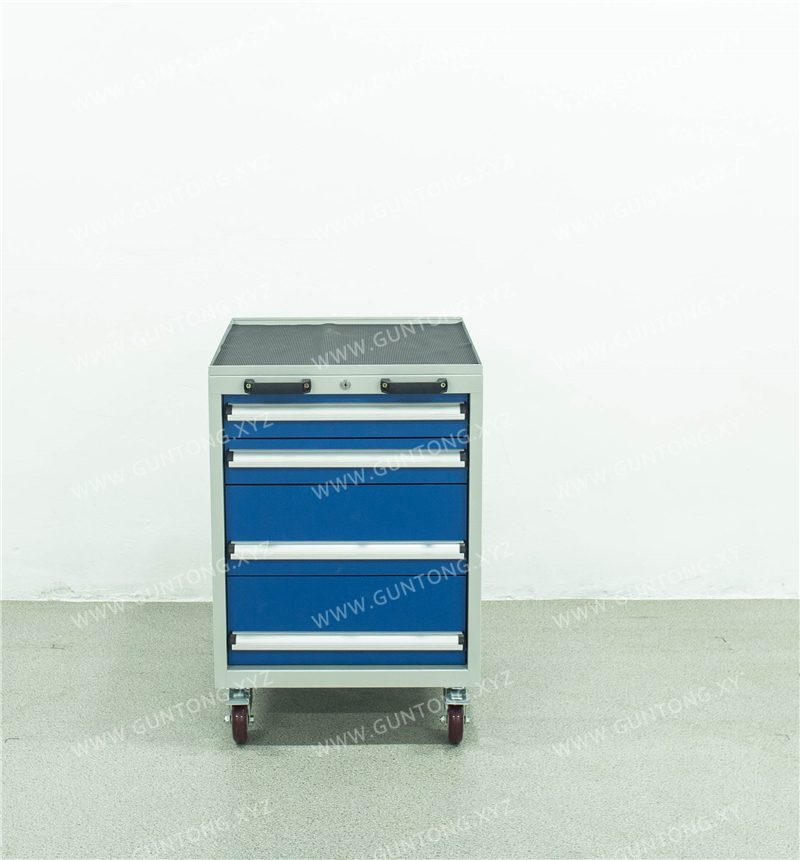
- Using standardized components (like lean pipes, pegboards, or drawer mechanisms) as a base, then customizing the outer shell or layout. For instance, a 4-Drawer 1-Door Tool Cart might use a standard footprint but feature a square-hole pegboard for specific tool visualization.
- Surface & Finish Engineering:*
- Desktop structures often combine materials for durability and functionality. A common configuration is a composite desktop with raw steel plate and high-density fiberboard, balancing weight, cost, and wear resistance.
- Visual Management Integration:*
- Engineering support extends to 6S compliance. Designs often incorporate inner half-pegboard storage cabinets or external pegboards to enable visual inventory control, a critical requirement for maintenance and testing institutions.
Trade-off Consideration: Fully custom designs offer perfect fit but longer lead times. Modular customization offers faster delivery with slight compromises on exact dimensions. Evaluate which aligns with your project timeline.
3. Production & Quality Control: Ensuring Consistency
During the manufacturing phase, engineering support ensures that custom drawings translate accurately to physical products. Key quality checkpoints include:
- Material Verification:*
- Confirming steel plate thickness (e.g., 1.0mm vs. 1.2mm for cabinet bodies) and cold-rolling processes.
- Assembly Precision:*
- Ensuring drawer slides operate smoothly (e.g., 85% opening range) and shelf adjustments are secure.
- Surface Treatment:*
- Checking coating uniformity and edge banding integrity to prevent peeling in high-use environments.
Evidence of Capability: Suppliers with extensive product catalogs (e.g., 394+ detail pages) typically have mature production lines capable of handling both high-volume standard orders and low-volume custom batches without compromising quality.
4. Delivery, Installation & After-Sales: The Final Engineering Touch
Custom workstations often require on-site assembly and adjustment. Engineering support here includes:
- Site Planning:*
- Advising on floor loading, power/air line routing, and ergonomic height adjustments.
- Installation Guidance:*
- Providing clear assembly instructions or on-site supervision to ensure stability, especially for heavy-duty racks or automated storage accessories.
- After-Sales Adaptability:*
- Offering modifications or additional modules as production needs evolve.
Decision Criteria for Technical Evaluators
When comparing suppliers based on their custom manufacturing workflow, consider these questions:
- Can they handle my specific load and dimension constraints? (Check for engineering validation methods.)
- Do they offer modular customization? (Faster delivery vs. fully bespoke.)
- Is their design process integrated with 6S and visual management principles? (Critical for modern workshops.)
- What is their after-sales support scope? (On-site installation, training, or remote guidance?)
Conclusion
Choosing a workstation supplier is an engineering decision as much as a procurement one. A robust custom manufacturing workflow ensures that your specific operational needs—whether for electronics assembly, automotive parts storage, or vocational training—are met with precision, durability, and scalability. By evaluating the supplier’s engineering support from design through delivery, you can mitigate risks and ensure a successful implementation.
For detailed specifications on our workbenches, tool carts, and storage solutions, please explore our product catalog or contact our engineering team for a preliminary feasibility assessment.