
Storage Cabinet vs Tool Cabinet: Key Differences for Workshop Planning
When the Wrong Cabinet Slows Down the Line
A maintenance team in an automotive parts plant kept misplacing torque wrenches because they stored them in a general-purpose storage cabinet with fixed shelves. Retrieval required opening doors, moving bins, and searching by hand. Switching to a drawer-based tool cabinet with a pegboard door cut retrieval time and reduced tool-mix errors. This kind of mismatch is common when buyers treat "storage cabinet" and "tool cabinet" as interchangeable terms. In reality, their structural logic, load distribution, and access patterns differ in ways that affect daily workflow, 6S compliance, and long-term durability.
What Defines a Storage Cabinet
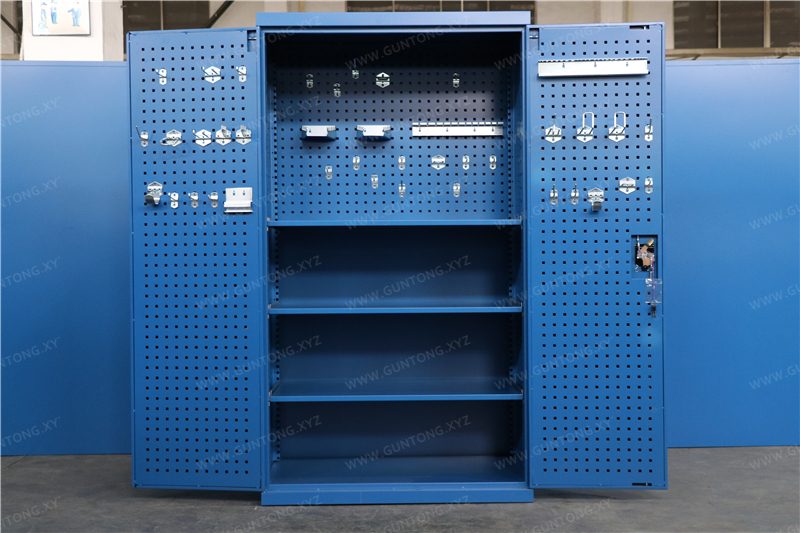
A storage cabinet is primarily an enclosed shelving unit designed to hold bulk items, spare parts, raw materials, or mixed inventory. Its typical structure includes:
- Fixed or adjustable shelves
- that distribute load across a wide horizontal plane.
- Full-height doors
- (single or double) that protect contents from dust, oil mist, and unauthorized access.
- Higher overall volume
- relative to footprint, suited for warehouse corners, mezzanines, or back-of-line staging areas.
Storage cabinets excel when the priority is capacity over frequency of access. For example, a hardware mold factory may use them to hold spare mold components, fastener boxes, or packaging materials that are retrieved a few times per shift rather than every few minutes.
What Defines a Tool Cabinet
A tool cabinet is engineered around organized, rapid retrieval of hand tools, instruments, and small assemblies. Its design logic centers on:
- Tiered drawer configurations
- that separate tools by size and function.
- Pegboard panels
- on doors or inner walls for hanging frequently used items and supporting visual management.
- Reinforced drawer slides
- rated for repeated daily cycling, with load capacity per drawer suited to heavy hand tools.
- Compact footprint
- optimized for placement beside a workbench or along a production cell.
Guang'ErMei's 4-Drawer 1-Door Tool Cart with Pegboard illustrates this approach: it combines four drawers in two height tiers with a square-hole pegboard, enabling both concealed storage and open visual access in a single unit. Each drawer supports substantial load, and the overall structure is designed for stable movement across the shop floor.
Side-by-Side Comparison
| Criterion | Storage Cabinet | Tool Cabinet |
|---|---|---|
| Primary purpose | Bulk or mixed-item containment | Organized tool and small-part retrieval |
| Access pattern | Door-open, shelf-reach | Drawer-pull, pegboard-grab |
| Load distribution | Even across shelves | Concentrated in drawer slides |
| Visual management | Limited (contents hidden behind doors) | High (pegboard + labeled drawers) |
| Mobility | Usually stationary | Often available on casters |
| 6S fit | Good for storage zones | Better for point-of-use stations |
| Typical placement | Warehouse aisles, mezzanines, staging areas | Beside workbenches, maintenance cells, testing stations |
Decision Checklist: Which One Do You Need?
Before specifying, walk through these five questions:
- What is retrieved most often? If operators reach for the same tools dozens of times per shift, a tool cabinet with drawers and pegboard reduces motion waste. If items are fetched a few times per day or week, a storage cabinet is sufficient.
- What is the load profile? Heavy, uniformly distributed loads (e.g., metal blanks, large sub-assemblies) suit shelf-based storage cabinets. Concentrated, repetitive loads (e.g., wrenches, gauges, calipers) require drawer slides rated for high cycle counts.
- Is visual management a priority? If 6S or lean audits require tools to be visible at a glance, pegboard-integrated tool cabinets outperform enclosed storage cabinets.
- Does the unit need to move? Mobile maintenance or field-repair tasks benefit from tool carts on casters. Stationary bulk storage favors fixed-leg storage cabinets.
- What is the adjacent workstation? If the cabinet sits beside a workbench, matching height and depth improves ergonomics. Guang'ErMei offers composite workbenches with integrated drawer modules that align with adjacent tool cabinets for a continuous workflow surface.
Common Risks When the Two Are Confused
- Overloading drawer slides
- by placing heavy bulk items in a tool cabinet not rated for uniform shelf loads.
- Underutilizing vertical space
- by using a low-profile tool cabinet where a tall storage cabinet would free floor area.
- Ignoring pegboard compatibility, which forces teams to retrofit hooks or abandon visual management entirely.
- Specifying the wrong door type: single-door units save aisle space; double-door units improve access width for large items.
Implementation Boundaries
- Custom dimensions, drawer layouts, and pegboard hole patterns should be confirmed against actual tool inventories and workstation drawings before production.
- Load ratings apply per drawer or per shelf; total unit capacity depends on frame design and floor conditions.
- For anti-static or clean-room environments, material selection (e.g., stainless steel desktops, ESD-safe finishes) must be specified at the quoting stage.
Next Step
If your team is planning a new workstation layout or upgrading an existing tool room, start by listing the items to be stored, their retrieval frequency, and the adjacent equipment. Guang'ErMei provides one-stop workstation equipment solutions covering standardized products and non-standard customization, with full-chain service from design and manufacturing to on-site installation and after-sales support. Share your layout requirements to receive a configuration recommendation aligned with your load, access, and 6S needs.