
How to Read Heavy Duty Workbench Load Capacity Specs: A Technical Decision Memo
Objective: Avoid Workbench Overload Failures in Real Workshop Use
When sourcing heavy duty workbenches for manufacturing, electronics assembly, automotive parts handling, or maintenance workshops, buyers often focus on a single number: the total load capacity. A workbench rated for 1,000 kg seems sufficient for most tasks. However, workshop failures—sagging desktops, stuck drawers, frame deformation—rarely occur because the total load limit was exceeded. They happen because individual component limits were misunderstood or ignored. This decision memo helps procurement teams and workshop managers read load capacity specifications accurately, identify hidden risks, and select workbench configurations that perform reliably under actual working conditions.
Alternatives: Three Common Approaches to Load Capacity Evaluation
Approach 1: Rely on Total Load Capacity Only
Many buyers compare workbenches using the overall load rating alone. A bench rated at 1,000 kg is assumed to handle any combination of tools, parts, and fixtures up to that weight. This approach is fast but incomplete. It ignores how weight is distributed across the desktop, drawers, shelves, and pegboard accessories.
Approach 2: Evaluate Component-Level Load Ratings
A more rigorous approach examines each structural element separately:
- Desktop load rating: The maximum weight the work surface can support without deflection. For example, a composite desktop built with a 5 mm raw steel plate over 45 mm high-density fiberboard provides high point-load resistance for heavy fixtures or vise installations.
- Frame load rating: The structural frame—typically C-type cold-rolled steel sections such as 100×50×1.5 mm C-channel—determines the overall stability and long-term deformation resistance.
- Drawer load rating: Individual drawers may be rated for 80 kg each. A four-drawer configuration does not mean 320 kg can be loaded simultaneously without considering the cabinet structure and slide rail limits.
- Shelf load rating: Adjustable shelves in storage cabinets or under-bench units typically carry 100 kg per shelf. Concentrated loads near the center of an unsupported span create higher bending stress than evenly distributed weights.
Approach 3: Match Load Specs to Actual Workflow Patterns
The most effective approach maps load specifications to real usage scenarios. A maintenance workshop that places a 60 kg vise at one end of the desktop and stores 40 kg of tooling in a single drawer creates asymmetric loading that differs significantly from a uniform 500 kg test load.
Evidence: Key Technical Parameters That Define Real-World Performance
Desktop Construction and Point-Load Resistance
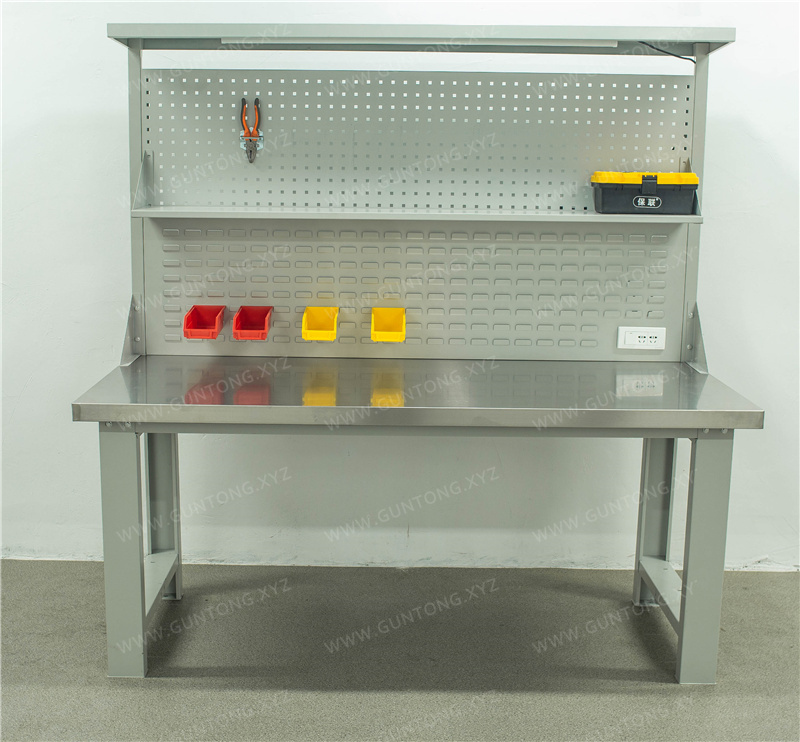
The desktop is the primary load-bearing surface. Guang'ErMei's composite desktops use a 5 mm raw steel plate bonded to 45 mm high-density fiberboard with black PVC edge banding. This structure resists point loads from heavy equipment—such as bench grinders, hydraulic presses, or large vise fixtures—far better than a single-material wood or laminate surface. The steel plate distributes concentrated forces across the fiberboard core, reducing localized deflection. Standard dimensions for heavy duty composite workbenches include 1500×750×800 mm, 1800×750×800 mm, and 2100×750×800 mm. Longer spans require additional frame cross-members to maintain the rated capacity across the full surface.
Frame Structure and Overall Stability
The frame determines whether a workbench maintains its rated capacity over years of use. C-type cold-rolled steel frames using 100×50×1.5 mm C-channel sections provide a total load capacity of 1,000 kg for standard configurations. The C-channel profile offers high moment of inertia relative to its weight, resisting both vertical bending and lateral racking forces. For workshops that experience dynamic loading—such as hammering, pressing, or impact testing—the frame's welded joint quality and floor anchoring provisions become critical. A 1,000 kg static rating does not automatically account for repeated impact forces.
Drawer and Cabinet Load Limits
Drawer load ratings are frequently misunderstood. A drawer rated for 80 kg refers to the maximum load on that single drawer with the slide rails fully extended. Key considerations include:
- Slide rail type: Single-track drawers typically open to 85% of their depth. The rail must support the full drawer load at maximum extension without binding.
- Cumulative cabinet loading: A four-drawer cabinet with each drawer loaded to 80 kg places 320 kg on the cabinet structure. The cabinet body—constructed from 1.0 mm or 1.2 mm cold-rolled steel—must resist deformation under this combined load.
- Drawer height configuration: Common configurations include 100 mm and 200 mm drawer heights. Taller drawers accommodate larger tools but shift the center of gravity higher, affecting stability when multiple drawers are open simultaneously.
Pegboard and Accessory Load Considerations
Pegboards mounted on workbench back panels add functional storage but introduce additional loading. A 500 mm standard square-hole pegboard holds hooks, tool holders, and small parts bins. While individual hook loads are small, a fully loaded pegboard can add 20–40 kg of distributed weight to the back panel structure. This load must be accounted for within the overall workbench capacity, not added on top of it.
Risk Boundaries: Where Load Capacity Misinterpretation Causes Failures
Risk 1: Concentrated Loads Exceeding Point-Load Limits
Placing a 200 kg machine at the center of a 2100 mm desktop creates a concentrated load that may exceed the desktop's point-load capacity, even though the total weight is well below the 1,000 kg rating. Solution: Position heavy equipment near frame support points and verify point-load ratings with the manufacturer.
Risk 2: Dynamic and Impact Loading
Static load ratings do not cover impact forces from hammering, drop-testing, or press operations. If your workflow involves repeated impact, request dynamic load analysis or select a workbench with a higher safety margin.
Risk 3: Asymmetric Drawer Loading
Loading one drawer to 80 kg while leaving others empty creates uneven stress on the cabinet frame. Over time, this can cause drawer misalignment and slide rail wear. Solution: Distribute heavy items across multiple drawers and avoid consistently overloading a single drawer.
Risk 4: Environmental Factors
Temperature fluctuations, humidity, and chemical exposure can affect material strength over time. Stainless steel workbenches are available for environments requiring corrosion resistance, such as food processing or cleanroom applications.
Recommendation: A Practical Load Capacity Evaluation Checklist
Before finalizing a workbench purchase, verify the following:
- Total load capacity: Confirm the overall rating meets your maximum expected load with a 20–30% safety margin.
- Desktop point-load rating: Verify the desktop can handle your heaviest concentrated load at any position on the surface.
- Drawer individual and cumulative ratings: Ensure each drawer's load rating matches your tool storage plan, and the total cabinet load stays within structural limits.
- Frame specification: Confirm the frame material and cross-section dimensions (e.g., 100×50×1.5 mm C-channel) are appropriate for your load pattern.
- Accessory loading: Account for pegboard, lighting, and shelf loads within the total capacity.
- Dynamic load considerations: If your work involves impact or vibration, request engineering guidance on appropriate safety margins. For non-standard requirements—such as extra-long spans, higher load ratings, or specialized desktop materials—custom workbench configurations are available. Guang'ErMei Precision Components provides on-site workstation planning, load-bearing design consultation, and full-process after-sales support for manufacturing customers across Guangdong Province and nationwide. Explore our Single Back Panel 4-Drawer Steel Plate Workbench for a configuration that combines a 1,000 kg rated frame with organized four-drawer tool storage. Review the Double Four-Drawer Floor Cabinet Composite Workbench for high-capacity storage with dual cabinet support.