
When to Choose Beech Wood Workbenches: Precision and Stability in Mold Debugging
Direct Conclusion
Choose a beech wood workbench when your workshop requires a stable, vibration-damping surface for mold debugging, precision fitting, or repetitive assembly tasks where surface protection and operator comfort matter. A thick finger-jointed beech top paired with a C-type cold-rolled steel frame provides consistent flatness, impact resistance, and long-term dimensional stability. For heavy stamping, direct welding, or high-temperature operations, steel plate or composite tops remain more appropriate.
Target Scenarios and Decision Triggers
Beech wood workbenches are best suited for:
- Hardware mold factories
- conducting mold debugging, polishing, and fitting where surface marring must be minimized.
- Automotive parts manufacturers
- performing precision assembly or inspection of machined components.
- Maintenance and testing institutions
- requiring a stable, non-marring platform for calibration or repair.
- Vocational college training centers
- teaching fitter skills where durability and operator safety are priorities.
First-time adopters typically consider beech tops when:
- Existing steel surfaces cause part scratches or tool slippage.
- Composite desktops show edge wear or delamination under repetitive impact.
- Operators report fatigue from hard, non-damping surfaces during extended fitting tasks.
Material and Structural Validation
Why Finger-Jointed Beech?
Finger-jointed construction balances internal stress, reducing warping and cracking compared to solid slab timber. At sufficient thickness, the top absorbs impact energy during hammering or pressing while maintaining flatness across the working zone. Beech offers fine grain density and natural oil resistance, making it suitable for environments with light lubricants or cutting fluids.
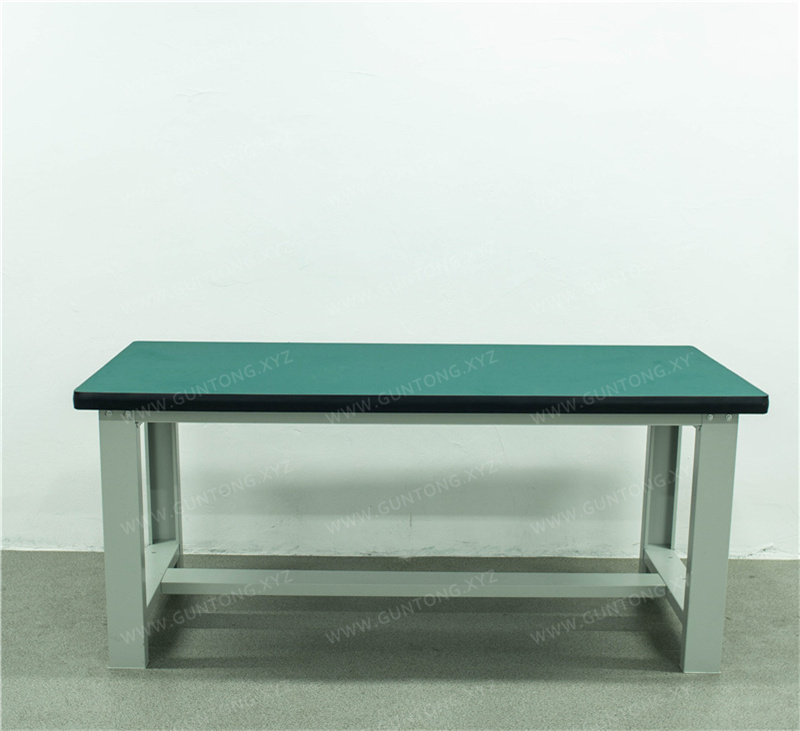
Frame Compatibility: C-Type Cold-Rolled Steel
The workbench frame must match the top's load profile. A C-type cold-rolled steel frame provides high torsional rigidity and even load distribution. Guang'ErMei's standardized frames support total load capacities up to 1000kg, with reinforced leg sections and cross-beams designed to prevent deflection under concentrated loads. When specifying, verify:
- Frame gauge and weld continuity at stress joints.
- Leveling foot adjustability for uneven workshop floors.
- Compatibility with back panels, pegboards, or under-bench storage.
Preparation and Layout Planning
Before deployment, technical evaluators should:
- Map load zones: Identify where concentrated loads (vices, pressing tools, mold halves) will sit. Distribute heavy items over frame cross-members.
- Define accessory needs: Square-hole pegboards, drawer cabinets, or lighting mounts should be specified upfront to avoid post-installation drilling that compromises structural integrity.
- Assess environmental conditions: Beech performs well in standard workshop humidity. In high-moisture or washdown areas, stainless steel or sealed composite tops are recommended instead.
- Plan for 6S integration: Align workbench placement with tool cart routes, material flow, and visual management zones. Guang'ErMei supports on-site workstation planning to optimize layout efficiency.
Implementation and Acceptance Checklist
During installation and handover, verify:
- Flatness tolerance: Measure across diagonal and longitudinal axes. Acceptable deviation should remain within standard workshop tolerances under no-load conditions.
- Joint integrity: Inspect finger-joint seams for uniform adhesion and absence of gaps. Surface sanding should be even with no splintering edges.
- Frame-to-top fastening: Confirm all mounting bolts are torqued to specification with anti-vibration washers where applicable.
- Load test: Apply rated load uniformly for a sustained period. Check for permanent deflection or frame deformation after unloading.
- Accessory function: Test drawer slides, pegboard hooks, and door hinges for smooth operation under load.
Maintenance and Lifecycle Boundaries
Beech tops require minimal but consistent care:
- Wipe spills promptly; avoid prolonged exposure to solvents or standing water.
- Light sanding and re-oiling periodically restores surface integrity in high-use zones.
- Do not use as a direct welding platform or cutting base for abrasive discs; use protective steel plates for such operations.
- Expected service life is extended in standard fitting and debugging scenarios when maintenance guidelines are followed.
When to Consider Alternatives
- Heavy stamping or forging: Specify raw steel plate composite desktops (e.g., 5mm raw steel plate + high-density fiberboard) for maximum impact resistance.
- Cleanroom or food-grade environments: Stainless steel workbenches with sealed edges meet hygiene and corrosion requirements.
- ESD-sensitive electronics assembly: Anti-static workbenches with conductive surfaces and grounding points are mandatory.
- High-density tool storage: Pair workbenches with Inner Half-Pegboard Storage Cabinets or 4-drawer tool carts for organized retrieval without cluttering the work surface.
Next Steps for Technical Evaluators
If your workshop is transitioning to beech wood workbenches for the first time, start with a pilot zone covering a few stations. Validate load performance, operator feedback, and maintenance routines before scaling. Guang'ErMei Precision Components provides standardized beech-top workbenches and non-standard customization, including dimension adjustments, accessory integration, and on-site installation. Share your layout drawings, load requirements, and environmental conditions to receive a matched configuration proposal and delivery schedule.