Custom Workbench Design Process: From Requirement to Mass Production
Custom Workbench Design Process: From Requirement to Mass Production
For manufacturing enterprises in electronics, automotive parts, hardware molds, and warehousing, a workbench is not just furniture; it is a critical node in production efficiency and safety. When standard off-the-shelf options fail to meet specific spatial, ergonomic, or load-bearing requirements, a structured custom workbench design process becomes essential.
At Guang'ErMei Precision Components, we bridge the gap between abstract workshop needs and tangible industrial equipment through a rigorous four-phase workflow: Requirement Discovery, Engineering Design, Prototyping/Validation, and Mass Production/Delivery. This article outlines this process to help procurement managers and plant engineers evaluate suitability, understand trade-offs, and plan successful implementations.
Phase 1: Requirement Discovery & Site Assessment
The foundation of any successful customization project lies in accurate data collection. Before selecting materials or dimensions, we conduct a detailed analysis of the user’s operational context.
Key Inputs for Design
- Operational Throughput & Ergonomics: We assess the frequency of tool retrieval and part handling. For example, high-frequency assembly lines may require integrated tool carts with pegboards (e.g., 4-drawer configurations) to minimize movement, while static testing stations need robust, stationary surfaces.
- Spatial Constraints: Precise measurements of the installation area, including aisle widths, door clearances, and column obstructions, are recorded to optimize footprint utilization.
- Load-Bearing Requirements: This is the most critical technical parameter. We determine the maximum static and dynamic loads. Our C-type cold-rolled steel frames are engineered to support significant weights; for instance, our standard heavy-duty models can handle up to 1000kg total load capacity, with individual drawers rated for 500kg per drawer unit where applicable.
- Environmental & Safety Standards: Factors such as ESD (Electrostatic Discharge) requirements for electronics, corrosion resistance for chemical environments, or hygiene standards for food/pharma sectors dictate material choices (e.g., stainless steel vs. powder-coated steel).
Phase 2: Engineering Design & Trade-off Analysis
Once requirements are defined, our engineering team develops detailed CAD drawings and BOMs (Bill of Materials). This phase involves balancing performance, cost, and lead time.
Standardized vs. Non-Standard Solutions
- Standardized Products:*
- If the requirement aligns with existing modular designs (e.g., our Single Back Panel Single Door 4-Drawer Steel Plate Workbenches), lead times are minimized. These units feature composite desktops (5mm raw steel plate + high-density fiberboard) and square-hole pegboards for flexible accessory mounting.
- Non-Standard Customization:*
- For unique scenarios, such as integrating automated storage accessories or specific lean pipe layouts, we design bespoke components. While this offers perfect fit, it requires longer engineering cycles and potentially higher unit costs due to lower economies of scale.
Material & Structural Decisions
We prioritize structural integrity and longevity. Common trade-offs include:
- Desktop Composition:*
- Choosing between pure steel tops (for extreme durability/heavy tools) and composite tops (for vibration dampening/cleanliness).
- Frame Geometry:*
- Selecting between square-tube frames (aesthetic/modern) and C-channel frames (high load-bearing/cost-effective).
- Storage Integration:*
- Deciding between fixed shelves, adjustable shelving (100kg/shelf capacity), or mobile drawer units based on space availability.
Phase 3: Prototyping & Validation (If Applicable)
For complex non-standard projects, we often produce a pilot unit or detailed mock-ups to validate ergonomics and assembly logic. This step allows stakeholders to verify:
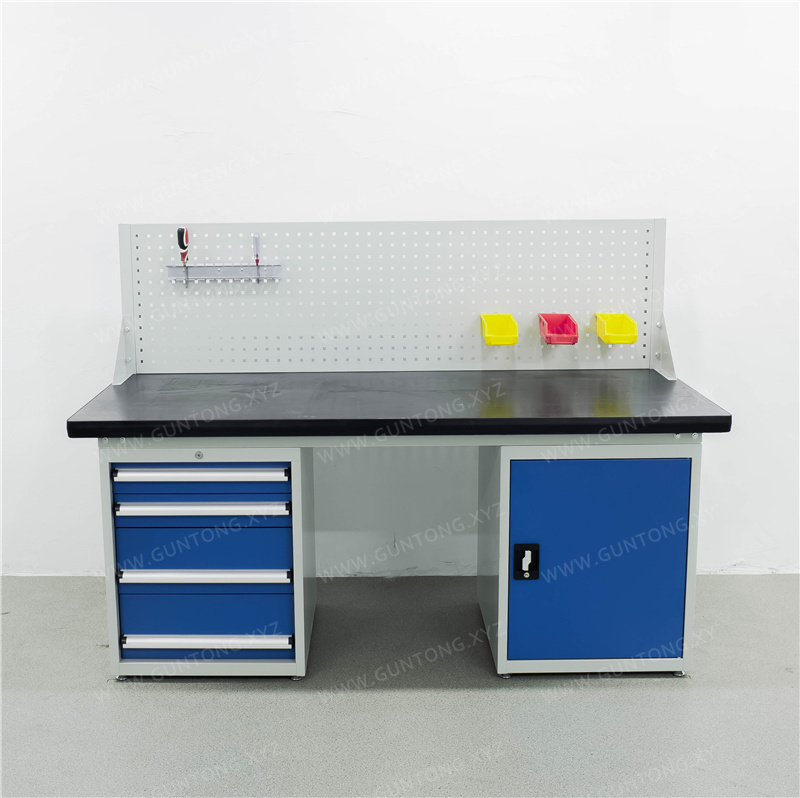
- Drawer slide smoothness under full load.
- Pegboard hole alignment for visual management tools.
- Overall stability during simulated operation.
This reduces the risk of costly rework during mass production and ensures the final product aligns with the 6S management principles adopted by many modern factories.
Phase 4: Mass Production & Quality Control
Upon approval of the design and samples, production begins. Guang'ErMei leverages its dual capability in standardized production and non-standard customization to maintain consistency.
Quality Assurance Steps
- Material Inspection: Verification of steel plate thickness (e.g., 1.0mm–1.2mm for cabinets, 5mm for desktops) and surface treatment quality.
- Assembly Precision: Ensuring weld points are smooth and structural joints are secure.
- Load Testing: Random sampling for load-bearing verification to ensure compliance with design specifications.
- Surface Treatment: Checking powder coating uniformity and adhesion for corrosion resistance.
Phase 5: Delivery, Installation & After-Sales
Delivery is coordinated to match the customer’s site readiness. Our service extends beyond shipping:
- On-Site Installation:*
- Professional teams assemble units, ensuring levelness and stability.
- Training:*
- Basic maintenance guidance for users.
- After-Sales Support:*
- Full-process service coverage, including spare parts supply and modification services if operational needs change over time.
Decision Criteria: How to Evaluate Your Supplier
When comparing manufacturers for custom workbench projects, consider these factors:
- Design Capability:*
- Can they provide 3D renderings and engineering drawings, or only basic quotes?
- Production Flexibility:*
- Do they have experience with both high-volume standard items and low-volume custom jobs?
- Application Experience:*
- Have they served your specific industry (e.g., automotive vs. electronics)?
- Service Scope:*
- Is the offer limited to product sales, or does it include planning, installation, and after-sales?
Conclusion
The custom workbench design process from requirement to mass production is a systematic journey that transforms operational challenges into efficient physical solutions. By focusing on precise requirement gathering, rational design trade-offs, and rigorous quality control, manufacturers can ensure their workstation equipment enhances productivity, supports 6S implementation, and delivers long-term value.
For enterprises seeking reliable workshop workbench customization or Huizhou workbench manufacturer services, partnering with a provider that offers full-chain support—from design to after-sales—is key to success.
Next Steps
To initiate your custom workstation project:
- Prepare Site Data: Measure available space and list specific tool/part storage needs.
- Define Load & Environment: Specify max weight per shelf/drawer and environmental conditions.
- Contact Our Team: Share your requirements for a preliminary consultation and feasibility assessment.
Get a Free Consultation | View Product Catalog