
Guang'ErMei Workbench New Configuration Release: Upgraded Drawer and Pegboard Layouts for Scaling Workshops
When Production Scales, Workbench Layouts Must Keep Up
Manufacturing teams expanding from pilot lines to full-volume output often hit a quiet bottleneck: the workstation itself. Tools multiply, part variants increase, and operators spend more time searching than assembling. Guang'ErMei's latest workbench configuration release addresses this exact friction point by introducing upgraded drawer tiers, integrated pegboard options, and reinforced composite desktops across its core product lines.
This article breaks down what changed, which scenarios benefit most, and where these configurations reach their practical limits.
What's New in the Latest Configuration Release
The new configurations focus on three areas that directly impact daily workshop efficiency:
1. Tiered 4-Drawer Systems with Higher Per-Drawer Load Capacity
Previous drawer setups used uniform heights. The new release introduces mixed-height drawer tiers, allowing operators to store small fasteners in shallow drawers and larger hand tools or gauges in deeper ones. Each drawer supports substantial load capacity, and the overall cabinet structure maintains stability even when all drawers are fully loaded.
This matters for teams running high-mix production where tool changeovers happen multiple times per shift.
2. Pegboard Integration on Cabinets and Carts
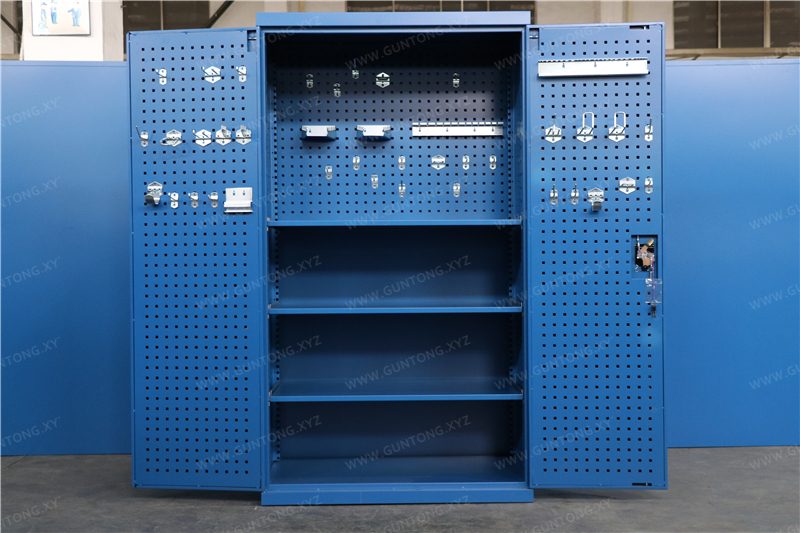
The new inner half-pegboard storage cabinet and pegboard-equipped tool carts add a standard square-hole pegboard zone. This enables visual tool management—operators can see at a glance whether a tool is missing, which supports 6S compliance without extra signage or shadow boards.
For workshops already running lean management programs, this eliminates the need to retrofit separate pegboard panels after installation.
3. Composite Steel Desktop Reinforcement
The upgraded desktop structure combines a raw steel plate with high-density fiberboard and black PVC edge banding. The C-type cold-rolled steel frame delivers high total load capacity. This configuration targets heavy-duty fitting, mold maintenance, and automotive parts inspection where both impact resistance and surface flatness are required.
Who Should Consider These Configurations
| Scenario | Recommended Configuration | Why It Fits |
|---|---|---|
| Electronics assembly with frequent tool changes | 4-drawer tool cart with pegboard | Mixed drawer heights + visual pegboard reduce retrieval time |
| Automotive parts inspection stations | Single back panel 4-drawer steel plate workbench | High load capacity handles heavy gauges and sample parts |
| Hardware mold maintenance bays | Inner half-pegboard storage cabinet | Dual pegboard layout on door + adjustable shelves supports heavy mold components |
| Vocational training centers | Any 4-drawer configuration | Tiered storage teaches organized workflow habits to trainees |
| Warehousing and logistics packing stations | Pegboard storage cabinet | Adjustable shelves + pegboard accommodate changing packaging tool sets |
Decision Checklist Before Ordering
Before specifying these new configurations for your facility, verify the following:
- [ ] Floor space: Confirm the footprint fits your current layout with adequate clearance for operator movement. Common workbench lengths include multiple standard options; cabinets and carts follow compact footprints suitable for aisle-side placement.
- [ ] Load requirements: If your heaviest single item exceeds the per-drawer rating, it should sit on the desktop or a dedicated shelf—not in a drawer.
- [ ] ESD sensitivity: These configurations use steel and fiberboard. If your line handles static-sensitive components, you need an anti-static worktop variant instead.
- [ ] Pegboard tool weight: Standard square-hole pegboard hooks support hand tools and light fixtures. Heavy power tools require dedicated bracket mounts.
- [ ] Expansion plans: If you anticipate adding automated storage and retrieval systems (such as Miniload tote-based systems), ensure workbench placement leaves aisle clearance for future integration.
---
Boundaries and Limitations
These configurations are engineered for indoor workshop environments with standard temperature and humidity ranges. They are not designed for:
- Cleanroom environments requiring stainless steel-only construction (though Guang'ErMei offers separate stainless steel workbench lines for those cases).
- Outdoor or high-corrosion settings without additional surface treatment specifications.
- Load scenarios exceeding the rated total capacity on the workbench frame or the per-shelf rating in storage cabinets.
Custom dimensions beyond the standard range are available through non-standard customization, but lead times and structural validation requirements will differ from catalog configurations.
Next Steps
If your facility is scaling production and current workstations are causing tool retrieval delays or 6S audit findings, these new configurations offer a direct upgrade path. To move forward:
- Audit your current workstation pain points—note which tools are most frequently searched for and which surfaces show the most wear.
- Match scenarios to configurations using the table above.
- Request a site-specific workstation plan that accounts for your floor layout, load requirements, and any planned automation integration.
Guang'ErMei supports on-site workstation planning, load-bearing design validation, and full-process after-sales service across Guangdong Province and nationwide delivery regions.