
Guang'ErMei Workbench Manufacturing Process Improvement: Upgraded Stages and Validation Process
In industrial manufacturing environments, a workbench is not just a table; it is a critical node in the production workflow. For facility managers and procurement specialists in the electronics, automotive, and hardware mold sectors, the reliability of workstation equipment directly impacts operational continuity. This technical log documents the recent process improvements at Guang'ErMei Precision Components, focusing on the manufacturing logic, validation stages, and technical boundaries of our heavy-duty steel plate workbenches and tool storage systems.
Scenario Diagnosis: Why Process Upgrades Were Necessary
The decision to upgrade our manufacturing process was driven by field feedback from high-stress environments, particularly automotive parts manufacturing and hardware mold maintenance. In these scenarios, workbenches are subjected to dynamic loads, impact from heavy tooling, and continuous usage.
Standard industry practices often rely on simple angle-iron welding or thin-gauge steel tops that may deform under concentrated point loads. Our internal review identified two primary failure points in legacy designs:
- Desktop Delamination: Separation of the steel surface from the substrate under thermal cycling or heavy impact.
- Frame Racking: Lateral instability in the leg assembly when heavy drawers or pegboards are fully loaded.
Upgraded Manufacturing Stages and Technical Logic
To address these boundaries, Guang'ErMei has implemented specific process controls across three critical stages of production.
1. Composite Desktop Lamination Protocol
For our Single Back Panel Single Door 4-Drawer Steel Plate Workbench, the desktop is the primary wear surface. The upgraded process utilizes a raw steel plate bonded to a high-density fiberboard core.
- Process Logic:*
- The steel plate provides impact resistance and a flat datum surface for precision assembly, while the fiberboard core dampens vibration and reduces the overall weight compared to solid steel blocks.
- Edge Banding Validation:*
- We use black PVC edge banding not just for aesthetics, but to seal the composite core against industrial coolants and moisture ingress, which can cause substrate swelling in humid workshop environments.
2. C-Type Cold-Rolled Steel Frame Welding
The structural integrity of a heavy-duty workbench depends on the leg profile. We have transitioned to a C-type cold-rolled steel frame design.
- Load Capacity Boundary:*
- This profile geometry increases the moment of inertia, allowing the frame to support substantial static loads without permanent deformation, meeting the demands of heavy-duty workshop applications.
- Welding Standards:*
- All critical joints are MIG-welded with specific penetration depths verified by visual inspection and periodic destructive testing of sample batches.
3. Drawer and Pegboard Integration
For mobile and storage units like the 4-Drawer 1-Door Tool Cart with Pegboard, the integration of moving parts requires tighter tolerances.
- Drawer Load Logic:*
- Each drawer is engineered for heavy-duty tool storage. The manufacturing process now includes a reinforced slide-rail mounting stage to prevent rail tear-out under full extension.
- Pegboard Modularity:*
- The standard square-hole pegboard is laser-cut to ensure hole alignment, allowing for flexible expansion of tool hooks without compromising the back panel's structural rigidity.
Validation Process and Quality Checkpoints
A manufacturing process is only as reliable as its validation. Our updated quality control log includes the following mandatory checkpoints before any workstation equipment leaves the Huizhou facility:
- Static Load Test:*
- Every batch of heavy-duty workbenches undergoes a static load test exceeding the rated capacity for an extended duration to check for frame creep.
- Drawer Cycle Testing:*
- Drawers in tool cabinets and carts are cycled repeatedly under rated load to validate the slide mechanism and handle durability.
- Surface Flatness Check:*
- The steel plate surfaces are checked for flatness deviations to ensure they meet the requirements for precision assembly tasks in electronics and testing institutions.
Applicable Boundaries and Selection Advice
While these process improvements significantly enhance durability, buyers must match the equipment to the specific application scenario:
- Heavy Machinery & Mold Repair:*
- The steel plate composite top is recommended. Avoid standard laminate or thin-steel tops for these high-impact environments.
- Electronics & ESD Sensitive Areas:*
- While the steel top is durable, it is conductive. For ESD-sensitive assembly, specify our anti-static workbench variants with specialized grounding paths.
- Warehousing & Logistics:*
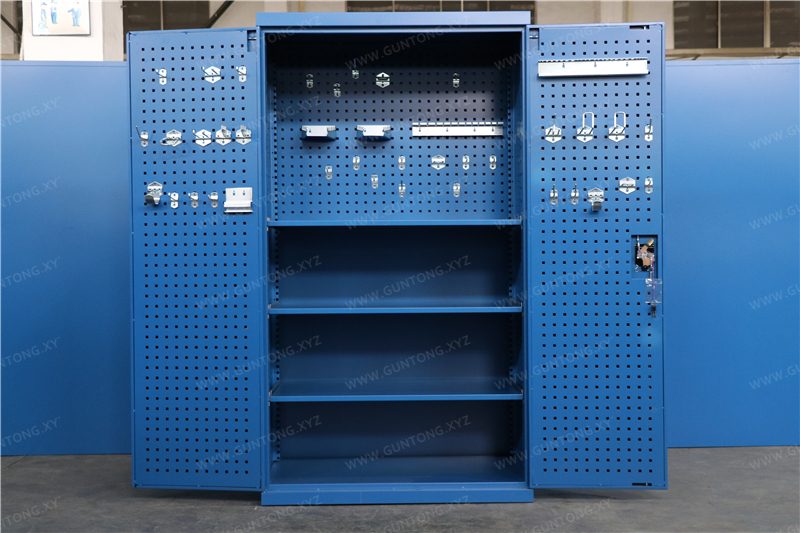
- For high-throughput picking, consider the Pegboard Storage Cabinet (Inner Half-Pegboard Type), which offers adjustable shelf capacity and visual management through the square-hole layout.
Conclusion and Next Steps
The Guang'ErMei workbench manufacturing process improvement log reflects a shift from generic fabrication to engineered workstation solutions. By controlling the lamination of steel plates, optimizing C-type cold-rolled frames, and enforcing strict validation checkpoints, we provide equipment that meets the rigorous demands of modern manufacturing.
For technical specifications or to discuss a custom workstation layout for your facility, please review our detailed product sheets or contact our engineering team for a site-specific load-bearing assessment.