
How Internal Design Reviews Are Conducted for Custom Workbenches
When manufacturing enterprises order custom workbenches for electronics assembly, automotive parts handling, or hardware mold maintenance, the gap between a conceptual drawing and a production-ready design can introduce costly errors. Guang'ErMei Precision Components addresses this through a structured internal design review process that validates every custom workbench drawing before it reaches the shop floor.
This article explains the operating logic, checkpoints, and applicable boundaries of the Guang'ErMei custom workbench design drawing review log, based on our documented engineering workflow for standardized and non-standard workstation equipment.
Who Needs a Formal Drawing Review?
Not every workbench order requires an intensive design review cycle. The process is triggered primarily under these conditions:
- Non-standard dimensions: When the requested length, width, or height falls outside common configurations such as 1500×750×800 mm or 2100×750×800 mm.
- Elevated load requirements: When the total load capacity target exceeds standard C-type cold-rolled steel frame ratings, or when point loads from heavy fixtures must be accounted for.
- Composite desktop specifications: When the desktop structure involves layered materials—such as a raw steel plate bonded to high-density fiberboard with PVC edge banding—and the bonding method or edge treatment must be verified.
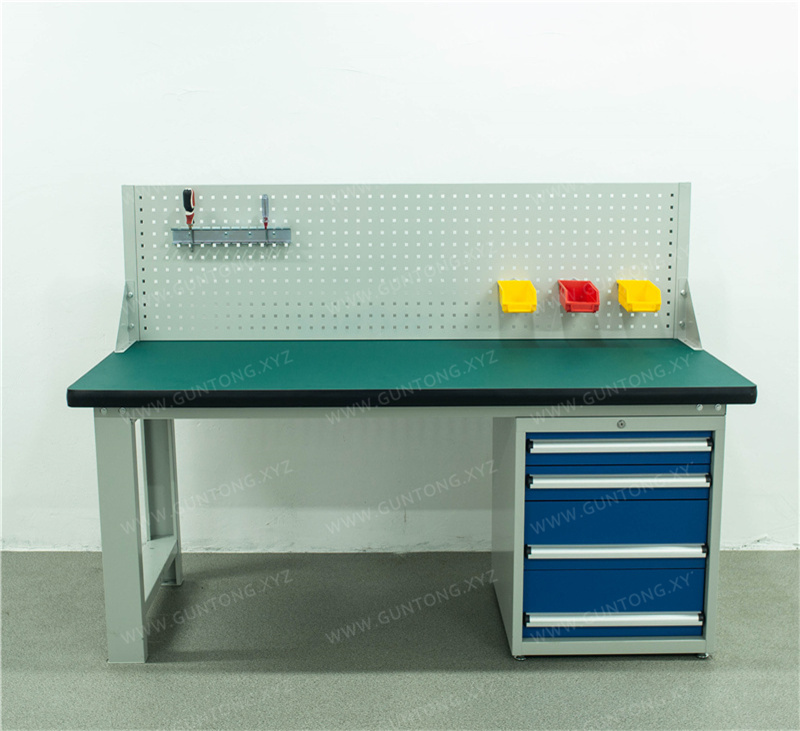
- Integrated storage configurations: When the workbench includes drawer tiers, pegboard back panels, or cabinet modules that affect the center of gravity and overall stability.
For standard catalog products like the Single Back Panel Single Door 4-Drawer Steel Plate Workbench, the review focuses on configuration matching rather than structural recalculation.
The Review Log Structure: What Gets Checked
The Guang'ErMei custom workbench design drawing review log follows a sequential checkpoint system. Each checkpoint must be cleared before the drawing advances to the next stage.
Checkpoint 1: Dimensional and Spatial Validation
The engineering team verifies that all overall dimensions (L×W×H), working height, and clearance tolerances align with the customer's facility layout. This includes:
- Confirming that the workbench footprint fits the designated workstation cell without obstructing adjacent lean pipe racks or automated storage and retrieval system (Miniload) aisles.
- Checking that the working surface height plus any back panel height does not interfere with overhead lighting, ventilation, or crane travel paths.
- Validating drawer extension clearance and door swing radius for single-door four-drawer composite workbench configurations.
Checkpoint 2: Load-Bearing Design Verification
Load capacity is the most critical structural parameter. The review log documents:
- Total frame load rating: For C-type cold-rolled steel frames, the standard rating is 1000 kg. If the customer's application involves concentrated loads—such as a heavy press mounted at one end of the desktop—the review flags the need for localized reinforcement or a heavier gauge frame.
- Drawer load rating: Each drawer in a 4-drawer tiered configuration is typically rated for 80 kg. The review confirms that the stamped steel drawer slides and bottom panels match this specification.
- Shelf load rating: For integrated storage cabinets, adjustable shelves are rated at 100 kg per shelf. The review ensures that the shelf support brackets and cold-rolled steel gauge are correctly specified.
Checkpoint 3: Material and Surface Specification Audit
The desktop structure directly determines service life and suitability for the target environment. The review log captures:
- Steel plate composite desktops: Verification that the raw steel plate + high-density fiberboard + black PVC edge banding specification is correctly noted, and that the bonding method is suitable for the expected thermal and humidity conditions.
- Stainless steel workbenches: Confirmation of stainless steel grade, surface finish, and welding requirements for cleanroom or food-grade environments.
- Anti-static workbenches: Validation that ESD-safe laminates and grounding points are specified for electronics assembly scenarios.
Checkpoint 4: Configuration and Accessory Compatibility
Custom workbenches often integrate multiple storage and tool management modules. This checkpoint ensures:
- Square-hole pegboard back panels are compatible with the selected hook and tool holder inventory.
- Drawer divider configurations match the customer's tool size profile.
- Any double four-drawer floor cabinet composite workbench modules are structurally balanced to prevent tipping under full load.
Checkpoint 5: 6S and Lean Manufacturing Adaptation
For customers implementing 6S workplace management, the review log includes a visual management compliance check:
- Color coding for drawer fronts and cabinet doors matches the customer's 6S standard.
- Label slots, shadow boards, and tool outline markings are positioned for at-a-glance inventory control.
- Turnover rack interfaces (for automotive parts scenarios) align with the customer's existing tote dimensions and automated retrieval system specifications.
Operating Logic: How the Review Log Flows
The review process follows a linear approval chain:
- Initial drawing submission: The sales engineer submits the customer's requirement sheet and preliminary CAD drawing to the design team.
- First-pass review: The design engineer performs Checkpoints 1 through 3, annotating any discrepancies or required clarifications in the review log.
- Customer confirmation loop: If changes are needed, the revised drawing is sent back to the customer for approval. This loop may repeat until all structural and dimensional parameters are locked.
- Final configuration review: Checkpoints 4 and 5 are completed once the base structure is approved.
- Production release: The signed review log accompanies the drawing package to the manufacturing floor, serving as the quality baseline for incoming material inspection and final assembly verification.
Applicable Boundaries and Limitations
The internal design review log is a process control document, not a substitute for on-site workstation planning. Certain conditions fall outside its scope:
- Facility structural constraints: Floor load capacity, column spacing, and utility routing must be verified through a separate site survey.
- Regulatory certifications: If the customer requires specific safety certifications, the review log flags the requirement but does not constitute certification.
- Post-installation modifications: Any field modifications made after delivery are not covered by the original review log and require a separate engineering assessment.
Next Steps for Procurement and Engineering Teams
If your project involves non-standard workbench dimensions, elevated load requirements, or integrated storage configurations, request a formal design review at the quotation stage. Provide the following inputs to accelerate the process:
- Facility layout drawing with workstation cell dimensions.
- Maximum expected load per workbench, including point load locations.
- Tool and material inventory list for drawer and pegboard configuration planning.
- Any existing 6S or lean manufacturing standards that must be reflected in color coding and labeling.
Guang'ErMei's engineering team supports full-chain service from product design and manufacturing to on-site installation and after-sales, covering manufacturing customers in Huizhou and Guangdong Province with nationwide project delivery capability.