
Before Choosing a Double Pegboard Stainless Steel Workbench: What Cost and Value Reveal
Before Choosing a Double Pegboard Stainless Steel Workbench: What Cost and Value Reveal
Manufacturers upgrading their assembly, repair, or tool management stations often face a recurring dilemma: should they opt for a standardized double pegboard stainless steel workbench, or invest in a custom-configured solution? While upfront pricing may favor off-the-shelf models, long-term operational costs and productivity gains depend on deeper factors—many of which are overlooked during procurement.
This article uses a diagnostic approach to help decision-makers in electronics, automotive parts, hardware mold, and maintenance facilities evaluate whether a standard model meets actual workflow demands—or if non-standard customization delivers better lifecycle value.
Symptom: Tools Are Harder to Access, Misplaced, or Damaged
In high-frequency use environments such as electronics assembly lines or automotive component repair bays, technicians report increasing delays due to:
- Extended search times for frequently used tools
- Improper storage leading to tool wear or contamination
- Inflexible layouts that don’t align with current 6S organization standards
These symptoms suggest the existing workstation lacks optimized visual management and ergonomic zoning—problems a double pegboard configuration is designed to solve.
However, simply adding two pegboards does not guarantee improvement. The real issue often lies not in the presence of pegboards, but in their placement, structural support, and compatibility with existing tool sets.
Cause: Mismatch Between Standard Models and Operational Realities
Many manufacturers assume that any stainless steel workbench with dual square-hole pegboards will suffice. But standard configurations may fall short when:
- Pegboard height or mounting position doesn’t match technician reach zones
- Cabinet or drawer load ratings are exceeded by heavy tool sets
- Desktop structure cannot withstand impact or chemical exposure common in repair workshops
For example, while some models feature cold-rolled steel frames rated for high total load capacity, this assumes even weight distribution. Concentrated loads from power tools or molds can exceed localized stress limits if not properly supported.
Moreover, standard dimensions may not fit into constrained spaces or integrate with adjacent lean pipe assemblies or automated storage systems.
Checks: Key Parameters to Verify Before Selection
To avoid costly mismatches, verify these four aspects before finalizing a purchase:
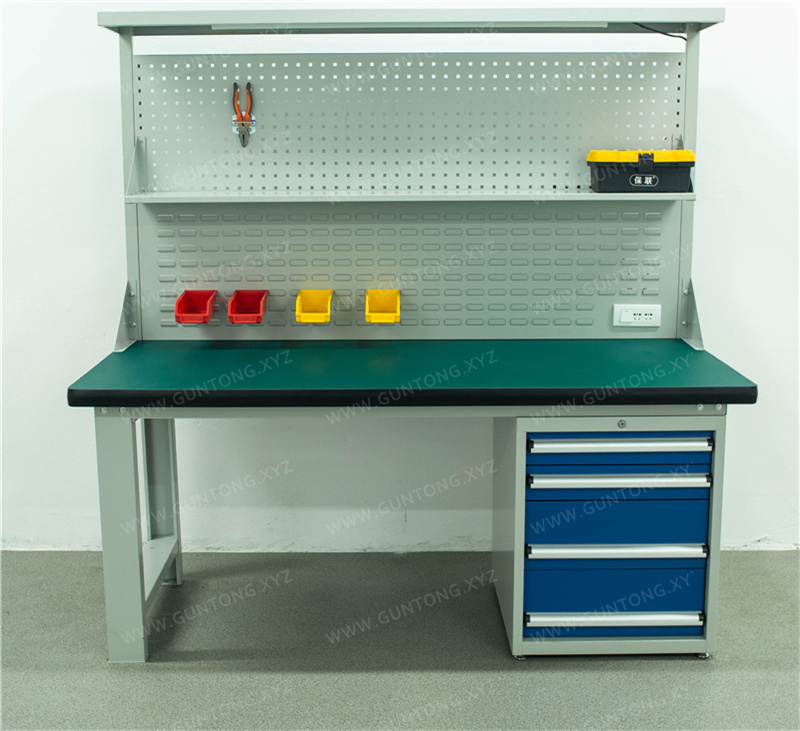
1. Desktop Composition and Load Distribution
Look for composite desktops combining raw steel plate with high-density fiberboard and edge banding. This structure supports heavy-duty use while protecting against deformation. Ensure the frame—typically C-type cold-rolled steel—is engineered for full-load stability across extended lengths.
Fact check: Some Guang'ErMei workbenches use composite desktop construction with high total load capacity.
2. Pegboard Integration and Flexibility
Confirm that both front and rear pegboards are mounted on reinforced backing plates to prevent sagging under prolonged load. Each square-hole panel should allow reconfigurable hooks and bins to adapt to changing tool inventories.
Also assess clearance behind the rear panel—especially in tight workshop layouts—where protruding tools could create safety hazards.
3. Drawer and Storage Configuration
Evaluate whether tiered drawer setups support your tool categorization needs. Individual drawers with substantial load ratings provide reliable performance, but only if paired with ball-bearing slides and proper alignment mechanisms.
If your facility uses mixed storage (hand tools, gauges, small parts), consider hybrid units combining drawers, doors, and internal half-pegboard shelves—all adjustable to evolving workflows.
Fact check: Certain Guang'ErMei tool carts specify load capacity per drawer, with documented configurations including casters and modular storage elements.
4. Material Suitability and Environmental Resistance
Stainless steel components offer corrosion resistance ideal for cleaning-intensive or humid environments. However, confirm whether the finish meets hygiene requirements in food-grade or medical device production areas.
Cold-rolled steel bodies provide structural integrity for general industrial use but require protective coating in corrosive settings.
Resolution: Choose Based on Application-Specific Customization
The optimal choice isn't always the cheapest or most feature-rich model—it's the one aligned with your specific operational context.
Guang'ErMei Precision Components offers solutions that combine standardized production efficiency with non-standard adaptability. Their design process includes:
- On-site workstation planning and space assessment
- Load-bearing analysis based on actual tool inventory
- 6S compliance mapping for visual management
- Full-cycle service from drafting to installation
This means you can start with a base model and upgrade it with dual pegboards, anti-static surfaces, or mobile casters based on real workflow data.
Such modular evolution reduces initial investment risk while ensuring scalability.
Escalation Boundary: When to Engage Direct Engineering Support
If your application involves:
- Loads exceeding typical shelf or tote limits
- Integration with automated storage and retrieval systems (AS/RS)
- Specialized environments requiring ESD-safe or stainless steel-only construction
…then off-the-shelf specifications are insufficient. These cases require direct consultation with engineering teams to validate structural drawings, material certifications, and installation protocols.
Standard catalogs do not cover all combinations. Final configurations must be confirmed via technical review and site-specific documentation.
Conclusion
The true value of a double pegboard stainless steel workbench lies not in its list price, but in its ability to reduce downtime, improve traceability, and scale with operational changes. By diagnosing workflow pain points early and verifying critical design parameters, manufacturers can make cost-effective decisions that deliver lasting returns.
Avoid treating workbenches as commodities. Treat them as engineered assets—integral to lean operations, safety compliance, and workforce efficiency.
Next Step
Contact Guang'ErMei’s technical team for a no-obligation workspace assessment. Share your tool inventory, floor plan, and 6S goals to receive a tailored proposal—including load calculations and layout options—for your next workstation upgrade.