
Executing the Implementation Process for Custom Double Pegboard Stainless Steel Workbenches: A Buyer’s Decision Checklis
Implementation Process Overview
Deploying a double pegboard stainless steel workbench across electronics assembly lines, automotive parts stations, hardware mold shops, or maintenance bays requires a disciplined implementation process. Rather than treating the unit as a standalone furniture item, manufacturers must evaluate how the workstation integrates with existing floor plans, material flow patterns, and 6S management standards. This checklist guides procurement and engineering teams through configuration validation, site preparation, and handover protocols.
Must-Haves: Structural Capacity and Spatial Alignment
Before evaluating storage layouts or surface finishes, confirm the baseline parameters that dictate whether the workstation can safely support your daily operations.
- Frame and Load Verification: Heavy-duty workshop applications typically require C-type cold-rolled steel frames paired with reinforced composite desktops. These configurations are engineered to handle verified total load capacities of up to 1000 kg when properly distributed. Always cross-reference your heaviest tools, fixtures, and raw materials against the manufacturer’s load charts.
- Dimensional Compatibility: Standard workshop footprints frequently utilize lengths of 1500, 1800, or 2100 mm, combined with consistent depth and height profiles. Measure aisle clearances, door thresholds, and overhead obstructions before finalizing the order to avoid assembly bottlenecks.
- Surface Specification Matching: Environments demanding corrosion resistance, chemical spill tolerance, or cleanroom compliance require genuine stainless steel tops. For general assembly or inspection tasks, high-density composite laminates provide cost-effective durability. Confirm the exact material grade and thickness against your quality control requirements.
Optional Factors: Workflow Zoning and 6S Integration
Once structural and spatial baselines are locked, layer in configuration options that directly impact operator efficiency and visual management.
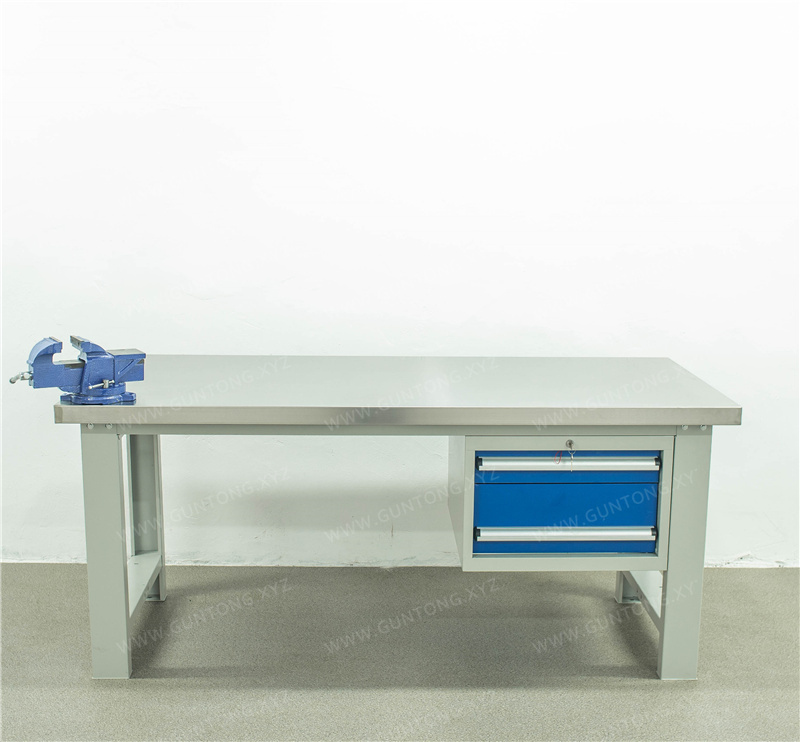
- Pegboard Layout and Reinforcement: A double-sided pegboard arrangement improves tool accessibility but shifts stress distribution across the back panel. Ensure the mounting system accommodates your intended hanging weight and allows for modular repositioning without compromising panel rigidity.
- Storage and Retrieval Mapping: Tiered drawer systems, open shelving, and cabinet modules should be sequenced according to part usage frequency. High-turnover items belong within arm’s reach, while bulk inventory moves to lower tiers or adjacent rolling carts. Square-hole pegboards enable rapid reconfiguration for jigs, gauges, or fastener bins.
- Specialized Add-Ons: Anti-static desktop coatings or grounded metal pathways are mandatory for sensitive electronics handling. Mobile variants with calibrated casters and integrated brakes suit rotating maintenance crews, whereas fixed installations anchor dedicated assembly cells. Power, data, and lighting drops must be coordinated with the workstation footprint during the planning phase.
Risks and Delivery Boundaries
Implementation failures typically originate from unverified site conditions or misaligned load assumptions. Recognizing these boundaries early prevents rework and protects warranty coverage.
- Floor Flatness and Anchoring: Uneven concrete or raised flooring can compromise frame stability and drawer alignment. Verify anchor point availability and request shimming or leveling hardware if the substrate falls outside standard tolerances.
- Center-of-Gravity Shifts: Adding heavy vises, secondary worktops, or automated storage accessories alters the unit’s balance. Custom modifications require updated engineering drawings to recalculate stress points and fastener torque specifications.
- Installation Scope Clarification: Factory delivery covers standard crate unpacking and bolt-together assembly. Site-specific tasks such as electrical grounding, custom cutting, or integration with existing conveyor lines fall outside standard installation packages unless explicitly contracted. Final tolerances, mounting hardware, and integration points remain subject to confirmed project documentation.
Long-Term Support and Validation
A successful deployment extends beyond the initial sign-off. Post-installation validation ensures the workstation performs reliably under production cycles.
- Handover Inspection: Verify levelness, drawer glide smoothness, pegboard anchoring torque, and caster brake engagement before approving the installation. Document any deviations immediately for factory adjustment.
- Preventive Maintenance: Schedule periodic checks for fastener tightness, track lubrication, and surface wear. Clean stainless steel tops with compatible agents to preserve finish integrity and prevent galvanic corrosion.
- Scalability Planning: Standardized modular components simplify future line expansions or layout reconfigurations. Maintain a master configuration log to streamline replacement orders and minimize downtime during upgrades.
Conclusion
The implementation process for custom double pegboard stainless steel workbenches succeeds when structural specs, workflow zoning, and site constraints are validated upfront. Apply this buyer decision checklist to filter configuration options, define delivery boundaries, and secure a deployment that supports immediate throughput and long-term adaptability. Contact our technical team to review your floor plan, load requirements, and 6S targets. We will return a tailored configuration matrix, installation checklist, and delivery timeline aligned with your production schedule.