
Guang'ErMei Beech Wood Workbench Manufacturing and Top Surface Inspection Record
Who This Log Is For
This record is intended for technical evaluators and workshop planners in manufacturing enterprises, electronics and electrical appliance factories, automotive parts producers, and vocational training centers who are considering a beech wood top workbench for their next workstation upgrade or replacement cycle. If your team is comparing worktop materials or preparing to deploy new benches on the shop floor, the checkpoints below clarify what to expect from a Guang'ErMei beech wood workbench in terms of build quality, surface integrity, and practical application limits.
Beech wood worktops are commonly specified in environments that require a balance between surface hardness, vibration dampening, and aesthetic cleanliness—such as precision assembly stations, electronics testing benches, and school practical training workshops. Unlike a single back panel single door 4-drawer steel plate workbench designed for heavy metalworking loads, beech top configurations serve medium-duty scenarios where operators handle smaller components, instruments, or sub-assemblies.
Step 1: Raw Material Receiving and Moisture Verification
Before any machining begins, incoming beech lumber batches are staged in the material preparation zone. The primary checkpoint at this stage is moisture content verification. Beech wood that has not been properly kiln-dried or acclimatized to the local humidity level is prone to warping, splitting, or surface checking after installation.
Inspection actions:
- Moisture meter readings are taken at multiple points across sample boards from each batch.
- Boards showing visible end-grain cracks, fungal staining, or excessive bowing are segregated.
- Acceptable stock is moved to the conditioning area to stabilize before cutting.
Boundary note: Guang'ErMei's production facility in Huizhou, Guangdong Province, operates in a subtropical climate. Seasonal humidity swings mean that moisture equilibrium targets must be adjusted throughout the year. Buyers in drier or colder regions should confirm that the worktop has been conditioned to match their facility's ambient environment, or plan for a post-delivery acclimatization period.
Step 2: Cutting, Planing, and Edge Profiling
Once the beech stock passes moisture inspection, it moves to the CNC cutting and planing stage. The goal here is to achieve uniform thickness and a flat reference surface across the entire worktop panel.
Key process points:
- Boards are ripped and cross-cut to the target workbench dimensions based on the buyer's order specifications.
- A thickness planer brings all laminated strips to a consistent gauge.
- Edge profiling is applied—typically a slight chamfer or rounded edge—to reduce the risk of chipping during daily use and to improve operator comfort when leaning against the bench front.
Exception handling: If a board exhibits internal stress release (visible as movement after the first cut), it is re-measured and, if necessary, replaced before lamination. This prevents a finished top from developing a twist that would compromise flatness under load.
Step 3: Lamination and Pressing
For worktops wider than a single board, edge-glued lamination is used to build the full panel width. This stage directly affects the long-term flatness and load distribution of the beech top.
Process controls:
- Adhesive is applied uniformly to mating edges, and boards are clamped in a hydraulic or mechanical press.
- Pressing time and pressure are set according to the adhesive manufacturer's specifications and the ambient temperature on the production floor.
- After pressing, the laminated panel rests for a defined curing period before any further machining.
Risk to watch: Insufficient curing time before sanding or frame assembly can lead to joint line telegraphing—visible ridges along the glue lines that appear weeks after delivery. Guang'ErMei's production scheduling accounts for this curing window to minimize post-installation surface complaints.
Step 4: Surface Sanding and Finish Application
The sanded surface is where the operator interacts with the workbench daily, so this stage receives focused attention.
Sanding sequence:
- Coarse grit sanding removes planer marks and levels any minor lamination unevenness.
- Progressive finer grits produce a smooth, splinter-free surface suitable for precision assembly or inspection work.
- Dust extraction is maintained throughout to prevent particle embedding in the wood grain.
Finish options and boundaries:
- A clear sealant or light oil finish may be applied to protect against moisture ingress and minor staining. The specific finish type depends on the buyer's application: electronics assembly environments may require low-VOC or anti-static-compatible coatings, while general mechanical workshops may accept a standard polyurethane seal.
- Beech is not inherently chemical-resistant. If the workstation will be exposed to solvents, cutting fluids, or aggressive cleaning agents, a composite desktop with steel plate overlay is a more appropriate choice.
---
Step 5: Frame Assembly and Load-Bearing Integration
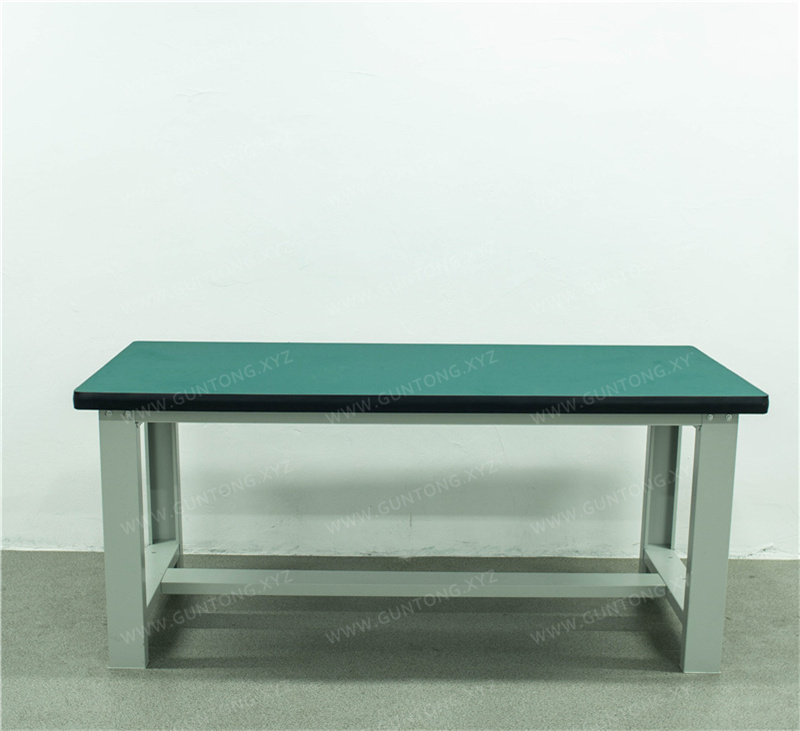
The beech top is mounted onto the workbench frame—typically a C-type cold-rolled steel structure consistent with Guang'ErMei's standard workbench platform. The frame provides the primary load-bearing capacity, while the wood top serves as the functional work surface.
Assembly checkpoints:
- Frame squareness is verified before the top is fastened, ensuring that the beech panel sits flat without induced stress.
- Mounting hardware (bolts or threaded inserts) is torqued to specification to prevent loosening under vibration.
- Leveling feet or adjustable pads are installed to allow on-site compensation for uneven workshop floors.
Load context: Beech wood tops are suited for medium-duty applications. For workstations requiring heavy-duty load capacities or involving heavy impact work (such as fitter or mold-repair benches), a raw steel plate composite desktop is the recommended configuration. Beech tops perform best in the light-to-medium load range where surface feel, noise reduction, and component protection are priorities.
Step 6: Final Surface Inspection and Documentation
Before packaging, each beech worktop undergoes a visual and tactile inspection under controlled lighting.
Inspection criteria include:
- Flatness:*
- A straightedge is placed across the surface diagonally and along the length. Gaps beyond the acceptable tolerance are flagged for rework.
- Surface defects:*
- Knots, resin pockets, sanding scratches, or glue squeeze-out that was not cleaned during pressing are documented and addressed.
- Edge integrity:*
- Chamfers and rounded edges are checked for consistency and smoothness.
- Dimensional accuracy:*
- Length, width, and thickness are measured against the order specification.
Each inspected unit is logged with its inspection result, date, and operator identifier. This manufacturing log ensures traceability from raw material batch through to finished workbench.
Application Boundaries: Where Beech Tops Fit—and Where They Don't
| Scenario | Beech Wood Top Suitable? | Recommended Alternative |
|---|---|---|
| Electronics assembly and testing | Yes | — |
| Precision instrument calibration | Yes | — |
| Vocational school training workshops | Yes | — |
| Heavy fitter or metalworking benches | No | Steel plate composite top |
| Chemical or solvent-heavy environments | No | Stainless steel or chemical-resistant laminate |
| High-humidity washdown areas | No | Stainless steel workbench |
Next Steps for Buyers Evaluating Beech Wood Workbenches
- Confirm your load and environment requirements. Match the worktop material to the actual tasks, tools, and substances present at the workstation.
- Request the dimensional and finish specification sheet for the specific beech workbench model you are considering, including available edge profiles and coating options.
- Discuss on-site conditions with Guang'ErMei's planning team. Factors such as floor flatness, ambient humidity, and workflow layout affect both the workbench configuration and the long-term performance of a solid wood top.
- Plan for acclimatization if shipping to a different climate zone. Allow the worktop to stabilize in the installation environment before final leveling and anchoring.
For a detailed comparison of worktop materials across your workstation fleet, or to request a site-specific quotation, contact Guang'ErMei Precision Components directly through the official website inquiry channel.