
What to Look for When Buying a Heavy-Duty Workbench for Industrial Use
When a production line, maintenance bay, or tooling area needs a work surface that can handle heavy components, repeated impact, and years of daily use, a standard light-duty table will not hold up. The decision comes down to understanding how a heavy-duty workbench is built, what it can realistically support, and whether the supplier can adapt it to your specific workflow.
This guide walks through the key evaluation criteria for heavy-duty industrial workbenches, drawing on real product specifications from Guang'ErMei Precision Components' workstation equipment range. It is written for manufacturing engineers, maintenance managers, and procurement teams who need to compare options without guesswork.
Who Needs a Heavy-Duty Workbench?
Heavy-duty workbenches are not limited to one industry. They appear wherever the work surface must bear concentrated loads, resist deformation, and remain stable under dynamic forces. Common application scenarios include:
- Automotive parts manufacturing and assembly: supporting engine components, transmission parts, and heavy fixtures during fitting or inspection.
- Hardware mold maintenance and repair: holding molds and die sets that can weigh several hundred kilograms.
- Electronics and electrical appliance production: where anti-static properties may be required alongside structural strength for testing large assemblies.
- Maintenance and testing institutions: providing a rigid, flat reference surface for measurement and teardown tasks.
- Vocational training centers: where workbenches must survive student use while demonstrating real industrial standards.
If your daily work involves placing heavy items on the same surface repeatedly, or if you use vises, presses, or hammering operations directly on the bench, you are in heavy-duty territory.
Criterion 1: Frame Construction and Total Load Capacity
The frame is the backbone of any heavy-duty workbench. Look beyond a single "maximum load" number and ask two questions: what is the total static load capacity, and how is the frame engineered to resist twisting and sagging over time?
For example, Guang'ErMei's single back panel steel plate workbench uses a C-type cold-rolled steel frame with a rated total load capacity of 1000 kg. This rating is not just a material thickness claim—it reflects the structural design of the leg assemblies, cross-bracing, and welded joints working together.
When comparing options, check:
- Whether the load rating applies to the entire work surface or only to a concentrated area.
- Whether the frame uses formed C-channel sections or simple angle iron—C-channel resists bending better under heavy point loads.
- Whether the legs include leveling feet with sufficient thread diameter to transfer load to the floor without sinking or vibrating loose.
A frame that meets a 1000 kg total rating is suitable for most mold repair stations, heavy assembly cells, and tooling setup areas. If you regularly place single heavy items on one half of the bench, confirm with the manufacturer that the frame can handle that concentrated load without permanent deformation.
Criterion 2: Desktop Composition and Durability
The desktop is where the work happens, and it takes the most abuse. A heavy-duty workbench desktop is rarely a single sheet of material—it is a composite designed to balance hardness, flatness, vibration damping, and replaceability.
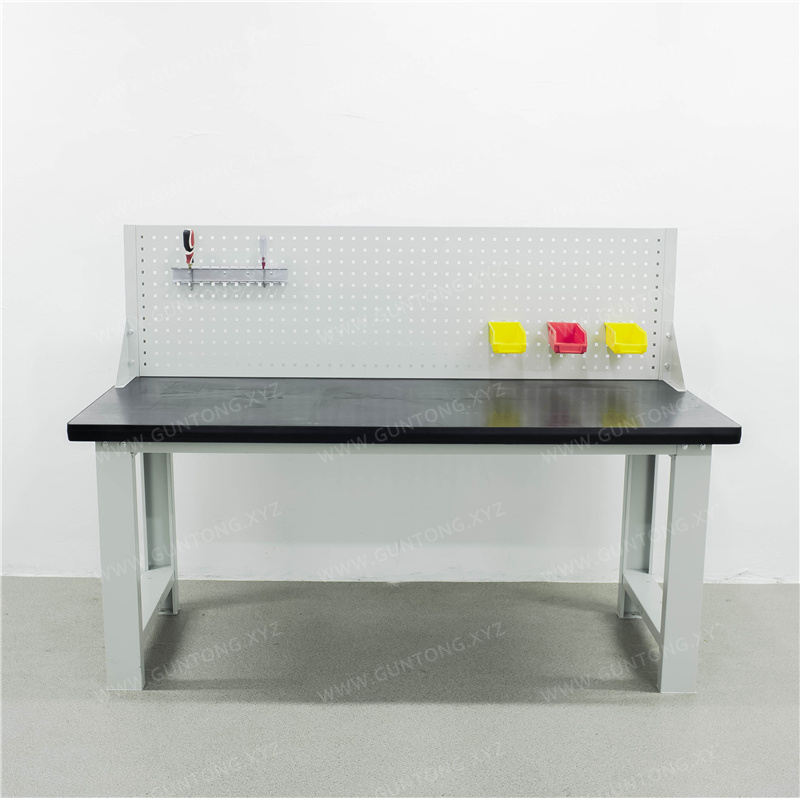
Take the composite desktop used in Guang'ErMei's heavy-duty workbench range as a reference. The construction layers a raw steel plate top sheet over a high-density fiberboard core, finished with black PVC edge banding. This combination delivers several practical benefits:
- The steel surface resists dents, scratches, and oil absorption.
- The fiberboard core dampens vibration and reduces noise during hammering or grinding operations.
- The PVC edge banding protects the desktop perimeter from moisture and impact damage.
- The total desktop thickness provides a solid feel and resists warping.
When evaluating desktop options, consider your specific work:
- For heavy assembly and fitting: a steel-top composite is appropriate. It handles dropped tools and clamped fixtures without gouging.
- For precision measurement or inspection: ask about flatness tolerance. A steel surface can be ground flat, but you need to specify this requirement upfront.
- For electronics or ESD-sensitive work: you may need an anti-static desktop material. Confirm whether the manufacturer offers anti-static workbench configurations as a standard option.
- For wet or corrosive environments: stainless steel workbench tops are available and should be specified with the appropriate grade (typically 304 or 316 for chemical resistance).
A practical check: ask the supplier how the desktop is attached to the frame. A bolted connection allows future replacement if the surface becomes damaged—an important consideration for long-term asset management.
Criterion 3: Storage Integration and Workflow Fit
A heavy-duty workbench rarely stands alone. It is part of a workstation that includes tool storage, parts organization, and sometimes overhead fixtures. Evaluating storage integration upfront prevents workflow bottlenecks later.
Guang'ErMei's single back panel 4-drawer steel plate workbench illustrates a common and effective configuration. The integrated back panel serves multiple functions:
- It prevents tools and small parts from falling behind the bench.
- It provides a mounting surface for square-hole pegboard accessories, allowing visual tool management.
- It can support shelving or bin rails above the work surface.
The four-drawer tiered design organizes tools by size and frequency of use. In a heavy-duty context, drawer load capacity matters. Check that drawer slides are rated for full extension under load and include a locking mechanism to prevent unintended opening if the bench is moved or bumped.
Other storage configurations to consider:
- Tool carts with pegboards: for mobile tool storage that moves between workstations. A 4-drawer 1-door tool cart with a square-hole pegboard provides organized storage and visual tool access in a compact footprint.
- Pegboard storage cabinets: for centralized tool and consumable storage near the workbench. An inner half-pegboard cabinet with adjustable shelves can handle both heavy items and small hanging tools.
When planning your workstation layout, think about reach zones. Frequently used tools should be accessible without stepping away from the bench. Heavy items should be stored at waist height to reduce lifting strain. The workbench, storage cabinet, and tool cart should form a coherent triangle that minimizes walking and bending.
Criterion 4: Customization and Non-Standard Requirements
Standard workbench dimensions cover many applications. But industrial environments often require non-standard sizes, special load ratings, or unique features. A supplier's ability to handle customization is a critical evaluation factor.
Guang'ErMei operates with dual capabilities in standardized production and non-standard customization. This means you can start from a proven base design and modify specific elements rather than commissioning a fully bespoke product. Common customization requests include:
- Non-standard length, width, or height to fit existing floor layouts or match conveyor heights.
- Increased frame load capacity for unusually heavy workpieces.
- Specific desktop materials, such as thicker steel plate, stainless steel, or anti-static laminate.
- Additional drawers, different drawer configurations, or specialized drawer dividers.
- Integrated power strips, lighting, or compressed air connections.
- Color matching to corporate or 6S visual management standards.
When discussing customization, provide the supplier with clear information:
- Maximum weight of the heaviest single item placed on the bench.
- Whether dynamic loads (hammering, pressing) are involved.
- Any dimensional constraints from the facility layout.
- Environmental conditions (humidity, chemical exposure, ESD requirements).
A supplier with in-house design and manufacturing can typically provide faster turnaround on custom orders and better quality control than one that outsources production.
Criterion 5: Installation, Service, and Long-Term Support
A heavy-duty workbench is a long-term asset. The purchase decision should account for what happens after delivery.
Key service considerations:
- On-site installation: Heavy workbenches can weigh several hundred kilograms. Confirm whether the supplier provides installation services, including leveling and anchoring if required.
- Workstation planning support: Some suppliers offer on-site assessment to recommend workbench placement, storage configuration, and workflow optimization aligned with 6S or lean manufacturing principles.
- After-sales service: Ask about warranty terms, spare parts availability (especially drawer slides and desktop surfaces), and response times for service requests.
- Project delivery scope: If you are equipping an entire workshop or multiple facilities, confirm the supplier's capacity to handle bulk orders with consistent quality and coordinated delivery schedules.
Guang'ErMei's service model covers design, production, sales, and on-site installation, with full-process after-sales support. This integrated approach reduces the coordination burden on the buyer and ensures that installation issues are resolved by the same team that built the product.
Practical Evaluation Checklist
Use this checklist when comparing heavy-duty workbench options:
- Frame: C-channel or formed steel construction? Total load capacity clearly stated? Leveling feet included?
- Desktop: Composite construction with steel top? Total thickness? Edge protection? Replaceable?
- Storage: Drawer load rating? Full-extension slides? Locking mechanism? Pegboard compatibility?
- Customization: Can dimensions, load rating, and desktop material be modified? What is the typical lead time?
- Installation: Is on-site installation included? Can the supplier assist with workstation layout planning?
- Service: What warranty is provided? Are spare parts available? What is the after-sales response process?
Making the Decision
A heavy-duty industrial workbench is not a commodity purchase. The right choice depends on matching the bench's construction and configuration to your actual daily workloads, not just a spec sheet number.
Start by documenting your heaviest regular load, your most space-constrained workstation, and your most frequently accessed tools. Then evaluate suppliers against these real requirements. A manufacturer that offers both standardized heavy-duty models and non-standard customization—backed by installation and after-sales support—gives you flexibility as your production needs evolve.
For manufacturing teams in electronics, automotive, hardware molds, maintenance, warehousing, and training environments, a properly specified heavy-duty workbench improves productivity, safety, and workplace organization from day one.