
Composite Top Workbenches in Electronics and Automotive Workshops: Load Capacity, Drawer Layouts, and Selection Boundari
Who Needs Composite Top Workbenches?
Manufacturing environments that demand both heavy load capacity and surface protection benefit most from composite top workbenches. Typical users include electronics assembly lines handling soldering stations and testing fixtures, automotive parts workshops managing torque tools and component trays, and hardware mold factories requiring stable platforms for precision measurement.
The core challenge these facilities face is balancing three requirements: supporting substantial static loads, protecting delicate components from surface damage, and maintaining organized tool access within arm's reach. A single-material desktop—whether pure steel, pure wood, or pure polymer—rarely satisfies all three simultaneously.
How Composite Desktop Construction Solves Workshop Problems
The Composite Structure
Guang'ErMei's composite workbenches use a layered desktop design: a high-density fiberboard core bonded with either a raw steel plate or a green composite surface layer, finished with black PVC edge banding. This construction distributes point loads across the fiberboard core while the steel or composite top layer resists abrasion, chemical spills, and impact from dropped tools.
For electronics manufacturers, the green composite surface provides a neutral, non-marring workspace that won't scratch circuit boards or housings. For automotive and mold applications, the steel plate variant handles repeated impact from heavy dies and power tools without denting.
C-Type Cold-Rolled Steel Frame Performance
The supporting frame uses C-type cold-rolled steel legs, providing a total system load capacity of 1000kg. This specification matters for two reasons:
- Static vs. dynamic loading: A 1000kg rating covers static weight (tools, fixtures, parts bins resting on the surface). Dynamic forces—such as dropping a heavy mold onto the desktop—create momentary loads exceeding static ratings. The C-type profile resists bending under these transient forces better than square tube or angle iron alternatives.
- Long-term deflection: Under continuous heavy loads, cheaper frame designs gradually sag at mid-span. The C-type steel maintains flatness over multi-year service cycles, which is critical for precision assembly where even minor deflection affects fixture alignment.
Configuration Choices: Drawers, Pegboards, and Cabinet Layouts
Drawer Configurations for Tool Organization
Composite workbenches support multiple drawer layouts depending on workflow:
- Two-drawer suspended cabinet: Drawer panels use steel with single-rail slides, opening 85% with 80kg capacity per drawer. Suitable for environments where operators need quick access to a limited set of hand tools and measuring instruments.
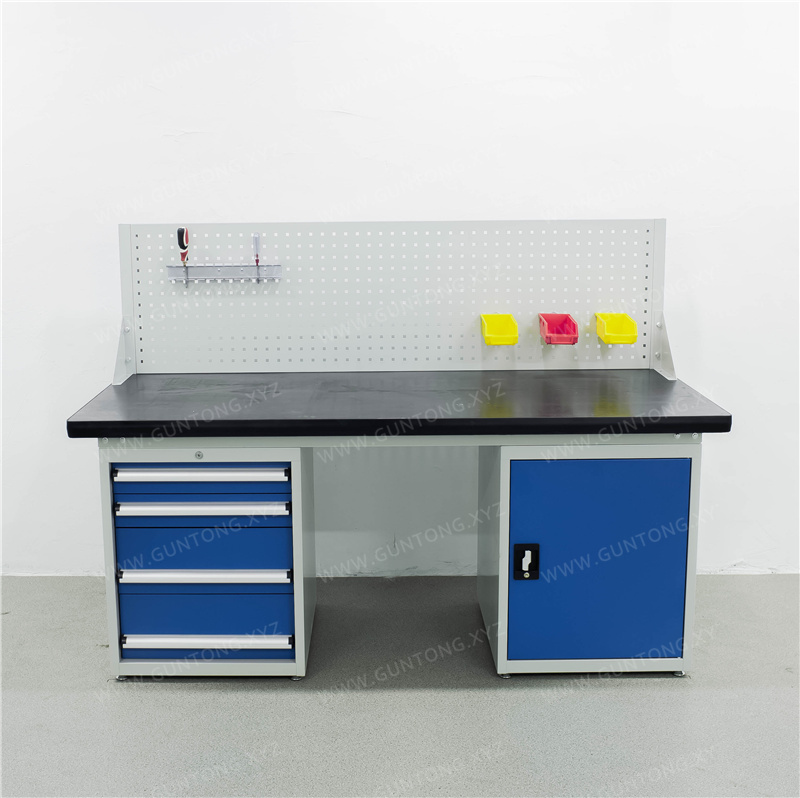
- Four-drawer tiered design: Combines different drawer heights to separate small fasteners from larger power tools. The tiered approach reduces search time during high-mix, low-volume production runs.
- Single-door cabinet with drawers: Adds enclosed storage for sensitive items (calibrated instruments, cleanroom gloves) while keeping frequently used tools in drawers for visual management.
Pegboard Integration for Visual Management
For workshops implementing 6S methodology, adding a square-hole pegboard above the work surface transforms the bench into a visual management station. Tools hung on the pegboard are immediately visible, making missing items obvious during shift changes. The square-hole pattern accepts standard hooks, allowing reconfiguration without replacing the board.
Selection Boundaries: When Composite Tops Are Not the Right Choice
Temperature and Chemical Exposure Limits
Composite fiberboard cores are sensitive to prolonged moisture exposure and high temperatures. Facilities with washdown requirements, frequent solvent spills, or welding operations directly on the desktop should consider stainless steel or solid steel plate alternatives instead.
Cleanroom and ESD-Sensitive Environments
Standard composite surfaces do not provide electrostatic dissipation. Electronics manufacturers handling MOSFETs, ICs, or other ESD-sensitive components require anti-static workbenches with grounded conductive surfaces and wrist strap connections. Guang'ErMei offers dedicated anti-static workbench configurations for these scenarios.
Load Concentration Issues
While the 1000kg total capacity handles distributed loads well, concentrated point loads—such as a single heavy press mounted on small feet—can exceed the local bearing capacity of the fiberboard core. Applications involving heavy concentrated loads need reinforcement plates or solid steel desktops.
Implementation Steps for Cross-Regional Deployment
Step 1: On-Site Workstation Planning
Before ordering, map the workflow: which tools are used at each station, what parts flow through, and where operators stand. This determines whether a standard or extended bench length is appropriate, and whether pegboards or drawer cabinets add more value.
Step 2: Load-Bearing Verification
Calculate the maximum simultaneous load: fixture weight + parts inventory + tool weight + operator lean force. If this approaches the upper limit of the green composite surface rating, specify the steel plate composite variant instead.
Step 3: Configuration Lock and Production
Finalize drawer layouts, pegboard heights, and color schemes (standard gray-white frames with blue or green accents). Production lead times vary by customization level; standard configurations ship faster than fully custom dimensions.
Step 4: Installation and 6S Adaptation
On-site installation includes leveling, anchoring (if required for seismic zones or heavy vibration environments), and initial 6S labeling. Guang'ErMei provides installation services covering Guangdong Province and supports nationwide project delivery for larger deployments.
Real-World Application Scenarios
Electronics assembly line: Standard-length composite workbench with green surface, two-drawer suspended cabinet, and pegboard. Operators assemble PCB testers with soldering irons, multimeters, and component trays. The composite surface prevents scratching enclosures while the pegboard keeps soldering stations visible.
Automotive parts maintenance: Extended-length steel plate composite workbench with four-drawer cabinet and single-door storage. Technicians disassemble and inspect fuel injectors, using torque wrenches stored in deep drawers and precision gauges kept in the enclosed cabinet.
Vocational training center: Standard-length composite workbenches arranged in rows, each with two-drawer cabinets. Students learn mechanical assembly techniques on durable surfaces that withstand years of novice tool handling.
Next Steps for Procurement Teams
If your facility is evaluating composite top workbenches for an upcoming production line expansion or workshop reorganization, start by documenting your load requirements, surface protection needs, and tool storage workflows. Compare these against the configuration options outlined above.
For facilities in Huizhou, Guangdong, or other regions requiring on-site assessment, Guang'ErMei Precision Components provides workstation planning consultations covering load-bearing design, 6S adaptation, and full-process after-sales support. Contact the engineering team to discuss your specific configuration requirements and request a site survey.