
Steel Top vs Beech Top vs Composite Top Workbench: A Practical Selection Guide for Workshop Buyers
Who This Guide Is For
If you are specifying workbenches for an electronics assembly line, a hardware mold factory, an automotive parts workshop, or a maintenance and testing lab, the workbench top is the surface that takes the most abuse. The decision between a steel top, a beech wood top, and a composite top workbench is rarely about price alone. It is about matching the surface to the tools, workpieces, and environmental conditions your operators face every shift.
This field guide breaks down the practical signals, evaluation criteria, and risk boundaries for each material, drawing on real configuration data from industrial workstation deployments.
---
Quick Comparison: Signals at a Glance
| Evaluation Signal | Steel Top Workbench | Beech Top Workbench | Composite Top Workbench |
|---|---|---|---|
| Typical load scenario | Heavy fitter and repair tasks, vise-mounted operations | General assembly, inspection, light-to-medium fitting | Electronics, ESD-sensitive environments, cleanrooms |
| Surface hardness | High — resists impact and cutting | Medium — firm but can dent under sharp point loads | Varies by core; generally moderate |
| ESD / static control | Requires grounding design | Naturally low static generation | Can be specified with anti-static laminate |
| Moisture sensitivity | Low (with proper surface treatment) | Moderate — requires moisture protection | Low to moderate depending on core material |
| Common thickness reference | Varies by plate gauge and frame reinforcement | 50 mm beech finger-joint board is a common industrial spec | Typically 25–40 mm depending on laminate and core |
| Maintenance focus | Surface rust prevention, scratch management | Moisture control, surface sealing, cleaning | Laminate edge protection, chemical resistance |
---
Steel Top Workbench: When Heavy-Duty Demands Take Priority
Best-Fit Scenarios
Steel top workbenches are the default choice for fitter workbenches, heavy repair stations, and any task where a bench vise is bolted to the surface. In a typical fitter workshop, operators use hammers, files, and chisels directly on the top. The steel surface absorbs impact without splintering or delaminating.
For heavy-duty configurations, the frame must match the top. Industrial steel-top workbenches often use cold-rolled steel frames rated for 1,000 kg or more in total load capacity, with surface treatments such as pickling, phosphating, and powder electrostatic spraying to resist corrosion and wear.
Selection Criteria
- Workpiece weight and impact frequency:*
- If operators regularly place 50+ kg parts on the bench or use percussive tools, steel is the conservative choice.
- Vise and fixture mounting:*
- Steel tops allow direct drilling and bolting for bench vises, which are essential in fitter and metalworking operations.
- Frame-to-top balance:*
- A thick steel plate on an under-rated frame creates a failure point. Always confirm the frame's load rating alongside the top specification.
Risk Boundaries
- Uncoated or poorly treated steel tops will rust in humid environments, especially in southern Chinese manufacturing regions.
- Steel surfaces can damage delicate workpieces if no protective mat or jig is used.
- Noise levels are higher when metal tools and parts contact a steel surface repeatedly.
---
Beech Top Workbench: Balancing Durability and Workpiece Protection
Best-Fit Scenarios
Beech wood tops are widely used in general assembly, inspection, and light fitting environments. The 50 mm beech finger-joint board is a proven industrial specification, offering a firm but slightly forgiving surface that protects workpieces from scratches and dents.
In vocational training centers and school practical workshops, beech top workbenches are common because they handle a wide variety of tasks without the noise and cold feel of steel. They also perform well in tool cabinet-integrated workstations where operators need a clean, organized surface for hand tools and measuring instruments.
Selection Criteria
- Workpiece sensitivity:*
- If your operators handle finished or semi-finished parts that must not be scratched, beech provides a naturally protective surface.
- Tool layout planning:*
- Beech tops pair well with drawer cabinets and pegboard configurations, allowing operators to plan tool and workpiece positions efficiently.
- Dimensional stability:*
- A 50 mm finger-joint board offers good resistance to warping under normal indoor conditions.
Risk Boundaries
- Moisture is the primary enemy.*
- Beech tops require protection from liquid spills, high humidity, and direct water contact. Routine sealing and prompt cleaning are non-negotiable.
- Sharp point loads (e.g., dropping a heavy chisel tip-first) can dent the surface.
- Beech tops are not suitable for environments with frequent solvent or chemical exposure unless a protective overlay is added.
---
Composite Top Workbench: Engineered for Controlled Environments
Best-Fit Scenarios
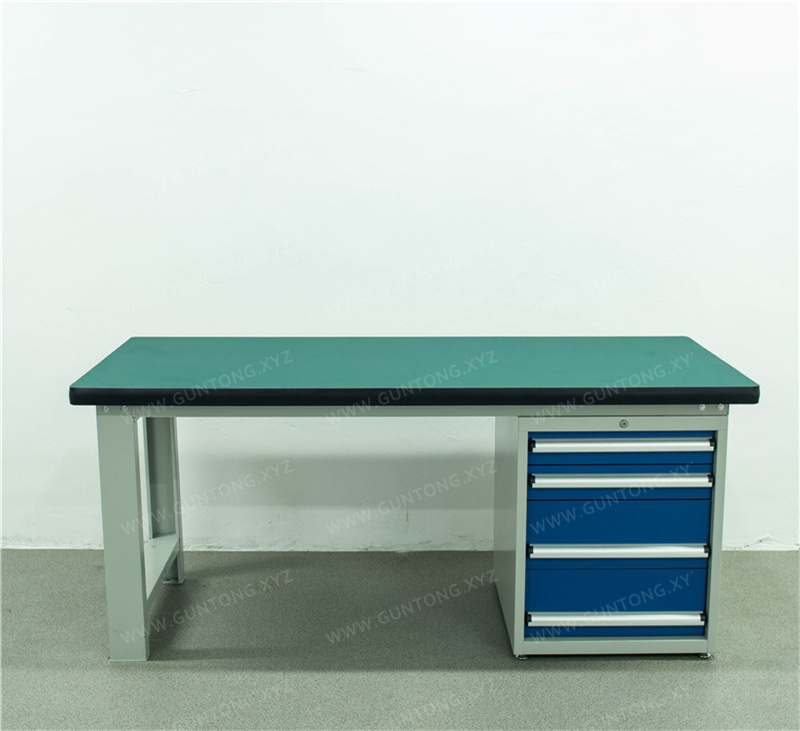
Composite tops — which include high-pressure laminate (HPL), anti-static laminate, and engineered wood-core surfaces — are specified when the environment demands ESD control, chemical resistance, or cleanroom compatibility. Electronics manufacturers and testing laboratories are the primary users.
An anti-static workbench with a composite top is standard in PCB assembly, semiconductor handling, and precision instrument calibration. The surface can be engineered to dissipate static charge at a controlled rate, protecting sensitive components.
Selection Criteria
- ESD requirements:*
- Confirm the surface resistivity specification matches your industry standard (e.g., 10⁶–10⁹ Ω for electronics assembly).
- Chemical exposure:*
- If operators use fluxes, solvents, or adhesives, specify a laminate with verified chemical resistance.
- Edge sealing:*
- Composite tops are vulnerable at the edges. Ensure the manufacturer uses proper edge banding to prevent moisture ingress and delamination.
Risk Boundaries
- Composite tops generally have lower impact resistance than steel or thick beech. Heavy dropped objects can chip or crack the laminate.
- Not all "composite" tops are anti-static. Buyers must verify the ESD specification rather than assuming it from the material category.
- Repair is more difficult — a damaged laminate section often requires full top replacement.
---
Decision Framework: Three Questions to Narrow Your Choice
- What is the heaviest single workpiece, and will percussive tools be used?
- Yes → Steel top, with a frame rated for the total dynamic load.
- No, but workpieces are moderately heavy → Beech top (50 mm board).
- No, and workpieces are light or ESD-sensitive → Composite top.
- Is the environment humid, chemically active, or ESD-controlled?
- Humid or outdoor-adjacent → Steel with proper surface treatment, or moisture-sealed composite.
- ESD-controlled → Anti-static composite top with verified resistivity.
- Standard indoor workshop → Beech is viable with routine moisture management.
- Will fixtures, vises, or heavy jigs be mounted to the surface?
- Yes → Steel top is the safest substrate for bolted fixtures.
- Light clamping only → Beech or composite can work, depending on other factors.
---
Practical Configuration Notes
Regardless of top material, the overall workstation performance depends on integrated design:
- Drawer and cabinet integration:*
- Heavy-duty drawer units with stamped guide rails (rated around 80 kg per drawer) can be paired with any top type, but the total load must be calculated against the frame capacity.
- Standard dimensions:*
- Common industrial workbench sizes include 1500×750×800 mm, 1800×750×800 mm, and 2100×750×800 mm. Non-standard sizes are available through custom manufacturers.
- Surface treatment matters:*
- For steel frames and tops, processes like pickling, phosphating, and high-temperature powder coating (e.g., 250°C baking) significantly extend service life.
---
Next Steps
If you are planning a workstation upgrade or a new workshop layout, start by documenting your heaviest workpiece weight, the tools used on the surface, and any environmental constraints (humidity, ESD, chemicals). Share these parameters with your workstation equipment supplier to receive a material recommendation backed by load calculations — not just a catalog selection.
Guang'ErMei Precision Components provides custom workbench solutions across steel, beech, and composite top configurations, with full design, manufacturing, and on-site installation support for workshops in Huizhou, Guangdong, and nationwide.