
Steel Top vs Beech Top vs Composite Top Workbench: A Buyer's Decision Guide
Which Workbench Top Material Fits Your Workshop?
When sourcing workbenches for manufacturing, assembly, or maintenance operations, the desktop material directly impacts daily productivity, equipment lifespan, and long-term replacement costs. Buyers typically evaluate three mainstream options: steel plate tops, solid beech wood tops, and composite tops (steel plate bonded to high-density fiberboard). Each serves distinct operational profiles.
This comparison focuses on practical decision criteria—load capacity, surface durability, environmental resistance, and task compatibility—based on real workstation configurations deployed across electronics, automotive parts, hardware mold, and maintenance testing environments.
Steel Plate Workbench Tops: Maximum Durability for Heavy-Duty Tasks
Where Steel Tops Perform Best
Steel plate desktops are the default choice for fitter workbenches, mold repair stations, and heavy assembly areas where impact resistance and extreme load-bearing are non-negotiable. A typical configuration uses a 5mm raw steel plate surface, often paired with a C-type cold-rolled steel frame rated for high total load capacity.
Key Characteristics
- Surface hardness: Resists dents, scratches, and deformation from dropped tools, metal parts, and vise clamping.
- Load performance: Handles concentrated point loads from heavy fixtures, bench vises, and large workpieces without flexing.
- Environmental tolerance: Unaffected by oils, coolants, solvents, and metal shavings common in machining and mold workshops.
- Maintenance: Wipe-clean surface; minor surface wear does not compromise structural integrity.
Constraints to Consider
Steel tops are heavier than alternatives, which affects workstation repositioning flexibility. The hard surface can also damage delicate components if dropped, making steel less suitable for electronics assembly or precision instrument calibration without additional protective matting.
Beech Wood Workbench Tops: Traditional Craftsmanship for Fitter and Assembly Work
Where Beech Tops Perform Best
Solid beech desktops—typically constructed from 50mm thick finger-joint beech boards—are widely specified for fitter training centers, vocational school workshops, and general assembly benches where a firm yet slightly forgiving surface is preferred.
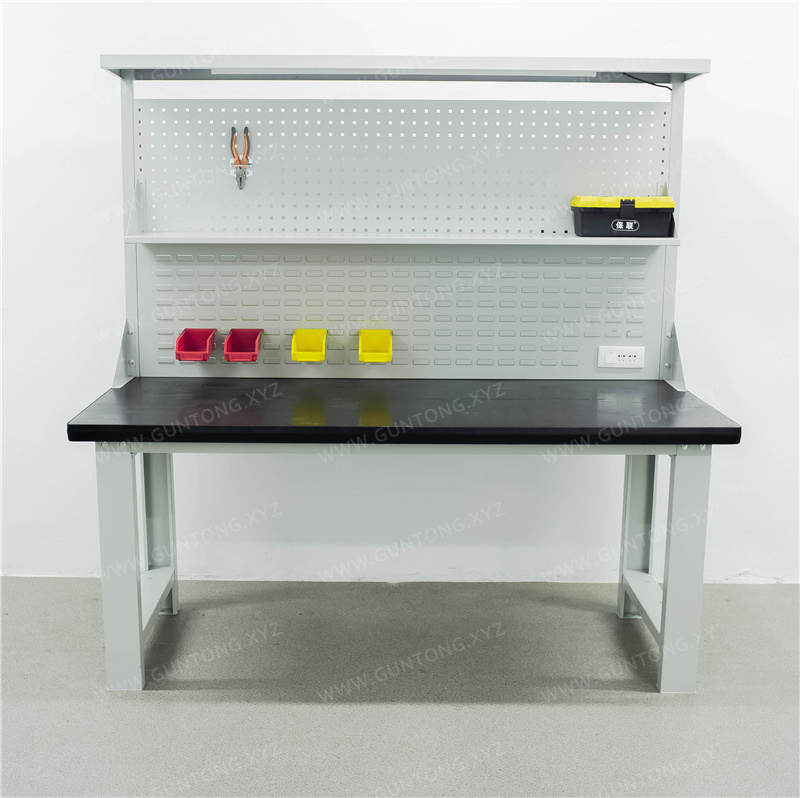
Key Characteristics
- Work surface feel: Provides natural grip and slight shock absorption, reducing fatigue during extended hand-tool operations.
- Dimensional stability: Finger-joint construction minimizes warping compared to solid-slab hardwood.
- Load capacity: When paired with a heavy-duty cold-rolled steel frame, beech-top workbenches also achieve high load ratings.
- Aesthetic and training environments: Preferred in school practical training centers and demonstration areas for professional appearance.
Constraints to Consider
Beech is susceptible to moisture damage, oil staining, and chemical exposure. It requires periodic surface maintenance (sanding, re-oiling) in humid environments or workshops with heavy coolant splash. Not recommended for food-grade, cleanroom, or high-humidity applications without specialized sealing.
Composite Workbench Tops: Balanced Performance for Multi-Purpose Stations
Where Composite Tops Perform Best
Composite desktops combine a 5mm raw steel plate bonded to high-density fiberboard, finished with PVC edge banding. This hybrid construction targets workshops that need steel-like durability with reduced weight and improved vibration damping—common in electronics assembly, automotive parts inspection, and general maintenance bays.
Key Characteristics
- Balanced load and weight: Delivers high load capacity while remaining lighter than full-steel alternatives, supporting modular workshop layouts.
- Surface versatility: The steel face handles tooling and clamping; the fiberboard core dampens vibration and reduces noise.
- Edge protection: PVC banding prevents edge chipping and protects operators from sharp steel margins.
- Cost efficiency: Typically more economical than pure steel plate tops of equivalent thickness, while outperforming wood in moisture and chemical resistance.
Constraints to Consider
The bonded structure is highly durable under normal industrial use, but extreme point impacts (e.g., dropping heavy dies from height) may cause localized delamination over time. For the most severe impact environments, a monolithic steel plate remains the conservative choice.
Decision Matrix: Matching Desktop Material to Your Application
| Decision Factor | Steel Plate Top | Beech Wood Top | Composite Top |
|---|---|---|---|
| Primary scenario | Heavy mold repair, fitter stations, metal assembly | Training centers, hand-tool assembly, general fitter work | Electronics, automotive inspection, multi-purpose maintenance |
| Load capacity | High (frame-dependent) | High (frame-dependent) | High (frame-dependent) |
| Impact resistance | Excellent | Good (may dent) | Very Good |
| Moisture/chemical resistance | Excellent | Poor–Fair | Very Good |
| Surface noise/vibration | High reflection | Low reflection | Moderate damping |
| Weight (relative) | Heaviest | Moderate | Moderate |
| Maintenance requirement | Minimal | Periodic sanding/oiling | Minimal |
How Guang'ErMei Supports Your Selection
Guang'ErMei Precision Components manufactures all three desktop types as part of its workstation equipment lineup. Standard dimensions include 1500×750×800mm, 1800×750×800mm, and 2100×750×800mm, with non-standard customization available for specific workshop layouts. Frame options include C-section steel for high-capacity applications and square tube for standard-duty setups, with acid-wash, phosphating, and anti-static powder coating as standard surface treatment.
For buyers evaluating a Single Back Panel Single Door 4-Drawer Steel Plate Workbench or a Double four-drawer floor cabinet composite workbench, the desktop material is configurable to match your operational profile.
Next Steps for Procurement Teams
- Audit your primary tasks: List the top operations performed at each workstation—identify whether impact, chemical exposure, or precision handling dominates.
- Confirm load requirements: Calculate the maximum static and dynamic load per bench, including fixtures, vises, and workpiece weight.
- Evaluate environmental factors: Note humidity levels, coolant/oil splash frequency, and cleanliness standards.
- Request material samples or site references: Compare real surface performance before committing to a fleet-wide rollout.
Contact Guang'ErMei's engineering team to discuss your specific workstation configuration, including desktop material, frame specification, drawer layout, and pegboard integration.