
Quality Control Standards for Industrial Stainless Steel Workbenches: Testing Processes at Guang'ErMei
Quality Control Standards for Industrial Stainless Steel Workbenches: Testing Processes at Guang'ErMei
For procurement managers and facility planners in electronics, automotive, and hardware mold industries, the longevity of a workshop workstation is defined by its quality control (QC) standards. Unlike generic furniture, industrial stainless steel workbenches and supporting equipment must withstand heavy loads, chemical exposure, and frequent mechanical stress. At Guang'ErMei Precision Components, our QC process goes beyond visual inspection to ensure that every customized unit meets strict structural and functional benchmarks.
This article details the specific testing processes we apply to our product lines—including stainless steel workbenches, tool carts, and storage cabinets—providing buyers with clear criteria to evaluate manufacturer capabilities and ensure long-term operational safety.
1. Material Verification and Corrosion Resistance Testing
The foundation of any industrial workbench is its material integrity. For applications in maintenance, testing, or warehousing environments where hygiene and corrosion resistance are critical, we verify:
- Steel Grade Certification:*
- We confirm that raw materials meet specified grades suitable for the intended environment. This prevents premature rusting in humid or chemically exposed areas common in automotive parts turnover and hardware mold scenarios.
- Surface Finish Inspection:*
- The surface is checked for uniformity, ensuring no scratches, pits, or weld discoloration that could harbor contaminants or weaken the structure. A smooth finish is essential for easy cleaning in cleanroom or food-grade adjacent zones.
- Edge Banding and Joint Sealing:*
- In composite structures, such as those combining steel plates with high-density fiberboard, we test the adhesion of edge banding (e.g., black PVC) to prevent moisture ingress, which can cause swelling or delamination over time.
2. Static and Dynamic Load Capacity Validation
Load capacity is the most critical performance metric for industrial workbenches. Our testing protocols distinguish between static stability and dynamic usage scenarios, drawing on our experience with heavy-duty equipment like the Single Back Panel 4-Drawer Steel Plate Workbench.
Static Load Testing
We subject the workbench frame and desktop to incremental weight loads to verify structural rigidity.
- Frame Stability:*
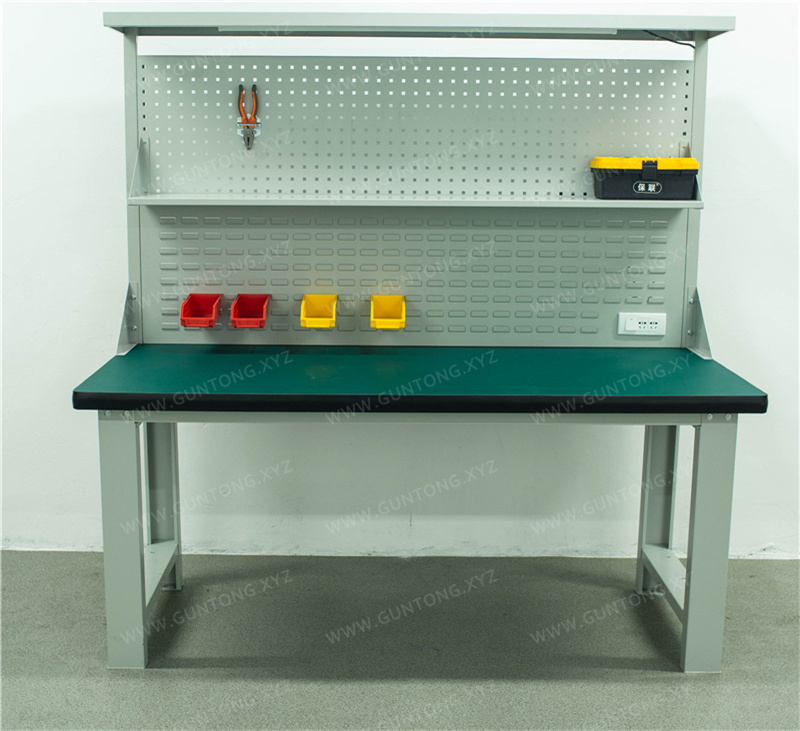
- Using C-type cold-rolled steel frames or reinforced stainless steel legs, we test for deflection under maximum rated load. For example, standard steel plate workbenches are tested to ensure they maintain their total load capacity without permanent deformation.
- Desktop Integrity:*
- For composite desktops (such as the 5mm raw steel plate + high-density fiberboard structure), we check for surface cracking or core separation under pressure points.
Dynamic Load Simulation
To simulate real-world usage, we perform drop tests and sliding load tests on drawers and shelves.
- Drawer Mechanisms:*
- Drawers (common in tool carts and storage cabinets) are cycled open and closed under load to ensure rails do not warp or jam. Each drawer is verified to hold its rated capacity without sagging. For instance, our 4-Drawer Tool Cart with Pegboard is engineered to support significant weight per drawer while maintaining stable overall structure.
- Pegboard Attachment:*
- For units featuring pegboards, we test the securement of hooks and bins to ensure they remain fixed during vibration or movement.
3. Dimensional Accuracy and Assembly Tolerance
Precision is vital for modular workshop layouts, especially when integrating lean pipes or automated storage accessories. Our QC team verifies:
- Dimensional Consistency:*
- All custom dimensions are measured with digital calipers and laser levels to ensure tight tolerances. This ensures seamless integration with other factory equipment and standardized components.
- Levelness and Alignment:*
- Legs and feet are adjusted to ensure the entire unit sits level on uneven factory floors, preventing tipping or instability.
- Fastener Security:*
- All bolts, screws, and welding joints are inspected for tightness and completeness. Welded joints are checked for penetration depth and smoothness to prevent stress concentration points.
4. Safety and Ergonomic Compliance
Safety is non-negotiable in industrial settings. Our testing includes:
- Tip-Over Resistance:*
- Fully loaded units, especially tall storage cabinets and tool carts, undergo tilt tests to ensure they do not tip over when drawers are opened or when lateral force is applied.
- Edge Protection:*
- Sharp edges on metal components are deburred and rounded to prevent injury to operators.
- Anti-Static Properties:*
- For electronics manufacturing applications, we verify that anti-static workbenches maintain their grounding continuity and surface resistivity within safe limits.
Why These Standards Matter for Your Procurement Decision
When evaluating potential suppliers, ask for evidence of these testing processes. Manufacturers who only provide visual samples without data on load testing or material certification may pose risks regarding product failure and downtime. Guang'ErMei’s dual capability in standardized production and non-standard customization allows us to tailor these QC checks to your specific industry needs, whether it’s the heavy-duty requirements of automotive parts turnover racks or the precision needs of electronic assembly lines.
Our products are designed to support diverse scenarios, from school practical training centers to large-scale warehousing logistics, ensuring that every unit contributes to efficient, error-free operations.
Next Steps: Ensuring Quality in Your Project
To guarantee that your new workstation equipment meets these rigorous standards:
- Define Your Load Requirements: Clearly specify the maximum weight each bench or cart will carry during the design phase.
- Request Test Reports: Ask your supplier for sample QC reports or video demonstrations of load testing for similar products.
- On-Site Installation Check: Ensure our installation team performs a final alignment and stability check upon delivery.
At Guang'ErMei Precision Components, we combine standardized quality controls with flexible customization to deliver workbenches that enhance productivity and safety. Contact us today to discuss your specific workshop requirements and receive a tailored quotation based on our proven QC standards.