
Material Selection Guide for Workshop Workbenches: Carbon Steel vs. Stainless Steel vs. Aluminum Alloy
Who Needs This Guide
Facility managers, procurement leads, and compliance officers in manufacturing environments face a recurring decision: which workbench material best balances structural performance with environmental demands. The wrong choice leads to premature surface degradation, load failures, or unnecessary capital expenditure. This guide addresses that decision for three common material options—carbon steel, stainless steel, and aluminum alloy—based on real workshop conditions in electronics assembly, automotive parts production, hardware mold operations, and maintenance facilities.
Decision Objectives
Before comparing materials, define the operational requirements that will drive your selection:
- Static and dynamic load requirements: Will the bench support heavy dies, press tools, or testing equipment?
- Environmental exposure: Are there coolants, solvents, humidity, or washdown protocols?
- Surface integrity needs: Does the application demand ESD control, particulate-free surfaces, or food-grade compliance?
- Lifecycle cost tolerance: Is the priority lowest upfront cost, or lowest total cost over the equipment lifecycle?
These four factors determine which material delivers genuine value rather than apparent savings.
Material Comparison: Evidence and Boundaries
Carbon Steel (Cold-Rolled and A3 Steel Plate)
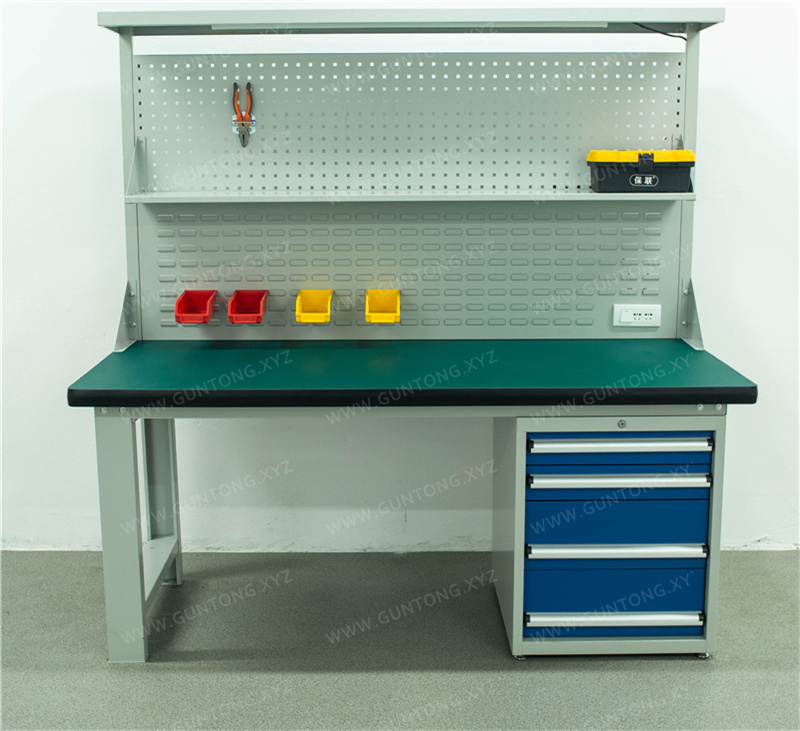
Load capacity: Carbon steel frames and desktops deliver the highest load-to-cost ratio. Guang'ErMei's fitter workbenches and mold tables use 20mm A3 steel plate desktops with water-ground finishing, supported by 2.0mm cold-rolled steel frames with leg sections of 100×50×2.0mm and beam sections of 80×50×2.0mm. This configuration supports heavy mold operations, bench fitting, and assembly tasks where substantial static loads are routine.
Corrosion resistance: Carbon steel requires surface treatment—powder coating, galvanizing, or regular maintenance—to resist oxidation. In dry or controlled environments such as electronics assembly workshops or warehousing facilities, coated carbon steel performs reliably for years. In high-humidity or chemical-exposed settings, surface degradation accelerates and maintenance intervals shorten.
Cost profile: Lowest initial investment among the three options. Suitable for high-load, low-corrosion scenarios where replacement cycles are planned and maintenance budgets exist.
Best-fit scenarios: Hardware mold factories, automotive parts manufacturing, vocational training centers, general assembly and repair workshops.
Boundary warning: Not recommended for cleanroom environments, food processing, or facilities with frequent chemical washdowns unless specialized coatings are applied and maintained.
Stainless Steel
Load capacity: Stainless steel workbenches provide strong load-bearing performance, though typically at a higher material cost per kilogram of capacity compared to carbon steel. The material's inherent strength allows thinner gauge construction while maintaining structural rigidity.
Corrosion resistance: Superior resistance to moisture, acids, alkalis, and repeated cleaning cycles. Stainless steel surfaces do not require protective coatings and maintain integrity in washdown environments, chemical laboratories, and food-grade production areas.
Cost profile: Highest upfront material cost. Justified when corrosion-related downtime, coating maintenance, or compliance failures would exceed the material premium over the equipment lifecycle.
Best-fit scenarios: Electronics manufacturing with strict particulate control, testing and inspection laboratories, food and pharmaceutical packaging lines, marine or coastal facility environments.
Boundary warning: Stainless steel is heavier than aluminum and more expensive than carbon steel. For applications where corrosion is not a primary concern, the premium is difficult to justify on pure economic grounds.
Aluminum Alloy
Load capacity: Aluminum alloy offers moderate load capacity—sufficient for light to medium assembly, inspection, and electronics work. It is not suitable for heavy die storage, press operations, or high-impact fitting tasks.
Corrosion resistance: Naturally forms a protective oxide layer, providing good resistance to atmospheric corrosion without additional treatment. Performs well in humid environments but can be vulnerable to certain alkaline solutions.
Cost profile: Mid-range initial cost. The material's light weight reduces shipping and installation labor costs, partially offsetting the material premium over carbon steel.
Best-fit scenarios: Lean production lines with frequent layout reconfiguration, electronics assembly stations requiring ESD-compatible structures, mobile workstations, and cleanroom-adjacent environments.
Boundary warning: Not appropriate for heavy mold operations, high-impact bench fitting, or applications requiring the mass and stability of steel construction.
Decision Matrix
| Requirement Priority | Recommended Material | Rationale |
|---|---|---|
| Maximum load capacity, lowest cost | Carbon steel (A3 plate + cold-rolled frame) | Proven in mold and heavy assembly applications |
| Corrosion resistance, hygiene compliance | Stainless steel | No coating maintenance, washdown-compatible |
| Lightweight, reconfigurable layouts | Aluminum alloy | Lower mass supports lean manufacturing flexibility |
| Balanced cost and moderate corrosion resistance | Carbon steel with upgraded coating | Acceptable for controlled environments with planned maintenance |
Implementation Considerations
Hybrid configurations: Many workshops benefit from mixed-material deployments. Heavy-duty mold repair areas use carbon steel or cast iron workbenches, while adjacent inspection or packing stations use stainless steel or aluminum. Guang'ErMei supports this approach through standardized and non-standard customization across all material types.
Desktop and frame combinations: Material selection is not always all-or-nothing. A carbon steel frame with a stainless steel desktop, or an aluminum frame with a composite wood top, can optimize cost against performance at the contact surface where it matters most.
On-site planning: Load-bearing design, 6S adaptation, and workstation layout should be evaluated together. Material choice affects not only the individual bench but also floor loading, anchoring requirements, and workflow ergonomics.
Next Steps
- Audit your current workstation inventory: note which benches show surface degradation, structural deflection, or fail compliance audits.
- Map each workstation to its actual load, environmental, and hygiene requirements—not assumed ones.
- Request a site assessment to evaluate whether material upgrades, hybrid configurations, or full replacements deliver the best return.
Guang'ErMei provides on-site workstation planning, load-bearing design consultation, and full-process delivery from manufacturing through installation and after-sales support. Our product range includes workbench configurations across carbon steel, stainless steel, and composite material options.