
Composite vs ESD Worktops: A Comparison of Application Scenarios
Who Needs to Make This Choice?
Manufacturing floor managers, production engineers, and procurement teams in electronics, automotive parts, hardware mold, and maintenance facilities frequently face a specific decision: should the next batch of workbenches use a composite worktop or an ESD (anti-static) worktop? The wrong choice leads to premature surface wear, static damage to sensitive components, or unnecessary capital spend on over-specified equipment.
This comparison focuses on practical selection criteria based on actual workshop conditions—load demands, tool usage patterns, and environmental requirements—rather than generic material descriptions.
Core Differences at a Glance
| Decision Factor | Composite Worktop | ESD (Anti-Static) Worktop |
|---|---|---|
| Typical Structure | Thick composite board, often with steel plate lamination | Conductive or dissipative surface layer over substrate |
| Load Capacity | High overall bench load capacity with reinforced steel frame | Varies by substrate; generally lower point-load tolerance |
| Primary Use Case | Heavy assembly, fitter work, mold maintenance, hardware fabrication | Electronics assembly, PCB inspection, semiconductor handling |
| Surface Hardness | High—resists impact from metal tools and parts | Moderate—designed for static dissipation, not heavy impact |
| Static Control | Not inherently anti-static | Surface resistance typically in dissipative range |
| Cost Position | Moderate | Moderate to higher, depending on certification requirements |
Before Adoption: Diagnosing Your Real Requirement
Step 1: Identify the Dominant Risk
Ask a direct question: What causes more costly damage on this workstation—mechanical wear or electrostatic discharge?
- If operators handle metal stampings, mold components, or heavy automotive parts, mechanical impact and surface deformation are the primary risks. A composite worktop with a thick board and C-type steel frame provides the structural margin needed for heavy-duty loads.
- If operators handle PCBs, microcontrollers, sensors, or precision electronic assemblies, even a small static event can destroy components worth far more than the workbench itself. ESD worktops are non-negotiable in these scenarios.
Step 2: Check for Mixed-Use Stations
Some workstations serve both mechanical and electronic tasks—for example, a maintenance bench where technicians repair motor controllers that contain both heavy housings and sensitive boards. In these cases, buyers often choose a composite base with an ESD mat overlay, or specify dual-zone workbenches. This approach adds complexity but avoids the cost of replacing the entire bench later.
During Adoption: Configuration and Structural Considerations
Frame Compatibility
Both composite and ESD worktops mount to similar steel frames. Standard configurations use C-type cold-rolled steel legs, which support high overall bench loads regardless of the top material. The frame is not the differentiator—the desktop is.
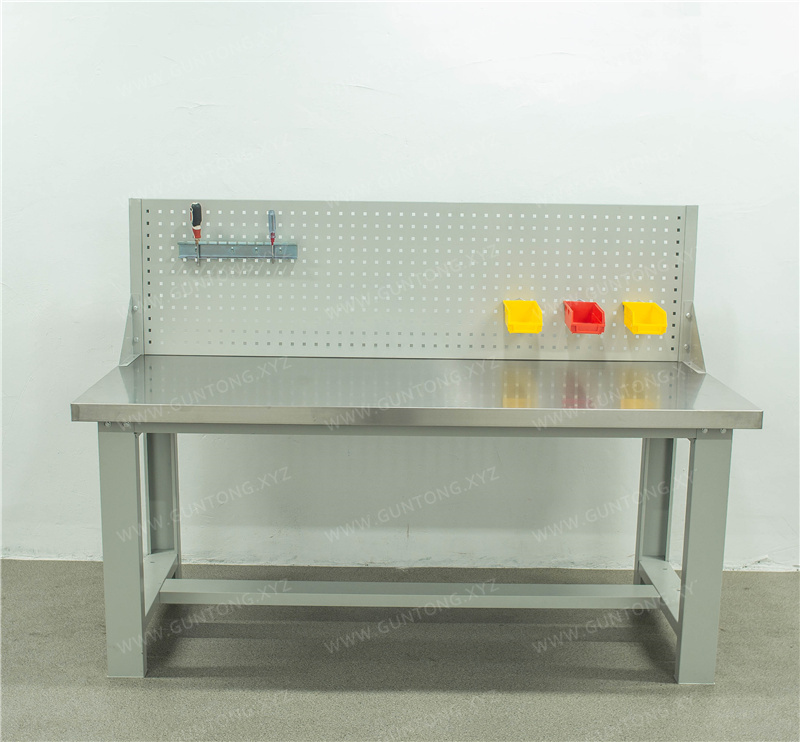
When specifying a composite worktop, confirm the full sandwich structure. For example, the Single Back Panel 4-Drawer Steel Plate Workbench uses a raw steel plate bonded to high-density fiberboard with black PVC edge banding. This composite approach delivers both impact resistance and a flat working surface.
Drawer and Storage Integration
Worktop choice affects how you configure under-bench storage. Heavy composite tops pair well with high-load drawer cabinets—drawers rated for substantial weight with high extension ratios are common in these setups. ESD worktops, being lighter, allow more flexibility in cabinet placement but require that all storage components (drawers, pegboards, tool rails) also meet static-dissipative requirements if the entire workstation must maintain ESD integrity.
Standard Dimensions and Lead Time
Common bench dimensions are available for both worktop types in standard lengths. Standard sizes reduce lead time and cost. Non-standard widths or depths require custom cutting and may extend delivery, particularly for ESD surfaces that must be tested after fabrication.
After Adoption: Maintenance and Lifecycle Boundaries
Composite Worktop Maintenance
- Do:*
- Inspect edge banding quarterly; re-seal if PVC lifting is observed.
- Do:*
- Use the steel plate surface for direct hammering or pressing operations.
- Don't:*
- Expose the fiberboard core to prolonged moisture if the steel layer is scratched through.
ESD Worktop Maintenance
- Do:*
- Test surface resistance periodically with a megohmmeter to confirm dissipative properties remain within spec.
- Do:*
- Clean with ESD-safe solutions only; standard industrial degreasers can alter surface resistance.
- Don't:*
- Place heavy metal parts directly on the ESD surface without a sacrificial mat—point loads can crack the conductive layer.
Replacement Triggers
| Signal | Composite Top | ESD Top |
|---|---|---|
| Surface gouging exposing core | Replace or overlay | Replace immediately if conductive layer is breached |
| Edge delamination | Repairable in some cases | Usually requires full replacement |
| Failed static test | Not applicable | Replace—no field repair restores certified ESD performance |
Decision Summary: Which Worktop Fits Your Scenario?
Choose a composite worktop when:
- Your primary work involves metal parts, heavy assemblies, or mold maintenance
- Operators use hand tools, presses, or impact equipment directly on the surface
- Static control is not a process requirement
- You need maximum load capacity at a moderate cost point
Choose an ESD worktop when:
- Your products include bare PCBs, semiconductors, or static-sensitive assemblies
- Your quality system or customer contracts mandate ESD-compliant workstations
- Operators handle lightweight components where surface impact is minimal
- You can commit to periodic resistance testing and ESD-safe cleaning protocols
Consider a hybrid approach when:
- A single workstation serves both mechanical and electronic tasks
- Budget allows for an ESD mat over a composite base
- You need the structural capacity of composite with localized static protection
Next Steps
If your facility is planning a workstation rollout or replacement cycle, start by mapping each bench location to its dominant risk profile (mechanical vs. static). This single step eliminates most specification errors.
For detailed load calculations, custom dimensions, or to review composite and ESD worktop options with integrated drawer and pegboard configurations, contact Guang'ErMei Precision Components. Our team supports on-site workstation planning, 6S adaptation, and full-process delivery across Guangdong and nationwide.