
How to Use Adjustable Dividers in Tool Cabinets for 5S and Efficient Tool Organization
Who Should Use Adjustable Dividers in Tool Cabinets
Adjustable dividers are most valuable for manufacturing enterprises, electronics and electrical appliance manufacturers, automotive parts manufacturers, hardware mold factories, and maintenance or testing institutions that need to organize small-to-medium tools, inserts, gauges, and consumables. If your workshop is implementing 5S or 6S management, adjustable dividers help define fixed positions for each item, reduce search time, and make missing tools immediately visible.
They are less suitable for heavy molds or large parts — those belong on dedicated mold racks or heavy-duty workbenches. For mixed environments, Guang'ErMei's Pegboard Storage Cabinet (Inner Half-Pegboard Type) combines shelf storage with pegboard surfaces, allowing dividers to handle small items while pegboards manage frequently used hand tools.
Prerequisites Before Installing Dividers
Before adding dividers, confirm three conditions:
- Cabinet interior dimensions and shelf load capacity. Guang'ErMei's standard pegboard storage cabinets offer a load capacity per shelf with adjustable shelves inside a standard body. Dividers must fit within these shelf widths and depths without obstructing shelf adjustment holes.
- Tool inventory classification. Group tools by type, frequency of use, and user. 5S requires that every item has a designated location and that the location is labeled. Dividers work best when you already know what goes where.
- Compatibility with existing drawer or pegboard layouts. If your cabinet already includes drawers — such as the 4-Drawer 1-Door Tool Cart with Pegboard, which uses a stamped drawer configuration — dividers should complement, not duplicate, that storage logic.
Step-by-Step Installation and Layout
Step 1: Measure and Plan the Divider Grid
Measure the internal width and depth of each shelf. Plan divider positions so that each compartment holds one tool type or one set of consumables. Leave adequate clearance on each side for easy insertion and removal.
Step 2: Install Vertical and Horizontal Dividers
Most Guang'ErMei cabinets use square-hole pegboard panels or slotted steel channels that accept clip-in dividers. Insert vertical dividers first to create columns, then add horizontal dividers to form rows. Ensure each divider locks securely into the square-hole pattern — loose dividers defeat 5S purposes and create safety risks.
Step 3: Label Each Compartment
Use color-coded labels or shadow boards to mark each compartment. The label should show the tool name, part number, and quantity. This step is non-negotiable for 5S compliance.
Step 4: Load Tools and Verify Accessibility
Place tools in their designated compartments. Check that operators can retrieve and return items without moving other tools. If retrieval requires shifting items, the divider layout needs adjustment.
Step 5: Conduct a 5S Audit
After one week of use, audit the layout. Are compartments empty? Are tools placed in wrong sections? Empty compartments indicate over-separation; misplaced tools indicate unclear labeling. Adjust divider positions accordingly.
Load Limits and Boundary Conditions
Adjustable dividers in Guang'ErMei cabinets are designed for hand tools, gauges, inserts, and small consumables — not for heavy parts. The per-shelf capacity applies to the shelf itself; dividers add minimal structural support. Do not exceed the shelf load limit by stacking heavy items in divider compartments.
For heavy-duty applications — such as mold storage or automotive parts turnover — use dedicated mold racks or turnover racks instead. Dividers are not a substitute for load-bearing racks.
If your workshop handles long rod materials or oversized items, consider cantilever racks, which Guang'ErMei offers with strong single-arm capacity and reinforced column structures.
Combining Dividers with Pegboards and Drawers
The most effective 5S layouts combine three storage methods:
- Dividers
- for small, categorized items on shelves
- Pegboards
- for frequently used hand tools (Guang'ErMei's standard square-hole pegboard supports flexible hook placement)
- Drawers
- for secure storage of high-value or contamination-sensitive items
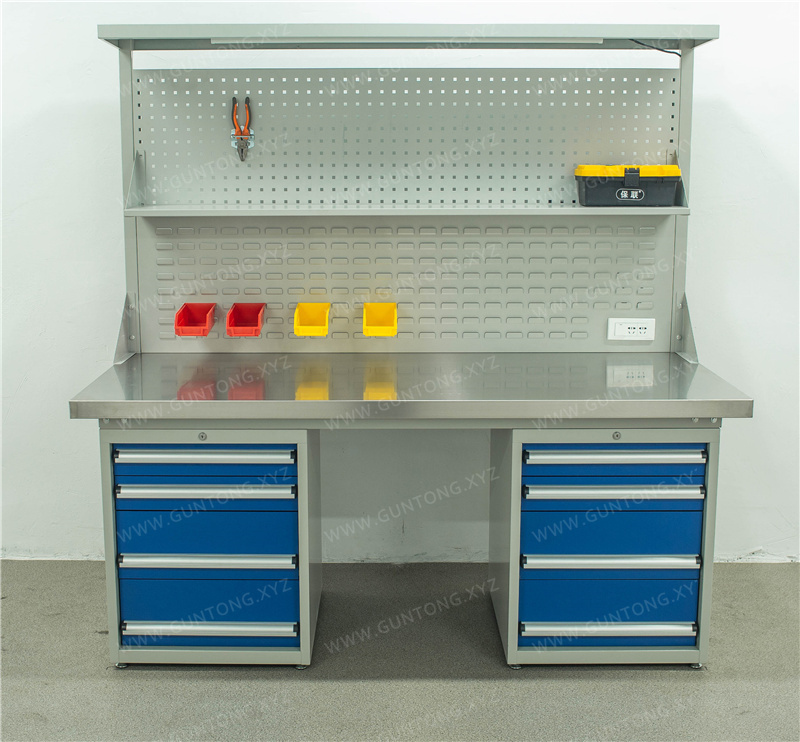
For example, a Single Back Panel Single Door 4-Drawer Steel Plate Workbench integrates a raw steel plate composite desktop with 4 drawers for tiered tool storage. Adding a pegboard storage cabinet nearby with adjustable dividers creates a complete workstation solution.
When to Request Custom Divider Solutions
Standard divider kits fit most Guang'ErMei cabinets, but custom scenarios may require:
- Non-standard shelf widths or depths
- Anti-static divider materials for electronics assembly
- Stainless steel dividers for cleanroom or food-grade environments
- Integrated labeling systems or RFID tracking
Guang'ErMei provides both standardized products and non-standard customization. If your workshop has unique requirements, contact the engineering team with your cabinet model, tool inventory list, and 5S layout diagram.
Next Actions
- Audit your current tool storage and identify items without fixed positions.
- Select the appropriate Guang'ErMei cabinet model based on load capacity and interior dimensions.
- Plan divider layout using the 5-step process above.
- Request a quote for standard or custom divider kits.
- Schedule on-site installation support if needed — Guang'ErMei provides full-chain service from design to after-sales.
For related workstation solutions, explore the Double four-drawer floor cabinet composite workbench or the Single-door four-drawer floor cabinet composite workbench, both designed for integrated tool and workstation management.