
Storage Cabinet Interior Layout Planning: How to Combine Shelves, Drawers, and Pegboards
Who Needs to Plan Storage Cabinet Interior Layouts?
Manufacturing enterprises, electronics and appliance assemblers, automotive parts suppliers, hardware mold factories, and maintenance or testing institutions all face the same challenge: storing mixed-size tools and components in a way that keeps them visible, accessible, and protected. Unlike generic office shelving, workshop storage cabinets must handle heavy items, frequent retrieval, and strict 6S requirements. Interior layout planning is the step where you decide how shelves, drawers, and pegboards work together inside a single cabinet or across a workstation zone.
What Makes a Good Interior Layout?
A well-planned storage cabinet interior balances three elements:
- Shelves
- for bulk or heavy items that do not need daily access.
- Drawers
- for small tools, fasteners, or instruments that must be retrieved quickly and kept dust-free.
- Pegboards
- for visual management of hand tools, gauges, or frequently used accessories.
The goal is not to fill every space, but to assign each item a fixed location that matches its weight, size, and usage frequency.
Step 1: Classify Your Tools and Parts by Weight and Frequency
Before choosing a cabinet model, list the items you need to store and sort them into three groups:
- Heavy or bulky items (e.g., molds, metal blanks, large wrenches) → assign to shelves.
- Medium-weight, high-frequency tools (e.g., power tool accessories, measuring instruments) → assign to drawers.
- Light, visual tools (e.g., screwdrivers, hex keys, calipers) → assign to pegboards.
This classification directly determines your cabinet's internal structure. For example, Guang'ErMei's Pegboard Storage Cabinet (Inner Half-Pegboard Type) uses an upper interior section with adjustable shelves, combined with a dual pegboard layout on the cabinet door. This design separates heavy storage from visual tool management without requiring two separate units.
Step 2: Match Load Capacity to Your Heaviest Items
Load capacity is the most critical technical constraint. If your heaviest stored item exceeds the shelf rating, the cabinet will deform or fail over time.
- Standard adjustable shelves in Guang'ErMei storage cabinets are rated for heavy-duty material storage.
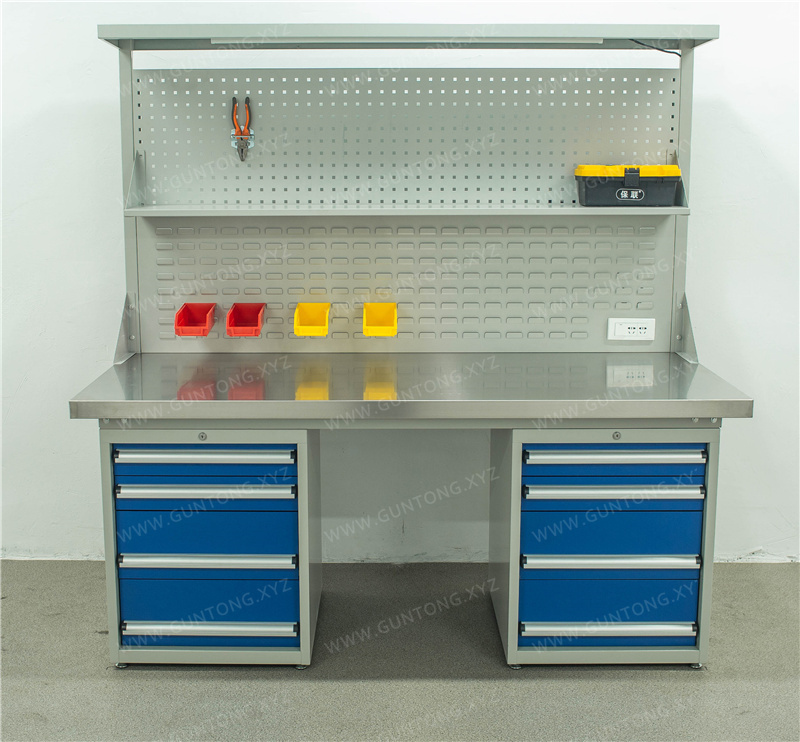
- For heavier workshop needs, composite workbenches with steel plate desktops use C-type cold-rolled steel frames designed for high total frame load capacity.
When planning your layout, always calculate the maximum weight of any single shelf load, not just the average. If your items exceed standard ratings, request a custom load-bearing design during the quotation stage.
Step 3: Decide Between Standard and Custom Configurations
Guang'ErMei offers both standardized products and non-standard customization. Use this decision rule:
- Choose standardized models
- if your tools fit common drawer heights and your cabinet footprint matches standard widths.
- Choose custom configuration
- if you need non-standard drawer combinations, special pegboard dimensions, or integration with existing workstation layouts.
For instance, the 4-Drawer 1-Door Tool Cart with Pegboard uses a fixed drawer configuration with varying drawer heights and a specified load capacity per drawer. If your tool sizes do not match this pattern, a custom drawer layout will prevent wasted space and improve retrieval speed.
Step 4: Plan for 6S and Visual Management
6S adaptation is not optional in modern manufacturing workshops. Your cabinet layout must support sorting, setting in order, shining, standardizing, sustaining, and safety.
- Pegboards enable shadow boards or outline markers for each tool.
- Drawers with labeled dividers reduce search time.
- Adjustable shelves allow you to reconfigure storage as product lines change.
Guang'ErMei's inner half-pegboard storage cabinet places the pegboard on the door interior, so tools are visible the moment the door opens. This supports daily 6S checks without requiring workers to move items around.
Implementation Boundaries and Risks
- Do not exceed shelf load ratings.*
- Overloading causes permanent deformation and voids warranty coverage.
- Do not mix incompatible items.*
- Storing oily parts above electronic instruments in the same cabinet risks contamination.
- Confirm dimensions before ordering.*
- Standard cabinet widths and depths must fit your available floor space, including clearance for drawer opening and door swing.
- Custom layouts require lead time.*
- Non-standard drawer heights, pegboard sizes, or frame modifications need design confirmation and production scheduling.
Next Steps for Procurement Teams
- Conduct a tool audit: list all items, weights, and daily usage frequency.
- Map items to shelves, drawers, or pegboards using the classification above.
- Request a layout proposal from Guang'ErMei with your item list and space constraints.
- Confirm load capacity, dimensions, and drawer configuration before production.
- Schedule on-site installation and 6S alignment if needed.
Guang'ErMei Precision Components provides full-chain service from design and manufacturing to on-site installation and after-sales support, covering standardized and custom workstation equipment for manufacturing, electronics, automotive, hardware, and training environments across Guangdong and nationwide.
For teams evaluating specific models, review the Single Back Panel Single Door 4-Drawer Steel Plate Workbench for heavy-duty composite desktop needs, or the Pegboard Storage Cabinet (Inner Half-Pegboard Type) for combined shelf and visual tool storage.