
Tool Cabinet vs. Tool Cart for Automotive Repair Workshops: A Practical Selection Guide
The Hidden Cost of Wrong Tool Storage in Auto Repair Shops
A common failure in automotive maintenance facilities is not the lack of tools, but the time lost retrieving them. When technicians walk back and forth between a central storage room and the service bay, or when specialized diagnostic instruments are buried under general-purpose wrenches, repair turnaround times increase and 6S management breaks down. This inefficiency usually traces back to a single decision: choosing between a stationary tool cabinet and a mobile tool cart without mapping the choice to the actual workflow.
Guang'ErMei Precision Components designs and manufactures both categories for hardware mold factories, automotive parts manufacturers, and maintenance institutions. The following comparison helps technical evaluators and workshop managers determine which configuration—or combination—fits their specific bay layout and task frequency.
When a Stationary Tool Cabinet Is the Right Choice
A tool cabinet serves as a fixed, high-capacity storage node. It is best suited for scenarios where:
- Heavy or bulky items dominate.*
- Items like torque multipliers, hydraulic pullers, and large socket sets require shelf load capacities that mobile units cannot safely support. Guang'ErMei's Pegboard Storage Cabinet (Inner Half-Pegboard Type) uses cold-rolled steel construction and provides substantial load capacity per adjustable shelf, with multiple shelves as standard.
- Visual management is a priority.*
- The inner half-pegboard layout places a square-hole pegboard on the upper interior section and dual pegboards on the cabinet doors. This allows technicians to hang frequently used hand tools at eye level while storing heavier items on the lower shelves, supporting 6S visual standards.
- The workstation does not move.*
- In dedicated engine rebuild bays or transmission service areas, tools stay in one zone. A tall cabinet anchors the storage to that zone without consuming floor space needed for vehicle lifts.
Boundary condition: Tool cabinets are not designed for frequent relocation. Once positioned and leveled, moving a fully loaded tall cabinet risks tipping and floor damage. If the workshop layout changes seasonally or bays are reconfigured for different vehicle types, a fixed cabinet may become an obstacle.
When a Mobile Tool Cart Fits the Workflow
A tool cart solves a different problem: bringing the tools to the vehicle. It is the better option when:
- Technicians service multiple bays.*
- In dealerships or fleet maintenance shops where a specialist (e.g., an electrical diagnostic technician) moves between vehicles, a cart eliminates repeated trips to a central cabinet.
- Drawer-based organization is needed.*
- Guang'ErMei's 4-Drawer 1-Door Tool Cart with Pegboard offers a tiered drawer configuration with robust load capacity per drawer. Stamped steel dividers keep small fasteners and precision instruments separated during movement.
- Pegboard expansion is required on-site.*
- The standard square-hole pegboard mounted on the cart allows hooks and holders to be reconfigured as the day's task list changes—from brake service in the morning to suspension work in the afternoon.
- Overall footprint must stay compact.*
- The cart fits between vehicle lifts and under overhead storage racks without blocking pedestrian aisles.
Boundary condition: Tool carts have a lower total load capacity than stationary cabinets. Overloading drawers beyond the rated capacity or stacking heavy items on the top shelf compromises caster stability and creates a tip hazard on uneven shop floors.
Decision Matrix: Matching Equipment to the Task
| Evaluation Factor | Tool Cabinet (Stationary) | Tool Cart (Mobile) |
|---|---|---|
| Primary use case | Dedicated bay, heavy tool storage | Multi-bay service, technician-follows-vehicle |
| Typical load per shelf/drawer | High load per shelf | Moderate load per drawer |
| Overall height | Tall vertical storage | Compact with pegboard |
| Pegboard integration | Inner half-pegboard + door pegboards | Top-mounted pegboard |
| Mobility | Fixed position | Lockable casters for bay-to-bay movement |
| 6S visual management | High (large pegboard surface) | Moderate (compact pegboard + drawer labels) |
Combining Both: A Layered Storage Strategy
Many automotive repair workshops achieve the best results by deploying both types in a layered approach. A stationary cabinet acts as the "warehouse" within the bay—holding bulk inventory, specialty tools used weekly, and heavy equipment. A mobile cart acts as the "daily kit," loaded each morning with the tools needed for that day's scheduled jobs.
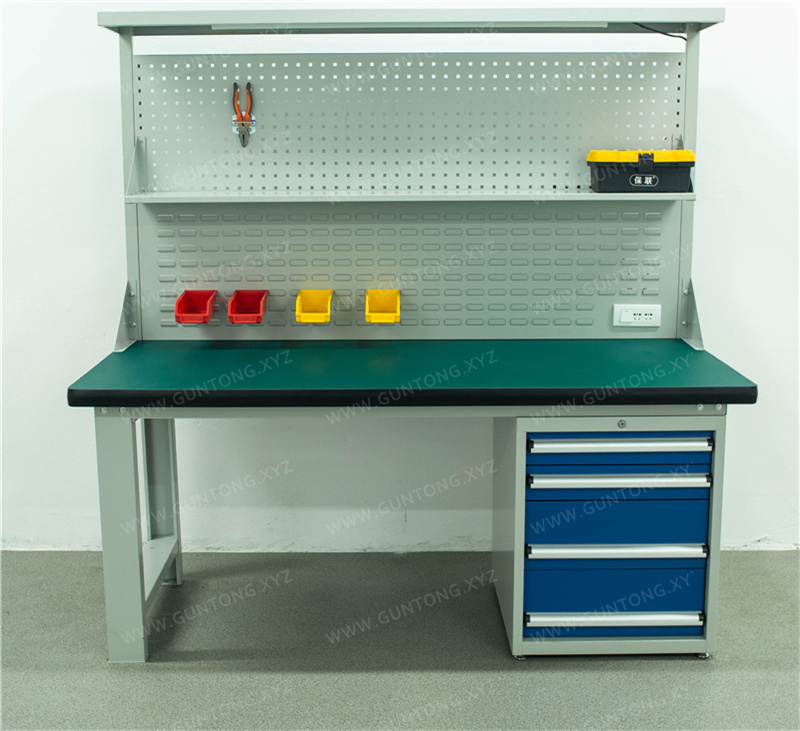
This layered model also supports Guang'ErMei's broader workstation ecosystem. For example, a Single Back Panel Single Door 4-Drawer Steel Plate Workbench can serve as the central assembly surface in a transmission rebuild bay, flanked by a tall pegboard cabinet on one side and a mobile cart on the other. The workbench's raw steel plate composite desktop and high total load capacity handle the heavy components, while the surrounding storage keeps hand tools within arm's reach.
Risk Boundaries and Implementation Notes
- Floor loading.*
- Verify that the workshop floor can support the combined static load of a fully loaded cabinet plus the vehicle lift and the vehicle itself.
- Anti-tip measures.*
- For tall cabinets, anchor to the wall or use anti-tip brackets, especially in seismic zones or facilities with overhead crane vibrations.
- Caster specification.*
- For tool carts, confirm that casters are rated for the total loaded weight and are suitable for the floor type (epoxy, concrete, or anti-static flooring). Polyurethane wheels are generally preferred for automotive shop environments to prevent floor marking.
- Drawer slide durability.*
- Single-rail drawers that open partially are standard for general-purpose use. For high-frequency environments where drawers are opened dozens of times per shift, specify full-extension heavy-duty slides.
Next Steps for Workshop Planners
- Map the workflow. Document how many bays a technician serves per shift and whether tools are shared or dedicated.
- Audit the tool list. Categorize tools by weight, frequency of use, and whether they are general-purpose or job-specific.
- Request a layout proposal. Guang'ErMei provides on-site workstation planning and load-bearing design services for manufacturing and maintenance facilities. Share your bay dimensions and tool audit to receive a customized cabinet-and-cart configuration.
- Validate with a pilot bay. Before rolling out across all service bays, equip one bay with the proposed combination and measure retrieval time and 6S audit scores over a two-week period.