
Tool Cabinet vs. Tool Cart: A Technical Selection Guide for Workshop Layouts
When planning a workshop layout, technical evaluators often face a recurring question: should tools and materials be stored in a fixed tool cabinet or deployed on a mobile tool cart? The answer depends on workflow patterns, load requirements, and how frequently tools need to move between stations. This guide compares the two categories using real product specifications from Guang'ErMei Precision Components to help you make an evidence-based decision.
Who Needs This Comparison
This selection guide is relevant for:
- Manufacturing enterprises setting up new production lines or reorganizing existing workshops
- Electronics and electrical appliance manufacturers requiring anti-static or precision tool storage
- Automotive parts manufacturers managing high-volume turnover and tool retrieval
- Hardware mold factories storing heavy dies and cutting tools
- Maintenance and testing institutions needing flexible tool deployment
- Vocational college training centers balancing durability with student access
Stationary Tool Cabinets: Fixed Storage for High-Load, Low-Mobility Scenarios
Tool cabinets are designed for permanent placement at a fixed workstation. They prioritize load capacity, structural rigidity, and organized internal storage.
Key characteristics:
- Load capacity:*
- Guang'ErMei's Single Back Panel Single Door 4-Drawer Steel Plate Workbench features a C-type cold-rolled steel frame with a total load capacity of 1000 kg. The desktop uses a composite structure of 5mm raw steel plate and 45mm high-density fiberboard, providing both durability and vibration resistance.
- Storage density:*
- The 4-drawer tiered design allows tools to be organized by category, with square-hole pegboards on the back panel enabling visual management of frequently used items.
- Footprint:*
- Standard dimensions range from 1500×750×800mm to 2100×750×800mm (plus 500mm back panel height), making them suitable for dedicated assembly or inspection stations.
When to choose a tool cabinet:
- Tools are heavy (dies, large wrenches, testing equipment) and rarely leave the workstation
- The workflow is stationary—operators remain at a fixed position for extended periods
- 6S management requires clear visual boundaries and fixed storage locations
- The facility has stable power and lighting infrastructure at the workstation
Mobile Tool Carts: Flexible Deployment for Dynamic Workflows
Tool carts are engineered for mobility and on-demand tool delivery. They sacrifice some load capacity and storage volume for the ability to move between workstations.
Key characteristics:
- Mobility:*
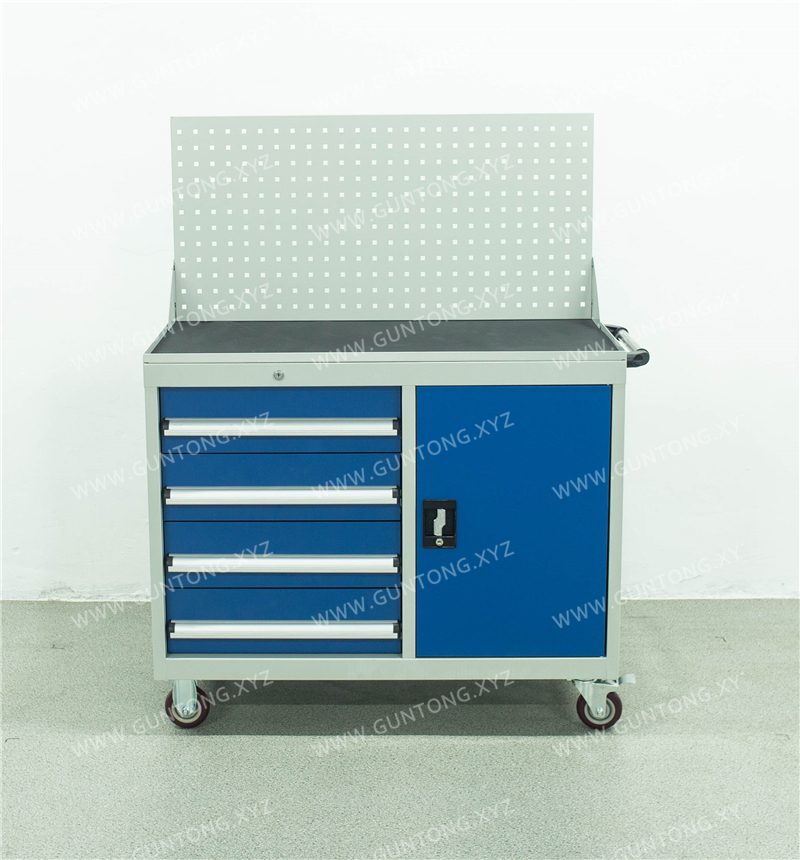
- Guang'ErMei's 4-Drawer 1-Door Tool Cart with Pegboard integrates drawer storage with a 500mm standard square-hole pegboard, allowing tools to be transported and displayed simultaneously. The cart uses high-strength casters with two directional wheels at the front and two swivel wheels with brakes at the rear, ensuring stable movement and secure positioning.
- Load distribution:*
- Each drawer supports 80 kg, with an overall stable structure suitable for medium-weight tools and consumables.
- Flexibility:*
- The pegboard allows tools to be hung at adjustable angles (horizontal or 15°/30° tilt), accommodating different tool geometries and retrieval preferences.
When to choose a tool cart:
- Tools must move between multiple workstations (e.g., maintenance rounds, multi-stage assembly)
- The workflow is dynamic—operators or technicians travel to different locations
- Space is limited, and storage must be consolidated or relocated as needed
- Training environments require shared tool access across multiple student stations
Decision Checklist: Cabinet vs. Cart
Use this checklist to evaluate your specific requirements:
1. Mobility requirement
- Fixed workstation → Tool cabinet
- Multi-station deployment → Tool cart
2. Load capacity
- >500 kg total, heavy dies or equipment → Tool cabinet (1000 kg capacity)
- <400 kg total, hand tools and consumables → Tool cart (80 kg per drawer)
3. Workflow pattern
- Stationary, long-duration tasks → Tool cabinet
- Dynamic, short-duration tasks with movement → Tool cart
4. Visual management
- Fixed pegboard for permanent tool outlines → Tool cabinet
- Mobile pegboard for flexible tool display → Tool cart
5. Space constraints
- Dedicated workstation with ample floor space → Tool cabinet
- Shared or limited space requiring consolidation → Tool cart
Hybrid Approaches: Combining Cabinets and Carts
Many facilities benefit from a hybrid strategy. For example:
- Primary workstation:*
- Install a tool cabinet for heavy, rarely moved items (dies, calibration tools, spare parts)
- Secondary deployment:*
- Use tool carts for daily consumables, hand tools, and items that must follow the operator
Guang'ErMei's product line supports this approach with complementary designs. The Single Back Panel 4-Drawer Steel Plate Workbench can serve as the primary station, while the 4-Drawer 1-Door Tool Cart with Pegboard handles mobile retrieval. Both products share the same square-hole pegboard standard (500mm), ensuring visual consistency across the workshop.
Implementation Boundaries and Risk Factors
Tool cabinet risks:
- Overloading drawers beyond rated capacity can damage slide mechanisms
- Poor placement (e.g., blocking aisles) can violate 6S principles
- Lack of mobility may force operators to walk excessive distances for tool retrieval
Tool cart risks:
- Exceeding per-drawer load limits (80 kg) can compromise caster stability
- Frequent movement may accelerate wear on pegboard hooks and drawer slides
- Inadequate brake engagement can lead to unintended cart movement on inclined floors
Mitigation strategies:
- Confirm load requirements with actual tool weights before procurement
- Map workflow patterns to determine mobility frequency
- Specify caster types (directional vs. swivel, with or without brakes) based on floor conditions
- Plan for future expansion—modular pegboard systems allow reconfiguration without replacing the entire unit
Next Steps for Technical Evaluators
- Audit current tool inventory: Categorize tools by weight, frequency of use, and mobility requirement
- Map workflow patterns: Identify stationary vs. dynamic workstations
- Calculate load requirements: Sum tool weights per station and compare against product specifications
- Request site assessment: Guang'ErMei provides on-site workstation planning and load-bearing design services to validate your selection
- Prototype and test: Deploy one unit of each type in a pilot area before full rollout
Conclusion
The choice between a tool cabinet and a tool cart is not about which is "better"—it is about which matches your workflow, load requirements, and space constraints. Stationary cabinets excel in high-load, fixed-position scenarios, while mobile carts provide flexibility for dynamic workflows. Many facilities benefit from a hybrid approach, using both to optimize tool accessibility and workshop efficiency.
Guang'ErMei Precision Components offers standardized products and non-standard customization across both categories, with full-chain service from design and manufacturing to on-site installation and after-sales support. Contact our technical team to discuss your specific requirements and receive a tailored workstation storage solution.