
How to Read Heavy Duty Workbench Load Capacity Specs: A Technical Guide for Facility Planners
How to Read Heavy Duty Workbench Load Capacity Specs: A Technical Guide for Facility Planners
When sourcing workstation equipment for manufacturing, automotive parts production, or hardware mold factories, buyers often focus solely on the total load capacity metric. However, a 1000kg total rating does not guarantee that the workbench will perform reliably under your specific operational conditions. Understanding how to read heavy duty workbench load capacity specs requires looking beyond the headline number to evaluate frame geometry, desktop composition, and component-level limits.
This guide breaks down the technical principles of load capacity specifications, helping facility planners and procurement teams make evidence-based decisions before, during, and after equipment adoption.
Before Adoption: Deconstructing the Specification Sheet
Before finalizing a purchase, it is critical to understand how the total load capacity is achieved. The structural integrity of a heavy-duty workbench relies on the synergy between its leg frame and desktop material.
Evaluating Frame Geometry and Material
The frame dictates the overall stability and load-bearing baseline. When reviewing specifications, look for the exact dimensions and material of the leg structure. For instance, heavy-duty composite workbenches typically feature a 50mm thick green composite desktop supported by 100x50x1.5mm C-type steel legs to achieve a 1000kg overall load capacity. The use of C-type cold-rolled steel provides superior torsional rigidity compared to standard square tubing, preventing frame racking when heavy loads are shifted across the surface.
Analyzing Desktop Composition
The desktop material determines how well the bench handles concentrated point loads versus evenly distributed loads.
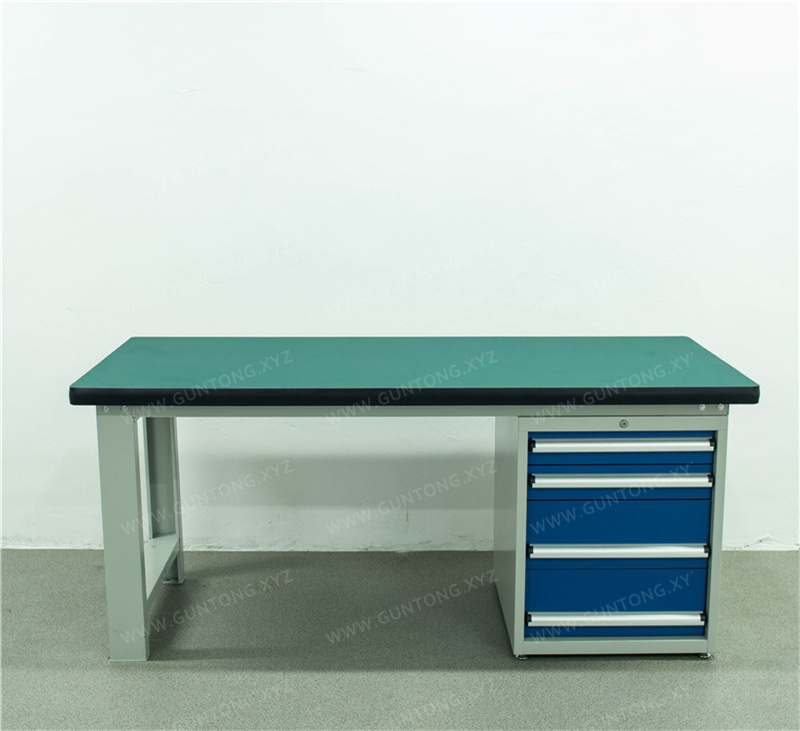
- Composite Desktops: A 50mm thick high-density composite surface is excellent for general assembly and absorbs vibration, but it requires a robust underlying steel frame to prevent sagging under concentrated heavy molds.
- Steel Plate Composite Desktops: For heavier impact or machining tasks, a composite structure featuring a 5mm raw steel plate over a 45mm high-density fiberboard offers higher localized load resistance and extends the service life of the surface.
During Adoption: Evaluating Component-Level and Dynamic Loads
During the installation and operational phase, the theoretical total capacity meets real-world physics. Facility planners must ensure that the workstation sub-components align with daily material handling processes.
Component Load Limits vs. Total Capacity
A common misinterpretation of specifications is assuming the total capacity applies to any single point. A standard composite top workbench with three horizontal drawers utilizes 100x50x1.5mm C-type steel for the legs and a 50mm thick green composite desktop, supporting an overall capacity of 1000kg with an 80kg limit per drawer. If an operator places a 150kg automotive part inside a single drawer, the drawer slides will fail, even though the total weight on the bench is well below 1000kg. Always cross-reference drawer, shelf, and pegboard limits against your heaviest individual items.
Dynamic vs. Static Loading
Specifications usually reflect static, evenly distributed loads. In dynamic environments, such as maintenance and testing institutions where heavy equipment is frequently dropped or slid across the surface, the effective load capacity is reduced. If your application involves dynamic impacts, you must apply a safety factor and select workbenches with reinforced crossbeams and thicker desktop plates.
After Adoption: Verification and Long-Term Performance Boundaries
After the workbenches are deployed on the shop floor, ongoing verification ensures that the equipment continues to operate within its designed boundaries.
Monitoring Deflection and Structural Fatigue
Over time, continuous loading near the maximum capacity can cause micro-deflections in the desktop or frame. Facility managers should periodically inspect the workbench for any visible sagging in the center of the desktop or misalignment in the drawer tracks. If a workbench is consistently loaded to 90 percent of its 1000kg capacity, consider redistributing the weight or upgrading to a custom heavy-duty model with additional center support legs.
Integration with Automated and Storage Systems
As facilities upgrade to lean manufacturing or automated storage and retrieval systems, workbenches often serve as transfer stations. When integrating workbenches with systems like miniload automated storage, which typically handles 50 to 100kg per tote, ensure that the workbench height and load transfer points align seamlessly without exceeding the localized load limits of the bench edge or integrated roller tracks.
Conclusion
Reading heavy-duty workbench load capacity specs is a multidimensional process. By evaluating the frame material, desktop composition, and individual component limits, manufacturing enterprises can avoid structural failures and optimize their workshop layouts. True load capacity is not just a single number; it is a carefully engineered balance of materials and geometry designed for specific industrial applications.
Next Steps
If your facility requires workstation equipment that goes beyond standard catalog specifications, Guang'ErMei Precision Components provides comprehensive design, production, and installation services. Contact our engineering team to discuss your specific load requirements, operational scenarios, and custom workstation planning.