
How to Choose Workshop Workbenches by Task Type: Assembly, Inspection, and Maintenance
Manufacturing facilities, electronics plants, and automotive parts workshops often deploy the same generic workbench across every station. This approach leads to premature surface damage, insufficient load capacity for heavy tooling, and inefficient tool access during maintenance. Choosing a workbench by task type—rather than by general availability—directly impacts workstation ergonomics, 6S compliance, and long-term equipment costs.
Huizhou Guang'ErMei Precision Components designs and manufactures workshop workbenches tailored to specific operational scenarios, supporting both standardized configurations and non-standard customization for clients across Guangdong and nationwide.
Task Type 1: Assembly Workbenches
Assembly operations require stable surfaces, moderate load capacity, and integrated storage for fasteners, small components, and hand tools.
Key Selection Criteria:
- Load Capacity: Most electronics and small-parts assembly tasks require workbenches with an overall load capacity of 500–1000 kg. Guang'ErMei's composite-top workbenches use 100×50×1.5 mm C-section steel legs and 50 mm thick composite desktops, delivering an overall bearing capacity of 1000 kg—sufficient for multi-operator assembly lines.
- Surface Material: A 50 mm green composite desktop provides impact resistance and a smooth finish that protects delicate components during electronics assembly.
- Storage Configuration: Horizontal drawer configurations (such as three-drawer or four-drawer setups with 85% extension slides) keep fasteners and torque tools within arm's reach. Each drawer typically supports 80 kg, accommodating heavy tool sets without sagging.
- Standard Dimensions: Common assembly bench sizes include 1500×750×800 mm, 1800×750×800 mm, and 2100×750×800 mm, allowing planners to align bench footprints with production cell layouts.
Suitability: Electronics manufacturing, electrical appliance assembly, and light automotive sub-assembly lines.
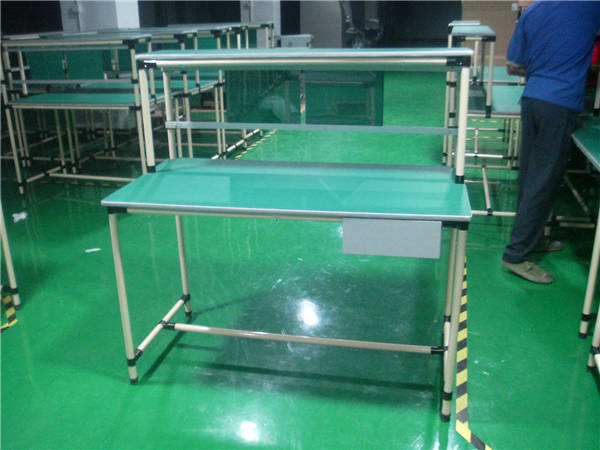
Task Type 2: Inspection and Testing Workbenches
Inspection stations prioritize surface flatness, anti-static properties, and mounting options for measurement instruments.
Key Selection Criteria:
- Anti-Static Requirements: For electronics testing and semiconductor inspection, anti-static workbenches with grounded composite or stainless steel surfaces prevent electrostatic discharge damage to sensitive components.
- Surface Flatness and Cleanliness: Stainless steel workbenches offer superior flatness and are easy to clean, making them suitable for precision measurement environments and testing institutions.
- Instrument Mounting: Inspection benches often require pegboards, overhead shelves, or monitor arms. Guang'ErMei supports non-standard customization, including integrated hanging panels and overhead frames for calibration equipment.
- Load Considerations: Inspection tasks generally involve lighter loads (200–500 kg), but the bench must remain vibration-free when heavy test fixtures are placed on the surface.
Suitability: Quality control labs, maintenance and testing institutions, vocational college training centers with precision measurement modules.
Task Type 3: Maintenance and Fitter Workbenches
Maintenance and fitter tasks involve heavy impact, frequent use of vices, and exposure to oils and metal shavings.
Key Selection Criteria:
- Heavy-Duty Construction: Fitter workbenches demand robust leg structures. C-section steel legs (100×50×1.5 mm) provide the rigidity needed for vice operations and hammering tasks. For heavier maintenance involving large molds or automotive components, workbenches with reinforced frames and load capacities exceeding 1000 kg are recommended.
- Surface Durability: Composite desktops resist oil penetration and impact, while stainless steel options are preferred in environments requiring frequent washdowns or where corrosion resistance is critical.
- Tool Accessibility: Maintenance technicians benefit from integrated tool cabinets with multiple drawer heights. Guang'ErMei's four-drawer hanging panel workbench configurations combine a 4-drawer tool cabinet (with varied drawer heights for wrenches, sockets, and diagnostic tools) with a pegboard for frequently used instruments.
- Mobility vs. Stability: Fixed workbenches are standard for heavy fitter work, while tool carts serve as mobile maintenance stations for on-machine repairs.
Suitability: Hardware mold factories, automotive parts manufacturers, equipment maintenance departments, and heavy machinery repair shops.
Comparing Workbench Options by Constraint
| Constraint | Assembly | Inspection | Maintenance |
|---|---|---|---|
| Typical Load | 500–1000 kg | 200–500 kg | 1000+ kg |
| Preferred Surface | Composite | Stainless Steel / Anti-Static | Composite / Stainless Steel |
| Storage Need | Drawers for small parts | Pegboards, monitor arms | Heavy-duty tool cabinets |
| Vibration Sensitivity | Low | High | Low |
| Customization Level | Standard to moderate | Moderate to high | High |
Implementation Prerequisites and Boundaries
- Maximum Point Load: Determine the heaviest single item placed on the bench. A 1000 kg overall capacity does not guarantee resistance to concentrated impact from a 200 kg mold dropped on one corner.
- Floor Condition: Uneven floors require adjustable leveling feet. Guang'ErMei's on-site workstation planning service addresses floor flatness and anchoring requirements during installation.
- ESD Compliance: Facilities handling sensitive electronics must specify anti-static surfaces and grounding straps; standard composite tops do not provide ESD protection.
- 6S and Lean Integration: Workbench placement should align with lean pipe systems and workflow paths. Guang'ErMei provides 6S adaptation consulting to integrate benches into existing lean manufacturing layouts.
Trade-Offs to Consider
- Standardized vs. Custom: Standard sizes (1500–2100 mm lengths) offer faster delivery and lower cost. Custom configurations—involving specific drawer layouts, hanging panels, or non-standard dimensions—require longer lead times but deliver better task alignment.
- Composite vs. Stainless Steel: Composite desktops are cost-effective and impact-resistant but lack the corrosion resistance and cleanability of stainless steel. Stainless steel benches carry a higher initial cost but reduce long-term replacement in harsh environments.
- Drawer Load vs. Extension: Drawers rated at 80 kg with 85% extension provide good access, but fully loaded drawers at maximum extension increase tipping risk on lighter bench frames. Always verify the bench's overall stability when drawers are fully extended.
Next Steps for Buyers
- Audit your current workstation tasks and categorize them into assembly, inspection, or maintenance.
- Document the maximum load, surface requirements, and tool storage needs for each category.
- Request a workstation planning consultation to align bench specifications with your facility layout and 6S standards.
Guang'ErMei Precision Components provides on-site workstation planning, load-bearing design, and full-process after-sales service for manufacturing enterprises across Huizhou, Guangdong Province, and nationwide. Contact our team to discuss your specific workbench requirements or request a customized quotation.