
Double Pegboard Stainless Steel Workbench: Customer Scenario Guide for Tool Management and Load Safety
Double Pegboard Stainless Steel Workbench: Customer Scenario Guide for Tool Management and Load Safety
Defining the Scenario: High-Intensity Workshop Demands
In manufacturing environments such as electronics assembly lines, automotive parts workshops, or hardware mold maintenance zones, the workstation is not merely a surface but a critical node in the production flow. The specific customer scenario here involves a need to manage heavy tools, jigs, and components while maintaining strict 6S management standards.
The primary challenge is balancing high-load stability with efficient tool retrieval. A standard workbench often fails when subjected to dynamic loads from frequent tool placement or when storage mechanisms jam under weight. For these applications, a Double Pegboard Stainless Steel Workbench (or a composite equivalent with stainless steel framing) must be selected based on verified mechanical performance rather than general appearance.
Structural Integrity: Frame and Load Capacity
The first step in evaluating a workstation for this scenario is verifying the frame geometry and total load rating. Inconsistent frame specifications are a common cause of premature failure in industrial settings.
According to Guang'ErMei Precision Components product data, the structural foundation relies on a 100501.5mm C-steel frame. This specific cross-section is engineered to support a total load capacity of 1000KG. This parameter is non-negotiable for scenarios involving heavy machinery parts or dense tooling. Selecting a unit without confirmed frame dimensions risks structural deformation under the cumulative weight of equipment and materials.
Furthermore, the surface treatment plays a role in longevity. The frames undergo pickling, phosphating, and anti-static spray processes. This ensures resistance to corrosion in environments where oils, coolants, or humidity are present, which is typical for automotive and mold factories.
Desktop Durability and Material Composition
For scenarios requiring chemical resistance and impact tolerance, the desktop material is the second critical factor. A simple steel sheet may dent or corrode; a solid wood top may warp. The recommended solution utilizes a 50mm thick green composite desktop.
This multi-layer construction provides specific benefits:
- Surface Layer:*
- A 2mm imported high polymer composite film offers superior abrasion and corrosion resistance.
- Core Structure:*
- Composed of 1-3 layers of medium-density fiberboard (MDF), selected based on the required thickness and rigidity.
- Moisture Barrier:*
- A black glue layer protects against moisture ingress.
- Edge Protection:*
- Black plastic edge banding seals the perimeter against dust and debris.
This configuration ensures the work surface remains dimensionally stable even when subjected to heavy machining tasks or repeated tool impacts, making it ideal for precision assembly where vibration control is essential.
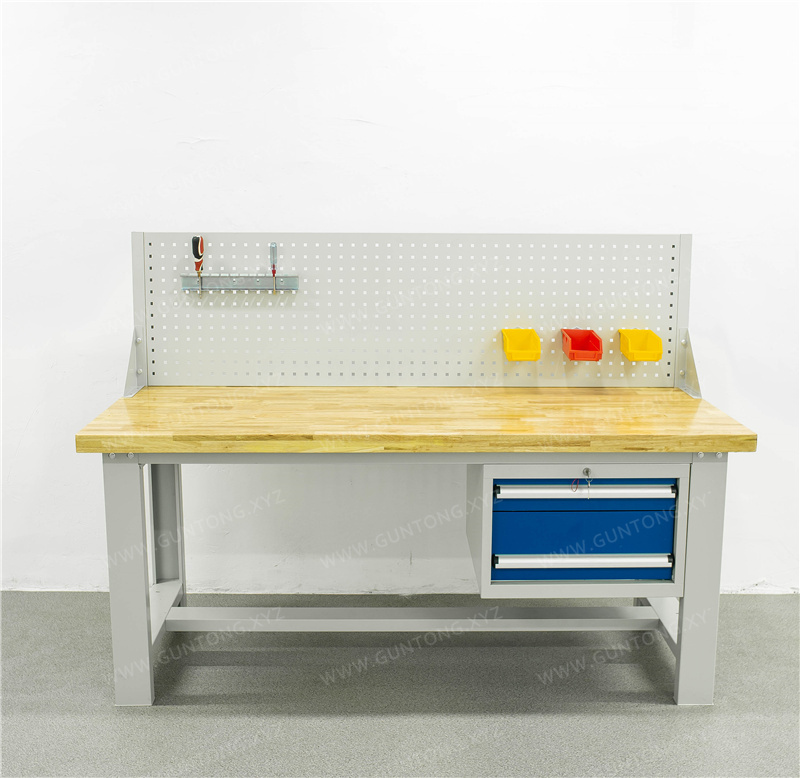
Storage Mechanics: Drawer Accessibility and Limits
Efficient tool management requires more than just shelf space; it demands that tools stored at the rear remain accessible. A common operational failure occurs when drawers cannot be fully opened due to rail limitations or when they sag under excessive weight.
Verified specifications for integrated drawer units indicate that the slide rail system must allow approximately 85% opening capability. This ensures that items stored deep within the cabinet can be retrieved without emptying the entire unit, significantly improving workflow efficiency.
Additionally, individual drawer load ratings are critical. Standard configurations support 80KG per drawer. Exceeding this limit can compromise the sliding mechanism, leading to misalignment or jamming. Decision-makers must ensure that the planned tool inventory does not exceed this per-drawer threshold to maintain long-term reliability.
Implementation Boundaries and Delivery Timelines
When planning the deployment of these workstations, businesses must distinguish between standard inventory and custom requirements.
- Standard Models:*
- Typically available within 2-3 working days for immediate deployment.
- Custom Configurations:*
- Non-standard sizes or specialized layouts require 7-10 working days for production.
Dimensions such as length, width, and height (e.g., 1500750800mm or 1800750800mm) should be validated against existing floor plans before ordering. Customization options extend to color (grey/white or blue/grey combinations) and surface treatment, but these must be confirmed during the inquiry phase to ensure compatibility with site safety regulations.
Application Scenarios and Suitability
This configuration is particularly effective for:
- Electronics/Electrical Appliance Manufacturers: Where static control and component organization are paramount.
- Automotive Parts Manufacturers: Requiring high load-bearing capacity for heavy assemblies.
- Hardware Mold Factories: Benefiting from the durable composite surface against oil and metal shavings.
- Maintenance and Testing Institutions: Utilizing the dual pegboard for rapid tool retrieval during troubleshooting.
Conclusion
Selecting a double pegboard stainless steel workbench requires verifying the 100501.5mm C-steel frame, confirming the 50mm composite desktop composition, and ensuring drawer mechanisms meet the 85% opening and 80KG load criteria. These technical parameters define the boundary between a temporary fixture and a long-term asset. By aligning equipment selection with these verified specifications, enterprises can mitigate risks related to structural failure and improve workshop efficiency through optimized 6S management.
Next Steps
To finalize your workstation layout, please review your specific load requirements and floor dimensions. Our team can assist in mapping out custom configurations that fit your production line constraints.
Contact Us for Custom Workstation Planning
View Product Specifications