
Deploying a Beech Top Workbench with Single Pegboard: A Scenario-Based Guide for First-Time Installation
Deploying a Beech Top Workbench with Single Pegboard: A Scenario-Based Guide for First-Time Installation
For manufacturing engineers and workshop managers in electronics, automotive parts, and hardware mold sectors, the initial deployment of a workstation is rarely just about purchasing a table. It is a critical decision that impacts workflow efficiency, 6S compliance, and long-term operational safety. When selecting a beech top workbench with a single pegboard, the core challenge lies in balancing the need for a stable, heavy-duty assembly surface with the requirement for immediate, visual tool access.
This guide outlines a practical, scenario-based approach to preparing, implementing, and maintaining these stations, leveraging verified product specifications to avoid common deployment pitfalls.
1. Preparation: Defining the Operational Boundary
Before finalizing a design, teams must distinguish between a fixed workstation and a mobile tool cart. This decision dictates the structural requirements and configuration.
- Fixed Station Scenario: Ideal for assembly lines, testing benches, or mold repair areas where the operator remains stationary for extended periods. The primary requirement is maximum stability and high load-bearing capacity for heavy components or precision instruments. A beech top or composite desktop workbench anchored to the floor is the standard solution here.
- Mobile Cart Scenario: Suitable for maintenance rounds or flexible cells where tools must travel to the machine. In these cases, a unit with casters is required. However, users must note that mobility often comes with trade-offs in maximum static load capacity compared to fixed legs.
Decision Checkpoint: If your process involves heavy pressing, precision alignment, or static assembly of large sub-assemblies, a fixed composite desktop workbench is mandatory. If the workflow requires frequent relocation of tools within a 50-meter radius, a mobile cart configuration should be considered as a supplement, not a replacement.
2. Implementation: Structural Validation and 6S Integration
Once the station type is defined, the configuration of storage and surface materials becomes critical. A common error in first-time deployments is underestimating the load requirements of drawer systems or misplacing visual management tools.
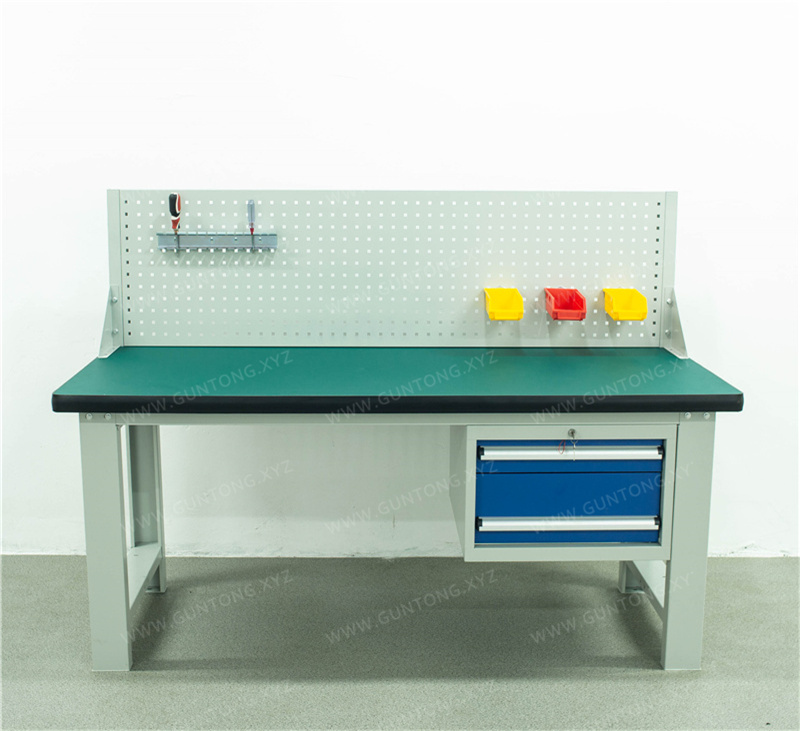
Validating Drawer Load Capacity
In heavy-duty environments like automotive parts manufacturing or mold maintenance, drawers are often overloaded with dense metal tools. Specifying the correct rail system is non-negotiable.
Based on verified specifications for heavy-duty tool storage units compatible with these workstations:
- Load Limit: Each drawer must be capable of supporting at least 80 kg. This ensures that even when fully loaded with steel dies or heavy power tools, the mechanism remains functional.
- Rail Extension: The drawer rails should allow for an 85% opening degree. This feature is essential for deep storage, allowing operators to access items at the rear of the drawer without removing front contents, thereby maintaining organization and safety.
- Material Integrity: The cabinet and drawer bodies should be constructed from 1.0 mm high-quality cold-rolled steel. This thickness provides the necessary rigidity to prevent deformation under repeated heavy loading.
Ignoring these parameters can lead to rail failure, drawer jamming, and compromised safety within months of operation.
Optimizing the Single Pegboard for 6S
The "single pegboard" element is the cornerstone of 6S (Sort, Set in order, Shine, Standardize, Sustain, Safety) visual management.
- Placement: For a right-handed assembly process, the pegboard should ideally be mounted on the rear or side panel within the primary line of sight.
- Function: It serves as the home for high-frequency tools (screwdrivers, calipers, wrenches). By keeping these items visible and outlined, operators reduce search time and can instantly identify missing tools.
- Integration: Unlike a standalone rack, a workbench-integrated pegboard saves floor space and keeps tools within arm's reach of the composite desktop, minimizing unnecessary movement.
3. Acceptance: Inspection Criteria for Custom Builds
When taking delivery of a custom workbench from a manufacturer like Guang'ErMei, the acceptance process should go beyond a visual check. Use the following checklist to verify compliance with your technical agreement:
- Desktop Verification: Confirm the desktop structure. For composite models, ensure the layering (e.g., steel plate combined with high-density fiberboard or beech wood) matches the order to guarantee flatness and wear resistance.
- Drawer Stress Test: Randomly select one drawer, load it with approximately 80 kg of test weight, and extend it to its limit. Verify smooth operation and check for any sagging or binding, confirming the 85% extension capability.
- Pegboard Stability: Apply lateral pressure to the pegboard to ensure it is securely welded or bolted to the frame, preventing wobble during tool retrieval.
- Dimensional Accuracy: Measure the overall footprint against the provided 3D layout to ensure it fits the designated cell without obstructing aisles or utility connections.
4. Maintenance: Sustaining Performance and Safety
Long-term reliability depends on proactive maintenance.
- Rail Lubrication: For heavy-duty drawers, apply light industrial lubricant to the rails every six months to maintain smooth extension, especially in environments with metal dust.
- Surface Care: For beech or composite tops, avoid direct exposure to corrosive chemicals or excessive moisture. Use anti-static mats if the workstation is used for sensitive electronics assembly.
- Fastener Check: Periodically tighten all bolts connecting the pegboard, drawers, and legs, as vibration from nearby machinery can loosen connections over time.
Conclusion and Next Steps
Deploying a beech top workbench with a single pegboard is a strategic investment in workshop efficiency. By adhering to strict load-bearing standards (80 kg/drawer), leveraging the 85% rail extension for accessibility, and strictly defining the boundary between fixed and mobile needs, manufacturers can create robust, 6S-compliant work cells.
Guang'ErMei Precision Components specializes in bridging the gap between standardized efficiency and non-standard customization. Whether you require a specific desktop material, a unique drawer configuration, or a complete workshop layout plan, our team provides design, production, and installation services tailored to your exact specifications.
Ready to optimize your workshop layout? Contact our engineering team today to discuss your specific load requirements and receive a customized 3D layout proposal.