
How to choose comparison and alternatives,sing: selection, rollout and support checklist
Direct Conclusion
For most general assembly, electronics, and hardware mold maintenance lines, a single pegboard 3-drawer composite workbench delivers the optimal balance of surface durability, organized storage, and cost efficiency. However, selecting the correct configuration depends on verifying load requirements, environmental conditions, and workflow frequency before committing to a fixed layout. A structured comparison and alternatives analysis prevents misallocation of capital and ensures the chosen setup aligns with actual floor dynamics rather than theoretical convenience.
Evidence: Core Comparison Criteria
When benchmarking workshop fixtures, focus on three verifiable parameters that directly impact daily operations:
- Desktop Composition & Impact Resistance
A composite desktop workbench typically layers a durable top surface over a reinforced substrate. This construction provides impact resistance, anti-fatigue properties, and electrical insulation without the premium cost of solid metal tops. It is well-suited for precision assembly, light machining, and component inspection where surface protection is critical.
- Storage Integration & Retrieval Speed
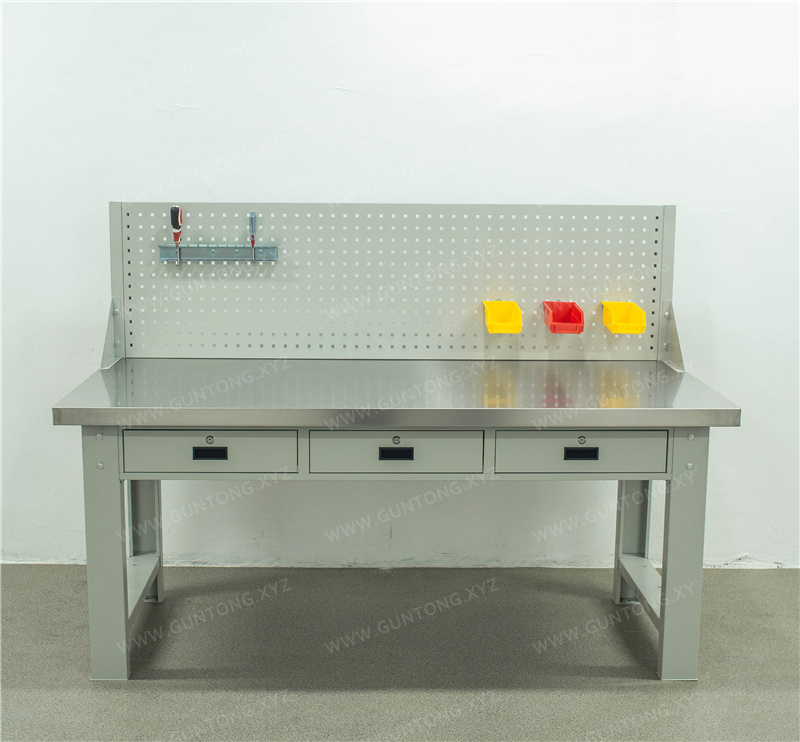
A single pegboard workbench paired with a three-drawer composite workbench setup enables vertical visual management alongside categorized tool stowage. The pegboard supports hooks, bins, and measuring instruments within arm’s reach, while tiered drawers keep fasteners, hand tools, and consumables separated by category. This layout directly supports 6S workbench standards by reducing search time and minimizing cross-contamination between parts.
- Structural Integrity & Frame Engineering
Cold-rolled steel frames with powder-coated finishes resist workshop wear, vibration, and minor chemical exposure. Standardized dimensions can be adjusted to fit tight aisles or wide assembly zones, and modular accessories allow future expansion without replacing the entire unit.
Counterexamples & Application Boundaries
Comparison does not mean one fixture fits all scenarios. Understanding where a composite setup falls short is equally important:
- High-Impact or Welding Zones: Direct welding sparks, heavy hammer forging, or abrasive grinding will degrade composite surfaces. In these environments, a reinforced fitter workbench or stainless steel workbench is required.
- Corrosive or Cleanroom Environments: Prolonged exposure to plating chemicals, solvents, or strict hygiene protocols demands non-porous, easily sanitized materials. Composite tops may absorb residues; stainless or specialized coated alternatives are safer.
- Mobile Maintenance or Cross-Station Testing: If operators require frequent relocation across multiple stations, a fixed single pegboard workbench becomes a bottleneck. Mobile alternatives, such as a 4-drawer 1-door tool cart with pegboard, better serve roaming teams that need to transport tools and components dynamically.
- Bulky Component Storage: When handling large assemblies, bulk fasteners, or irregularly shaped parts, shelf-based storage outperforms drawer-only layouts. A pegboard storage cabinet with adjustable shelves provides better volume utilization than deep drawers.
Actions: Selection & Implementation Checklist
To validate your selection and ensure smooth deployment, follow this assessment sequence:
- Measure Load Requirements: Verify both point-load (e.g., clamps, jigs) and distributed-load expectations against frame ratings. Confirm whether your line requires standard capacity or reinforced support.
- Audit Tool Inventory & Pegboard Compatibility: Check hole spacing, accessory mounting systems, and weight distribution to ensure your existing tooling integrates seamlessly.
- Define Environmental Specifications: Determine if ESD-safe surfaces, chemical-resistant coatings, or fire-retardant laminates are mandatory for your facility.
- Request Technical Documentation: Ask suppliers for detailed cross-section diagrams, finish specifications, and load-test reports. Do not rely on marketing claims alone.
- Map Footprint Against 6S Zoning: Align the workstation layout with traffic flow, emergency access routes, and shadow-board placement to maintain clear, compliant workspaces.
Next Steps
Custom workbench projects begin with accurate site surveys and usage profiling. If you need to optimize a specific zone, compare the proposed layout against your baseline metrics, adjust drawer depths or pegboard heights accordingly, and finalize technical drawings before production. Our engineering team supports full-process planning, from initial concept to on-site installation and after-sales maintenance. Contact us to schedule a workstation assessment or request specification sheets tailored to your line requirements.
Internal Link Suggestions:
- 4-Drawer 1-Door Tool Cart with Pegboard
- Pegboard Storage Cabinet (Inner Half-Pegboard Type)