
Avoiding Critical Errors in Double Pegboard Stainless Steel Workbench Selection
Avoiding Critical Errors in Double Pegboard Stainless Steel Workbench Selection
In manufacturing environments ranging from electronics assembly to hardware mold repair, the workbench is not merely a surface but a critical tool for operational efficiency. A frequent and costly mistake in procurement is treating double pegboard stainless steel workbenches as commodity items, overlooking the specific engineering required for heavy-duty, organized workflows. Decision-makers often prioritize dimensions while neglecting desktop composition, frame fabrication methods, and the adaptability needed for 6S visual management.
This guide outlines the most common specification errors and provides a fact-based checklist for selecting workstation equipment that meets rigorous industrial standards.
The Desktop Composition Trap: Ignoring Material Layers
One of the most prevalent errors is assuming that a "steel top" guarantees durability. Many generic suppliers provide single-layer steel sheets that are prone to denting, excessive noise, and poor vibration damping. This is particularly detrimental in precision assembly or mold repair scenarios where stability is paramount.
The Fact-Based Correction:
High-performance workbenches must offer customizable desktop structures to match specific workload requirements. According to Guang'ErMei's product specifications for mold repair and assembly tables, the desktop surface is not a fixed standard but a configurable element. The manufacturer supports selecting different desktop materials and thicknesses based on user work requirements, such as utilizing 20mm A3 steel plates (or cast iron platforms) treated by large surface grinding.
- Why it matters:*
- A composite or thickened surface treated by precision grinding provides a flat, stable platform that resists impact and reduces operator fatigue. In contrast, thin, untreated sheets can warp under heavy loads.
- Decision Check:*
- When requesting quotes, explicitly ask if the supplier can customize the desktop thickness and material (e.g., A3 steel vs. cast iron) and whether the surface undergoes grinding treatment. If the answer is limited to a single off-the-shelf option, the unit may not suit heavy industrial applications.
Structural Integrity: The Risk of Inferior Frame Fabrication
Another common oversight is underestimating the importance of frame construction. A workbench might appear sturdy visually but fail under the dynamic load of heavy molds, motor assemblies, or dense tool storage if the frame lacks proper reinforcement.
The Fact-Based Correction:
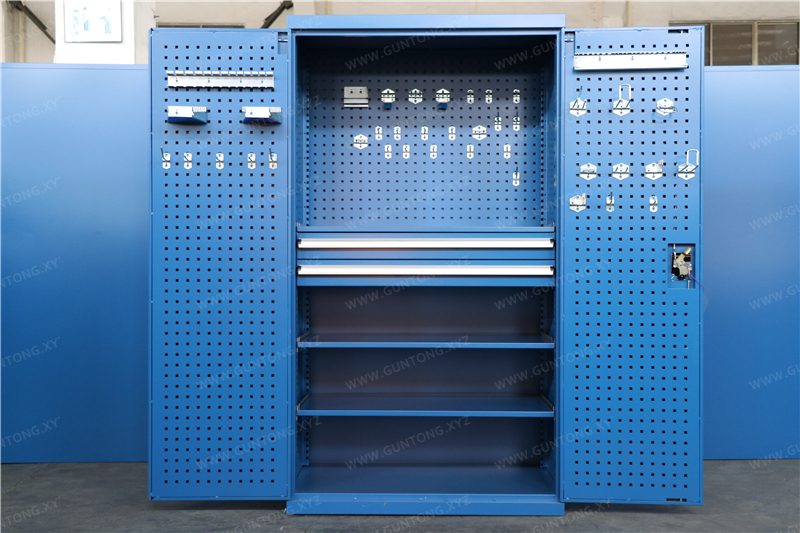
Robust workstation frames require more than simple welding; they demand precision forming. Guang'ErMei's manufacturing data indicates that high-quality frames are constructed using high-quality 2.0mm thick steel plates formed by specialized molds and binding processes.
- Application Context:*
- This fabrication method ensures consistent joint strength and structural rigidity, which is critical for hardware mold factories and maintenance testing institutions. Frames made from lighter gauge steel or without specialized molding often suffer from joint fatigue and wobbling over time, compromising the stability of the attached double pegboards.
- Decision Check:*
- Verify the steel thickness of the frame components and inquire about the fabrication process. Specifically, ask if the manufacturer uses specialized molds for forming key structural joints rather than relying solely on manual welding.
6S Management and Pegboard Functionality
The primary advantage of a double pegboard workbench is its ability to facilitate 6S visual management. However, a frequent implementation error is installing pegboards that are too small, poorly positioned, or incompatible with standard tooling hooks, rendering the system ineffective.
The Fact-Based Correction:
Effective designs integrate pegboards that allow for flexible expansion and zoning. While specific dimensions vary by custom order, the underlying principle is to support a wide range of hanging accessories for visual management. In related tool storage solutions, Guang'ErMei demonstrates this capability through systems designed for flexible tool retrieval and organized storage.
- Strategic Implementation:*
- For a double pegboard setup, ensure the vertical coverage allows for distinct zoning—separating frequently used hand tools from heavier, less frequent equipment. The mounting hardware must be robust enough to hold loaded tool shelves without sagging.
- Decision Check:*
- Confirm that the pegboard hole pattern (e.g., square hole) matches your existing or planned tooling ecosystem. Ask if the manufacturer supports non-standard pegboard heights to match specific wall-mounted workflows.
Customization Boundaries and Engineering Rigor
Buyers often assume "customization" means any dimension is possible without lead time or engineering implications. This leads to delays when structural recalculations are needed for non-standard sizes.
The Fact-Based Correction:
While Guang'ErMei supports extensive non-standard customization, specific constraints apply to maintain safety and quality. The company's engineering rigor is evident in its broader capability to deliver automated storage and retrieval system (Miniload) solutions, where design parameters for tote-based systems generally support loads of 50–100kg per tote and rack heights up to 12 meters. This level of precision engineering implies that custom workbench orders also undergo strict design validation to ensure load-bearing logic is maintained.
- Risk Mitigation:*
- Custom orders involving unique dimensions or specialized stainless steel grades require clear technical agreements. Do not expect off-the-shelf lead times for fully bespoke units.
- Decision Check:*
- Engage the manufacturer's engineering team early. Provide a layout plan that includes not just the bench size, but the intended load distribution and pegboard usage.
Conclusion: A Checklist for Procurement
To avoid these common mistakes, procurement teams should validate the following before signing a purchase order:
- Desktop Specification: Can the supplier customize the desktop material and thickness (e.g., 20mm A3 steel with grinding) based on specific work requirements?
- Frame Fabrication: Is the frame constructed from 2.0mm thick steel plates using specialized molds and binding processes?
- Pegboard Compatibility: Does the double pegboard design support flexible tool zoning and match your specific 6S management needs?
- Customization Protocol: Has the manufacturer confirmed the feasibility and engineering validation for your specific non-standard dimensions?
By focusing on these verifiable technical facts rather than generic marketing claims, manufacturing enterprises in Huizhou and across Guangdong can secure workstation solutions that truly enhance productivity and safety.
Next Step: If you are currently evaluating workbench suppliers, request a detailed specification sheet comparing desktop layers and frame fabrication methods. Contact Guang'ErMei Precision Components to discuss your specific workshop layout and receive a tailored proposal that adheres to these rigorous standards.