
Assessing Anti-Static Upgrade Feasibility for Composite Workbenches in Electronics Assembly: Technical Boundaries and Co
Assessing Anti-Static Upgrade Feasibility for Composite Workbenches in Electronics Assembly: Technical Boundaries and Configuration Limits
For manufacturing enterprises in electronics and electrical appliance production, ensuring electrostatic discharge (ESD) protection at workstations is critical. When evaluating upgrades to existing composite workbenches—particularly those used in high-precision assembly lines—the question arises: Can standard composite desktops be upgraded to meet anti-static requirements?
The answer lies not in general assumptions, but in verifying configuration attributes against documented product specifications.
Key Technical Principle: Anti-Static Is a Configuration Attribute, Not a Material Default
Anti-static capability is not an inherent property of composite workbench surfaces. It must be explicitly engineered through material selection and surface treatment. According to product documentation from Guang'ErMei Precision Components, the composite desktop used in their standard workbenches consists of multiple layers:
- Surface layer: 2mm imported high-molecular composite material
- Intermediate core: 1–3 layers of medium-density board (based on thickness)
- Bottom layer: black adhesive film
- Edge sealing: black plastic edging
This construction provides durability and impact resistance but does not inherently offer anti-static properties. Therefore, any upgrade must involve specific modifications such as conductive coatings or embedded anti-static materials—options that are not included by default in standard models.
Verified Fact: "Main material: Composite desktop: ... surface treatment: acid wash, phosphating, anti-static spray" — from official product documentation
Load-Bearing and Structural Compatibility: What Can Be Upgraded Without Compromise?
Even if anti-static features are added, structural integrity must be maintained. The workbench’s frame and desktop must withstand operational loads without degradation.
Guang'ErMei’s standard composite workbenches use a C-type cold-rolled steel frame with section dimensions of 100×50×1.5mm, designed to support up to 1,000kg total load capacity. This includes both static and dynamic loads during tool movement and component handling.
When considering upgrades, this load limit remains unchanged. Adding anti-static treatments—such as conductive coatings or conductive strips—must not compromise the structural integrity of the desktop or frame. Any modification should be performed by the manufacturer under controlled conditions to avoid weakening the surface or altering thermal expansion characteristics.
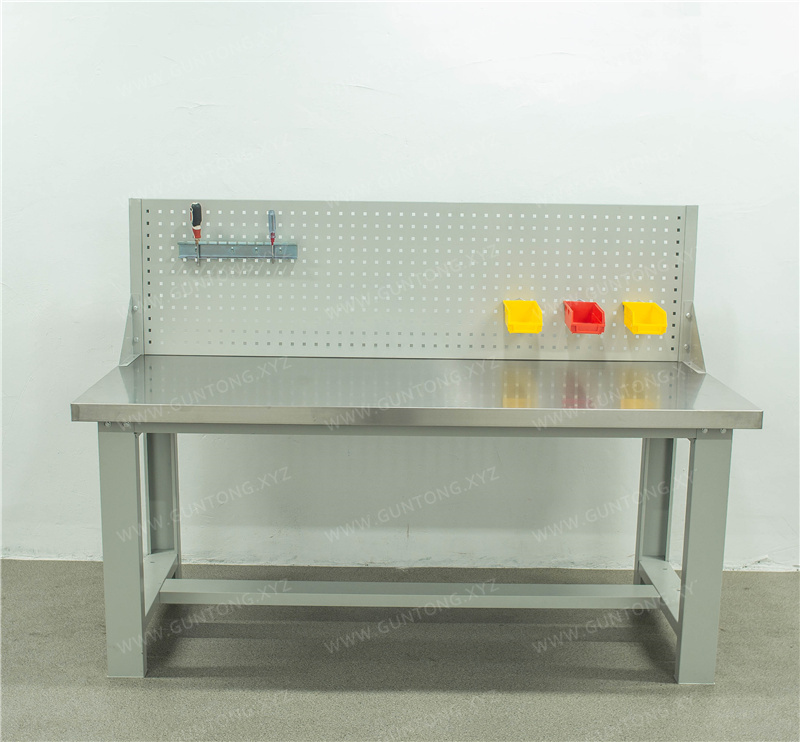
Verified Fact: "Table frame: section 100×50×1.5mm C-shaped steel (load capacity up to 1,000kg)" — from official product documentation
Application Scenarios: Where Upgrades Are Most Critical
In electronics assembly, especially for PCB assembly, semiconductor handling, and precision connector installation, even minor ESD events can cause latent defects. Workbenches located near sensitive operations require anti-static compliance.
However, not all workbenches need the same level of protection. For example:
- Primary assembly stations: Require full anti-static desktops with grounded connections
- Tool storage or secondary staging areas: May only need anti-static tools or mats, not upgraded workbenches
Thus, the decision to upgrade should be based on risk assessment, not blanket application.
Implementation Boundaries: What Cannot Be Done Without Manufacturer Support
Several limitations exist when attempting to retrofit anti-static features:
- No third-party coating application: Applying external anti-static sprays or films may void warranties and create uneven conductivity zones
- No DIY grounding: Grounding requires proper bonding and continuity testing; improper installation increases ESD risk
- No modification of desktop core: Altering the internal structure (e.g., drilling holes) compromises both strength and anti-static performance
Therefore, any anti-static upgrade must be coordinated directly with the equipment provider—Guang'ErMei Precision Components—to ensure compliance with design standards and safety protocols.
Recommended Next Steps for Technical Evaluation
If your electronics assembly line requires anti-static workbenches:
- Identify the workstation type: Confirm whether you need a single-drawer, three-drawer, or pegboard-integrated model (e.g., the Single Back Panel 4-Drawer Steel Plate Workbench or Inner Half-Pegboard Storage Cabinet)
- Verify current model specs: Check if the existing workbench uses a composite desktop with anti-static surface treatment
- Request official upgrade options: Contact Guang'ErMei for available anti-static configurations, including certified grounding methods and test reports
- Confirm delivery timeline: Standard non-customized models have 2–3 working days lead time; custom anti-static versions may require 7–10 working days
Explore related products: Single-door four-drawer floor cabinet composite workbench, Double four-drawer floor cabinet composite workbench
Conclusion: Upgrade Only Within Verified Technical Boundaries
Upgrading a composite workbench for anti-static use is feasible—but only within defined technical and manufacturing boundaries. Anti-static performance is not automatic; it must be specified during design or ordered as a certified configuration. Structural load capacity (up to 1,000kg) and frame integrity (100×50×1.5mm C-type steel) remain unchanged regardless of surface treatment.
For electronics manufacturers seeking reliable, compliant solutions, direct consultation with Guang'ErMei Precision Components is essential to validate upgrade paths and ensure long-term operational safety.
CTA Text
Contact Guang'ErMei Precision Components today to request a technical specification sheet for anti-static configured composite workbenches and confirm eligibility for on-site planning and installation services.