
Workbench Floor Cabinet vs Wall Cabinet: Load, Space, and Workflow Trade-Offs for Workshop Buyers
When planning a new workstation or upgrading an existing production line, buyers often face a specific question: should the storage go under the bench as a floor cabinet, or above the bench as a wall cabinet? The answer is rarely "one is better than the other." It depends on what operators handle, how heavy the items are, and how the workshop manages space and 6S visual standards.
At Huizhou Guang'ErMei Precision Components, we configure workbenches for electronics assembly, automotive parts, hardware mold maintenance, testing labs, and vocational training centers. Based on these deployments, here is a grounded comparison of workbench floor cabinets and wall cabinets, focusing on the constraints that actually drive purchasing decisions.
Where Each Cabinet Type Fits in a Real Workshop
A floor cabinet sits beneath the work surface, typically integrated into the workbench frame. It uses the otherwise wasted space under the desktop and keeps heavy tools, dies, or component bins within arm's reach while the operator is seated or standing at the bench.
A wall cabinet (also called an overhead cabinet or hanging cabinet) mounts above the workbench, usually on a back panel or pegboard upright. It stores lighter items—small parts boxes, measuring instruments, documentation, or frequently referenced samples—at eye level or just above the work zone.
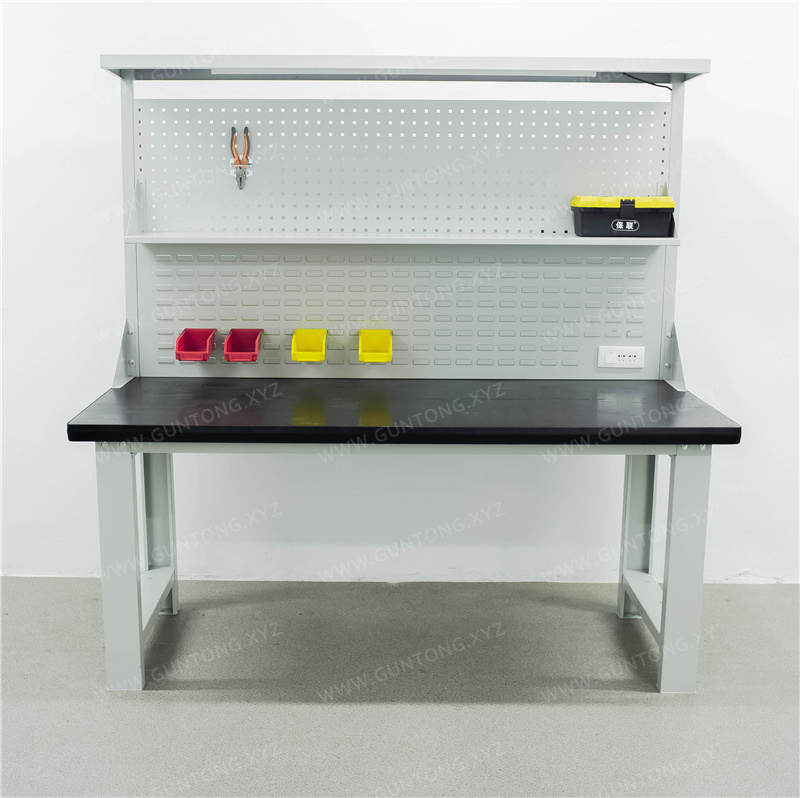
In practice, many Guang'ErMei workbench configurations combine both. A Single Back Panel Single Door 4-Drawer Steel Plate Workbench, for example, pairs under-bench drawer storage with an upper pegboard and optional overhead shelf, addressing both heavy and light storage needs in a single footprint.
Load Capacity: The Deciding Factor for Heavy-Duty Scenarios
The most significant difference between floor and wall cabinets is load-bearing capability.
Floor cabinets are structurally supported by the workbench frame. In Guang'ErMei's composite desktop workbenches, the C-type cold-rolled steel legs and reinforced drawer slides allow individual drawers to carry substantial weight, with total workbench load capacity reaching up to 1,000 kg. This makes floor cabinets suitable for storing metal dies, torque wrenches, automotive parts, and heavy fixture components.
Wall cabinets rely on mounting brackets and the back panel's structural integrity. They are designed for lighter loads—typically small parts bins, hand tools, or documentation. Overloading a wall cabinet risks bracket deformation or panel pull-out, especially in environments with vibration from nearby presses or grinders.
Decision rule: If the items stored per shelf or drawer are heavy metal parts, dies, or large tool sets, a floor cabinet is the safer and more durable choice. Wall cabinets should be reserved for lighter items such as small component bins, measuring instruments, and documentation.
Space and Footprint: When Ceiling Height and Aisle Width Matter
Floor cabinets consume no additional floor space beyond the workbench footprint itself. They are ideal for workshops where aisle width is constrained and adding standalone tool cabinets would obstruct material flow.
Wall cabinets consume vertical space above the bench. They require sufficient ceiling clearance to avoid interfering with overhead cranes, lighting rigs, or ventilation ducts. In facilities with low ceilings or dense overhead infrastructure, wall cabinets may not be feasible.
For lean manufacturing layouts using pipe-rack systems or automated storage and retrieval system (AS/RS) accessories, wall cabinets can interfere with tote-based Miniload systems where rack heights approach 12 meters. In these environments, under-bench floor cabinets are the default storage solution.
Tool Access and Operator Ergonomics
Floor cabinets require the operator to bend or crouch to access lower drawers. This is acceptable for tools used intermittently but inefficient for high-frequency retrieval. Guang'ErMei addresses this with tiered drawer configurations—such as varying drawer heights in the 4-Drawer 1-Door Tool Cart with Pegboard—placing the most-used items in the upper drawers at waist level.
Wall cabinets place items at or above eye level, reducing bending but requiring reaching or stepping for upper shelves. For precision assembly or electronics work where operators remain seated, wall cabinets keep small components and ESD-safe bins visible and accessible without cluttering the desktop.
Ergonomic guideline: High-frequency tools belong in the "golden zone"—waist to shoulder height. Floor cabinet top drawers and wall cabinet lower shelves both occupy this zone. Reserve deeper or higher positions for low-frequency items.
6S Visual Management and Standardization
In workshops implementing 6S methodology, wall cabinets offer a visual advantage: items stored on open shelves or behind transparent doors are immediately auditable. Floor cabinets, being enclosed and below sightlines, require labeled drawer fronts and shadow boards inside drawers to maintain visual control.
Guang'ErMei's Pegboard Storage Cabinet (Inner Half-Pegboard Type) bridges this gap by combining enclosed lower storage with an upper half-pegboard on the cabinet door, allowing both concealed heavy-item storage and visible tool hanging in a single unit.
Configuration Checklist for Buyers
Before specifying floor or wall cabinets, confirm the following:
- Heaviest item to be stored:*
- Determines whether floor cabinet load capacity is required.
- Retrieval frequency:*
- High-frequency items should be in the ergonomic golden zone, regardless of cabinet type.
- Ceiling clearance and overhead obstructions:*
- Limits wall cabinet feasibility.
- Workbench desktop type:*
- Composite desktops with high-density fiberboard and steel plate support heavier under-bench loads than standard laminate tops.
- Future automation integration:*
- If AS/RS or conveyor systems are planned, under-bench storage avoids overhead interference.
Next Steps
If your team is evaluating workstation configurations for a new production cell or a facility-wide 6S rollout, Guang'ErMei provides on-site workstation planning, load-bearing design, and full-process after-sales support across Guangdong and nationwide. Share your workbench dimensions, heaviest stored items, and operator workflow, and we will recommend a floor cabinet, wall cabinet, or combined configuration matched to your actual constraints.