
Why Load Distribution Matters Even with the Same Total Weight on a Workbench
Manufacturing planners and workshop supervisors often specify workbenches by a single number: the total load capacity. A bench rated for 1000 kg, for example, seems adequate for any combination of tools, fixtures, and workpieces that stay under that figure. In practice, however, the way weight is distributed across the desktop and frame is just as critical as the total mass. Uneven loading introduces bending moments, torsional stress, and localized fastener fatigue that a simple weight check will never reveal.
This article explains why load distribution matters on industrial workbenches, where the hidden risks appear in real workshop scenarios, and what buyers and facility planners can do to specify and use workstation equipment safely.
The Structural Logic Behind Load Ratings
When a manufacturer states that a workbench has an overall load capacity of 1000 kg, that figure is typically derived from a uniformly distributed load (UDL) test. The weight is spread evenly across the entire desktop surface, and the frame, legs, and joints share the stress proportionally.
In a real workshop, loading is rarely uniform. Consider a fitter workbench where a 150 kg vise is bolted to one corner, a 60 kg grinder sits nearby, and the rest of the surface holds only light hand tools. The total weight may be well under 1000 kg, but the leg and crossbeam nearest the vise are carrying a disproportionate share of the force. Over time, this leads to:
- Desktop deflection in the overloaded zone, especially on composite or fiberboard-core surfaces.
- Fastener loosening at the leg-to-frame connection on the heavily loaded side.
- Frame racking, where the rectangular geometry of the bench slowly deforms into a parallelogram under repeated asymmetric stress.
These failure modes are progressive. A bench may appear stable for months before a joint gives way or a drawer rail binds because the frame has twisted by just a few millimeters.
Where Uneven Loading Shows Up in Real Workshops
Heavy-Duty Assembly and Fitting Stations
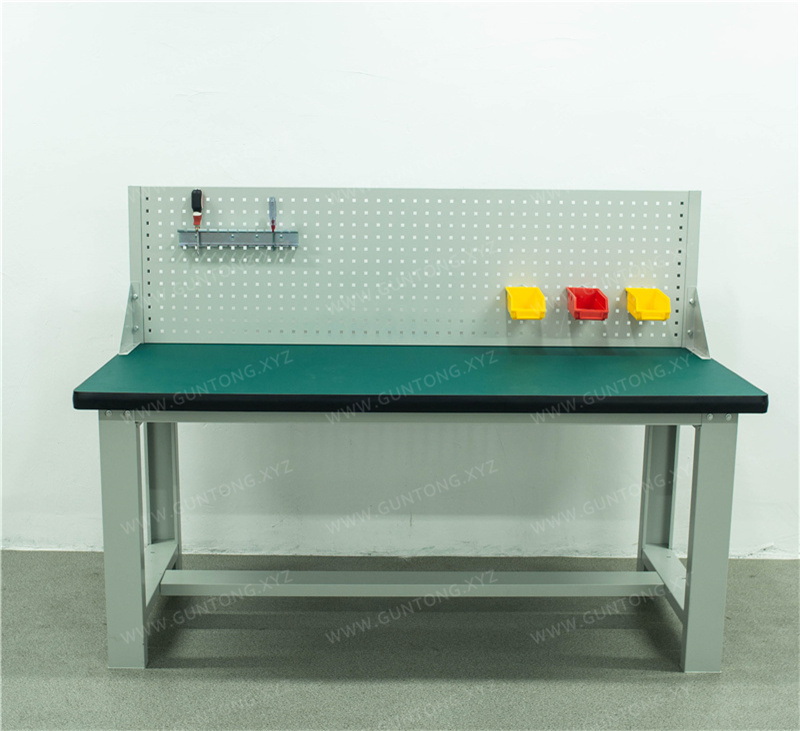
In automotive parts manufacturing and hardware mold factories, operators frequently mount heavy fixtures, press jigs, or torque multipliers to one section of the workbench. A composite-top workbench with a 50 mm high-density fiberboard core and C-type cold-rolled steel frame (100×50×1.5 mm profile) is engineered to handle substantial static loads, but the design assumption is that those loads are spread across the span. When a 200 kg assembly jig occupies only a 400×400 mm area on one end, the local bearing stress on the desktop can exceed the material's compression limit even though the bench's total load rating is not breached.
Drawer and Cabinet Configurations
Workbenches with integrated drawers introduce another layer of complexity. A four-drawer configuration, for instance, may have each drawer rated for 80 kg. If an operator stores dense metal stock or large die components in the top drawer only, the center of gravity shifts upward and to one side. This not only increases tipping risk when the drawer is fully extended (some designs allow 85% extension) but also imposes a lateral moment on the frame that a static load test does not replicate.
Tool Cart and Mobile Workstation Scenarios
Mobile equipment such as a 4-drawer 1-door tool cart with a pegboard back panel faces dynamic loading in addition to static imbalance. When the cart is pushed across an uneven workshop floor with heavy tools concentrated in the upper drawers, the inertial forces multiply the effective load on the caster mounts and the nearest frame joints. The 500 mm standard square-hole pegboard on the back adds further asymmetry when loaded with hanging tools.
Practical Rules for Managing Load Distribution
1. Map the Heaviest Items Before Specifying the Bench
Before ordering, list every fixture, machine, and tool group that will sit on or in the workbench, along with approximate weights and footprint dimensions. Identify the heaviest single item and the zone where it will be placed. If one zone will consistently carry more than 40% of the total load, request a reinforced frame section or a thicker desktop in that area.
2. Use the Frame Geometry to Your Advantage
C-type cold-rolled steel frames, such as the 100×50×1.5 mm profiles used in Guang'ErMei's composite-top workbenches, resist vertical compression well but rely on cross-bracing and the desktop-to-frame fastener pattern to resist torsion. Specify additional cross-members or gusset plates if the planned loading is heavily asymmetric. For benches longer than 1800 mm, a mid-span support leg reduces deflection significantly under concentrated loads.
3. Balance Drawer Loading from Top to Bottom
For workbenches with integrated drawer cabinets, establish a loading protocol: heaviest items in the lowest drawer, medium-weight items in the middle, and light items in the top drawer. This keeps the center of gravity low and reduces the overturning moment when drawers are extended. Where drawer loads are expected to approach the 80 kg per-drawer limit, confirm that the drawer slides are full-extension, heavy-duty rated, and that the cabinet body is welded rather than bolted.
4. Account for Dynamic and Impact Loads
Static weight is only part of the picture. Dropping a 30 kg workpiece onto a composite desktop from a height of 300 mm generates an impact force several times the static weight. In maintenance and testing environments where heavy components are frequently set down or repositioned, specify a steel-plate-top workbench (such as a 5 mm raw steel plate composite desktop) rather than a plain fiberboard or laminate surface. The steel plate distributes impact energy across a wider area of the core material.
5. Re-Evaluate After Layout Changes
Workshop layouts evolve. A bench that was originally positioned for light assembly may later be repurposed for heavy fitting work. Each time the task profile changes, revisit the load distribution assessment. This is especially important in 6S-managed facilities where workstation reconfiguration is frequent.
Boundaries and Limitations
It is important to recognize what load distribution management cannot fix:
- Exceeding the total rated capacity is never safe, regardless of how evenly the weight is spread.
- Point loads from sharp-edged fixtures can damage the desktop surface even when the overall weight is low. Use load-spreading plates under narrow-base equipment.
- Thermal and chemical exposure can degrade composite desktop materials over time, reducing their effective load capacity. In environments with welding spatter, solvent spills, or sustained high temperatures, stainless steel or solid steel tops are more appropriate.
- Non-standard modifications such as drilling additional mounting holes or cutting away sections of the frame invalidate the original load rating. Any modification should be reviewed by the manufacturer or a qualified structural engineer.
Selecting the Right Workbench Configuration
| Scenario | Recommended Desktop | Frame Consideration | Load Distribution Note |
|---|---|---|---|
| General assembly, evenly distributed tools | 50 mm composite (fiberboard core + PVC edge) | Standard C-type cold-rolled steel | UDL assumption holds; standard configuration adequate |
| Heavy vise or fixture on one end | 5 mm steel plate + composite core | Reinforced cross-member near heavy zone | Concentrated load zone requires local reinforcement |
| Maintenance and testing with impact loading | 5 mm raw steel plate composite | Additional mid-span leg for spans >1800 mm | Impact forces require energy-distributing surface |
| Cleanroom or food-grade environment | Stainless steel top | Stainless steel frame and fasteners | Corrosion resistance; load rating may differ from carbon steel |
| Mobile workstation with dynamic loads | Steel plate or composite with steel cap | Welded frame, heavy-duty casters | Dynamic forces amplify static load; reduce rated capacity by 20-30% for safety margin |
Next Steps for Workshop Planners
If your facility is specifying new workbenches or reconfiguring existing ones, start by documenting the actual load profile at each workstation—not just the total weight, but where that weight sits and how it moves during a shift. Share this data with your workstation equipment supplier so they can recommend frame reinforcements, desktop materials, and drawer configurations that match reality rather than assumptions.
Guang'ErMei Precision Components provides on-site workstation planning, load-bearing design, and 6S adaptation services for manufacturing facilities across electronics, automotive, hardware mold, and maintenance sectors. Our standard and custom workbenches, tool cabinets, and tool carts are engineered with documented load ratings and configurable frame geometries to address both uniform and asymmetric loading scenarios.
For instance, a typical composite-top workbench with 100×50×1.5 mm C-channel steel legs and a 50 mm thick green composite desktop is rated for an overall load of 1000 kg. When such a bench is configured with horizontal drawers—each rated for 80 kg and capable of 85% extension—the concentrated mass of fully loaded drawers on one side can shift the center of gravity and amplify the asymmetric stresses described above, even though the total weight remains within the 1000 kg limit.