
Steel Plate vs. Composite Desktops in Mold Maintenance: A Technical Evaluation for Workbench Selection
Steel Plate vs. Composite Desktops in Mold Maintenance: A Technical Evaluation for Workbench Selection
For manufacturing enterprises operating in high-wear environments such as automotive parts production, hardware mold repair, and precision tooling maintenance, the choice between steel plate and composite desktops is not merely aesthetic—it impacts long-term durability, safety, and workflow efficiency.
This article provides a condition-based comparison tailored for technical evaluators assessing workstation upgrades. It focuses on two core product types from Guang'ErMei Precision Components: the Single Back Panel 4-Drawer Steel Plate Workbench and standard **composite desktop workbenches, using verified specifications to evaluate suitability in mold maintenance scenarios.
Key Decision Factors: Wear Resistance vs. Cost Efficiency
1. Load Capacity and Structural Integrity
In mold maintenance areas, workbenches must support heavy tools, metal components, and frequent impact loads. The Single Back Panel 4-Drawer Steel Plate Workbench features a 5mm raw steel plate composite desktop layered over high-density fiberboard with black PVC edge banding. This structure is engineered for up to 1000kg total load capacity across a C-type cold-rolled steel frame.
In contrast, standard composite desktops—such as those used in the Composite Desktop Workbench series—typically use a multi-layer construction including medium-density board and surface protection. While these offer good initial flatness and noise reduction, their load-bearing performance is limited by material composition and is not explicitly rated beyond general structural integrity.
Technical Insight: For mold maintenance where tools like grinders, chisels, and die components are frequently placed or dropped, the 5mm raw steel plate offers superior resistance to denting, warping, and surface degradation under repeated impact.
2. Surface Durability and Longevity
Mold maintenance involves regular cleaning with solvents, exposure to oils, and potential chemical contact. The 5mm raw steel plate surface resists abrasion better than standard composite surfaces, which may degrade over time when exposed to sharp tools or aggressive cleaning agents.
Moreover, the black PVC edge banding on the steel plate workbench prevents moisture ingress and edge chipping—critical in humid or chemically active workshop zones.
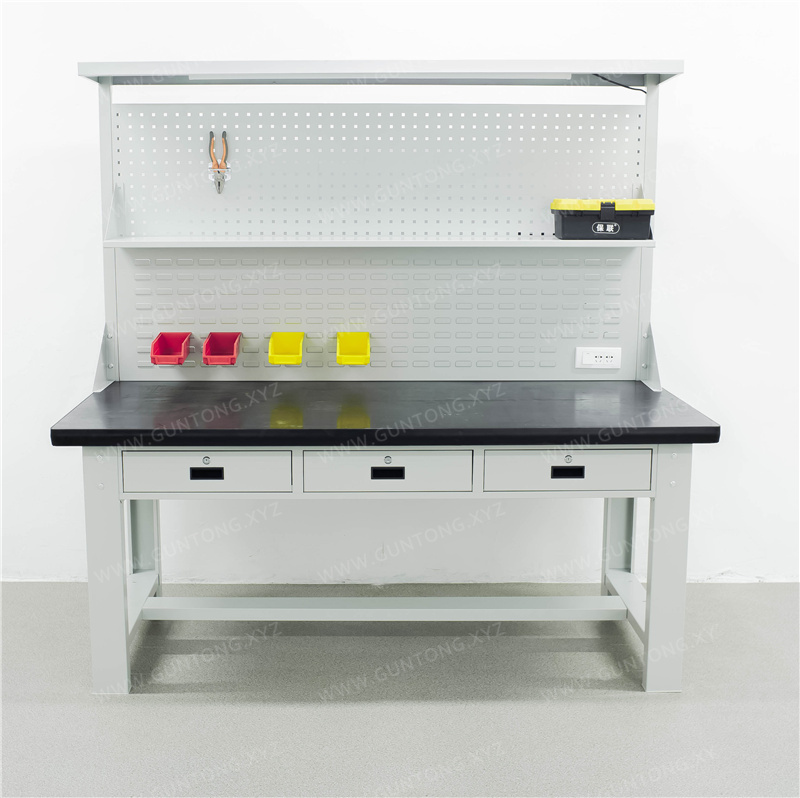
️ Limitation Note: Composite desktops are more susceptible to edge damage and surface pitting after prolonged use in high-impact settings. Their lifespan may be reduced in continuous-duty applications compared to steel plate alternatives.
3. Tool Management Integration: Pegboard Compatibility
Both workbench types can integrate with pegboard systems. However, the Inner Half-Pegboard Storage Cabinet demonstrates how design choices affect functionality:
- Features an inner half-pegboard layout
- with dual pegboard sections on the cabinet door.
- Supports 100kg per shelf
- and includes three adjustable shelves.
- Designed for visual management and rapid tool retrieval.
This configuration enhances 6S compliance in mold maintenance workflows. When paired with a steel plate workbench, it creates a cohesive, durable, and visually organized workspace.
Implementation Tip: For mold maintenance teams requiring both heavy-duty surface protection and efficient tool visibility, combining a steel plate workbench with an inner half-pegboard storage cabinet ensures alignment with lean manufacturing principles.
Application Scenarios: Where Each Solution Fits
| Scenario | Recommended Desktop Type | Rationale |
|---|---|---|
| High-impact mold repair with frequent tool dropping | 5mm Raw Steel Plate | Superior resistance to dents, scratches, and deformation |
| Routine inspection and minor adjustments | Composite Desktop | Lower cost, quieter operation, adequate for light tasks |
| Multi-shift operations with heavy tool turnover | 5mm Raw Steel Plate | Longer service life reduces replacement frequency |
| Budget-constrained projects with low-impact usage | Composite Desktop | Cost-effective entry point with acceptable durability |
Delivery and Customization Boundaries
Guang'ErMei Precision Components offers full-cycle services: design, production, on-site installation, and after-sales support. All products are customizable in dimensions (e.g., 1500×750×800 mm, 1800×750×800 mm, 2100×750×800 mm), drawer configurations, and mounting options.
However, load-bearing calculations must be confirmed per project. The 1000kg total capacity applies only to the specified C-type frame and steel plate combination. Custom modifications may affect structural integrity.
Critical Boundary: Any deviation from standard frame dimensions or desktop thickness requires re-evaluation of load capacity. Always consult engineering documentation before finalizing designs.
Final Recommendation: Prioritize Based on Usage Intensity
For mold maintenance environments involving heavy tools, frequent impact, or extended shifts, the 5mm raw steel plate composite desktop is the technically superior choice due to its proven load capacity and wear resistance. It aligns with the company’s documented capability in providing standardized and non-standard customization across industrial sectors including automotive, electronics, and hardware molds.
If budget is a primary constraint and the workload is light, composite desktops remain viable—but with clear limitations in longevity under high-stress conditions.
Next Step: Request a Site-Specific Assessment
To ensure your upgrade meets exact operational needs, request a free workstation planning consultation. Our team will assess your current setup, recommend appropriate desktop materials, and provide a customized layout with load-bearing verification.
Get Your Free Workstation Evaluation